
ADVERTISEMENTREMOVE AD

The Right to Breastfeed Means Little Without a Place For Mothers to Do It

'Why does a mother feeding her baby make people uncomfortable at all?' asks Shailja Lavania.

Published
story-hero-img
i
Aa
Aa
Small
Aa
Medium
Aa
Large

Picture a mother on a crowded Delhi metro. Her infant starts crying and she is three stops from home. There is no nursing room at the station and no private corner on the coach, just strangers staring. So she does what millions of Indian mothers do every single day. She manages, somehow, in a space that was never built for her.

Most people reading this will feel some sympathy for that mother. But sympathy is not the same as change. India has been sympathetic to nursing mothers for a long time—and the ground reality has barely shifted. According to a 2019 survey by Momspresso, only 6 percent of Indian mothers felt comfortable breastfeeding in public. 

That number is not just low, it is telling. It means 94 percent of mothers are spending those early months of their child's life navigating public spaces with anxiety rather than ease. That is not a personal failing. It is a failure of the society around them.

The stories that come out of this failure are not hard to find. In 2019, a woman in Kolkata was forced to feed her baby in a lane outside an examination centre because there was no lactation room inside the building. That same year, another woman wrote on social media about being told by a mall to go home and breastfeed there, because the staff considered it a household chore. 

More recently, a video from a D-Mart outlet at C21 Mall in Vijay Nagar, Indore went viral on social media. A young mother had moved to a quieter corner of the store to nurse her infant when male staff allegedly made catcalling remarks and suggestive gestures.

Her family confronted the store management on camera. D-Mart said it was investigating the matter.

But the incident touched a nerve because it happened in a well-lit, CCTV-monitored supermarket in the middle of the day. If a mother is not safe there, the question is not about that store. It is about every store.
ADVERTISEMENTREMOVE AD

On 19 February, 2025, the Supreme Court gave a clear answer on nursing mothers. A bench of Justices BV Nagarathna and Prasanna Varale, responding to a PIL filed by the NGO Avyaan Foundation, ruled that breastfeeding is an integral part of a child's right to life—and a natural part of a woman's reproductive process. It cannot be treated as obscene or inappropriate. Both the government and ordinary citizens have a duty to ensure lactating mothers are not shamed in public spaces or at workplaces, the court said.

The ruling placed this issue where it belongs, in the domain of rights, not personal comfort. But a court ruling is only as useful as the enforcement behind it, and on that count, India still has a long way to go.

How The Breast Became A Problem

To understand why we are even having this conversation in 2026, it helps to ask a more basic question: Why does a mother feeding her baby make people uncomfortable at all? The honest answer is that somewhere along the way, Indian urban society began to see the female breast purely as a sexual object. And once that happened, any exposure of it, even for the most functional reason possible, started to feel like a transgression.

In 2018, a petition was filed in the Kerala High Court calling a magazine cover showing a nursing mother "obscene" and "indecent". The court dismissed it. It said, plainly, that one man's vulgarity is another man's lyric—and that there is nothing prurient in a mother feeding her child. The obscenity, if any exists in that situation, lies in the eye of the person staring.

This discomfort around public breastfeeding is not unique to India, and it runs deeper than culture. Dr Lara Stevens, writing from the University of Melbourne in 2019, argued that it forces people to confront what she calls our human animality, the fact that we are, biologically speaking, mammals. The very word mammal comes from the Latin mamma, meaning breast. Every creature in our biological class, from whales to elephants to tigers, feeds its young the same way. Not one of them finds it shameful.

It is also worth noting that this stigma around public breastfeeding is not evenly spread even within India. In rural parts of the country, a woman nursing at a bus stop or under a tree is an unremarkable sight—and nobody thinks much of it. The shame, the staring, and the unsolicited opinions are overwhelmingly urban problems.

The more formal and commercial our public spaces have become, the less room they seem to leave for the natural demands of motherhood. A mother is welcome in a mall as a consumer. She is not as welcome as a mother. That contradiction sits at the heart of this problem, and it is a contradiction that good policy can resolve.

India Can Do A Lot Better

India is not alone in struggling with this, but it is falling behind countries that chose to act. The global comparison is useful because it shows that change is possible, and that it tends to follow deliberate policy rather than a gradual shift in attitudes.

In Scotland, a 2005 law makes it illegal to prevent a mother from nursing a child up to two years of age in any public place, with fines of up to £2,500 for violations. In the Netherlands, employers are legally required to provide a nursing room for the first nine months after a birth, and working mothers are entitled to spend up to 25 percent of their working hours breastfeeding or expressing milk, on full pay.

Kenya passed its Health Act in 2017, requiring all employers with 30 or more staff to set up breastfeeding stations and give nursing employees paid breaks of up to one hour every eight-hour shift. The result was direct and measurable. Kenya's exclusive breastfeeding rate jumped from 32 percent in 2008 to 60 percent in 2022. Vietnam extended paid maternity leave from four to six months in 2012, funded it through public money so women would not face hiring discrimination, and saw exclusive breastfeeding rates rise from 24 percent in 2014 to 45 percent in 2020.

These are not wealthy European countries operating under different conditions. Kenya and Vietnam are developing economies that made deliberate policy choices and got real outcomes in return. The broader global picture supports this. The WHO and UNICEF's 2023 Global Breastfeeding Scorecard found that exclusive breastfeeding rates have risen by 10 percentage points worldwide over the past decade and now stand at 48 percent, close to the World Health Assembly's 2025 target of 50 percent.

Countries that passed maternity protection laws and set up workplace lactation facilities drove most of that improvement. Countries that did not, including several in Asia, have seen little change. India, with its scale and its stated ambitions for inclusive growth, should be among the leaders. It is not. And even countries that are ahead are not perfect.

In France, topless sunbathing on a beach is unremarkable but nursing a baby in a café can still draw looks. In the US, legal protection for public breastfeeding only reached all 50 states in 2018. These examples show that the problem is global but the direction of travel is clear. Protect it in law, build the infrastructure, and breastfeeding rates go up. Do neither, and they do not.

Advisory Is Not Law

Back in India, the government will point to 423 nursing rooms installed at railway stations across the country as evidence of progress. Before accepting that at face value, consider what 423 actually means. Each room is effectively one cubicle for one nursing mother at a time. So the entire Indian Railways network, which moves roughly 13 million passengers every day, has simultaneously available nursing capacity for 423 infants. 

Now consider that India has approximately 44 million children under the age of two, according to UN World Population Prospects 2024. If even 3 percent of train passengers travelling with an infant under two need to breastfeed at any given moment, that is well over a million children. Against that number, 423 cubicles across 423 stations is not a facility. It is a gesture.

The government has also informed Parliament, in response to a Rajya Sabha question answered on 26 March 2025, that feeding rooms exist at 164 airports under the Airports Authority of India (AAI), 148 at non-AAI airports, and in 26 bus stations in Telangana, two in Tamil Nadu, and 50 in Uttar Pradesh. The Ministry of Women and Child Development has written to all states and ministries to create gender-friendly spaces, including lactation rooms. These are real steps. But an advisory is not a law, and a letter is not enforcement. The gap between what has been communicated and what exists on the ground is very wide, as a visit to one of those 423 railway stations makes plain.

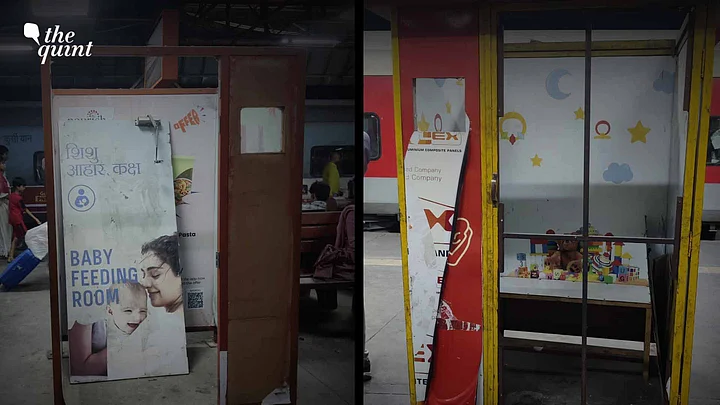
At New Delhi Railway Station, at 10:32 PM on a recent weeknight, the baby feeding cubicles on platforms 14 and 15 and on platforms 8 and 9 were checked one by one. What was found is worth describing in detail, because this is the country's busiest railway station, not a remote junction.

  • Platforms 14-15 had 4 cubicles and platforms 8-9 had 6 cubicles

  • No locking mechanism on any door from the inside

  • No fans in any cubicle

  • Door-closers fitted on the outside; no handles to open the door from within

  • Several cubicles had no seating at all

  • Some cubicles had no signage, only unmarked wooden ply on the door

  • All cubicles had visible cobwebs and accumulated dirt on doors and corners

  • Not a single cubicle was in use. No mother was present on any of the platforms

That last point matters as much as any of the others. Not one cubicle was being used. This is not because nursing mothers do not travel by train at night. It is because these cubicles are either unknown to most mothers, unusable in their current condition, or both.

When a nursing mother cannot lock the door from inside, cannot open it herself once shut, is sitting in an airless wooden box with no fan in Indian heat, surrounded by cobwebs, she will not use it. She will go back to managing on the platform, in the way she always has.

Some people, when confronted with this kind of evidence, will say that building nursing rooms is a waste of money, a freebie that working mothers do not actually use. That argument gets the logic exactly backwards.

A nursing room is not a luxury. It is a basic amenity, in the same category as a drinking water tap or a toilet. Nobody calls a water bottle stall on a platform a freebie. The reason these cubicles sit empty is not that the need does not exist. It is that the cubicles are not good enough to meet the need. The solution is to fix them, not to abandon the idea.

ADVERTISEMENTREMOVE AD

The Economic Cost Of Getting It Wrong

The conversation about breastfeeding connects directly to a much larger problem, which is the steady disappearance of women from well-paid formal work. The link is more direct than it might seem, because what happens to a woman in the months after childbirth very often shapes the rest of her career.

If she cannot nurse comfortably at work, if there is no crèche nearby, if she is made to feel that her presence with an infant is an inconvenience, she leaves. And she often does not come back to the same level she left from.

A 2026 report by Primeinfobase makes this visible through numbers. Women make up 23 percent of employees in India's listed companies. But as you move up the corporate ladder, the numbers collapse. Women hold 14 percent of key managerial positions, 10 percent of executive directorships, and just 5 percent of managing director or CEO roles.

Pranav Haldea of the PRIME Database Group calls this "a classic leaky pipeline", and he specifically names childcare and caregiving responsibilities as a cause of women exiting mid-career. That is a senior corporate research authority directly connecting the absence of childcare support to the disappearance of women from leadership.

The Udaiti Foundation's 2025 study adds further weight. Women's share in India's formal workforce stands at 18 percent, down one percentage point since 2020-21. Among workers earning more than Rs 18,000 a month, women's share fell sharply from 21 percent in 2020-21 to just 12 percent in 2024-25. At the same time, their share among lower-paid workers went up. Women are not leaving work altogether. They are being pushed into worse jobs.

And it often starts the moment they have a baby and find that nothing at work was arranged for them.

There is also a structural reason why these problems persist, and it is worth saying plainly. The people who design policy in India are overwhelmingly men. Women won only 14 percent of seats in the 18th Lok Sabha and hold 17 percent of Rajya Sabha seats. When decision-makers have never had to search for a lactation room at a railway station, or choose between breastfeeding and a career, it is not surprising that these needs sit at the bottom of the priority list.

The data from Panchayati Raj institutions is instructive by contrast. In the 21 states that have given women 50 percent reservation in local bodies, women's issues get addressed far more consistently. The same logic needs to travel upward through the system.

The government's Palna sub-scheme, which now covers 11,395 Anganwadi-cum-crèches across 34 states and UTs, is the most substantial step taken so far.

The 2017 Maternity Benefit Amendment made crèches mandatory in companies with 50 or more employees. These provisions exist. But compliance is weak, enforcement is weaker, and the 50-employee threshold excludes most Indian businesses.

The WHO estimates that if 50 percent of Indian women participated in the workforce, economic growth could rise by 1.5 percentage points. Against that, the cost of fixing the cubicles at the New Delhi station, enforcing the crèche law, and requiring malls and retail chains to have lactation rooms is not even worth calculating. It is trivially small.

ADVERTISEMENTREMOVE AD

The Road Ahead

Some of it is straightforward. Retail chains and commercial establishments above a certain size should be legally required to have clean, well-signposted nursing rooms, the way Kenya requires employers with 30 or more staff to do. Listed companies should have to publicly disclose whether they actually provide crèche facilities, not just whether the rule applies to them.

Nursing-friendly infrastructure should be a baseline requirement in smart city planning. And the 423 railway cubicles need to be made usable before the number is expanded.

But beyond policy, something simpler needs to shift. A nursing mother does not need applause or a designated awareness month. She needs a clean room with a working lock, an employer who does not make her feel like a problem, and the basic social understanding that feeding a child is not a provocative act.

That we have not yet managed even this, in our cities and supermarkets and railway stations in 2025, is not a reflection of individual attitudes alone. It is a reflection of choices we have made as a society through our laws, our buildings and our silences. Those choices can be made differently. The evidence from countries that have done so is clear. The cost of doing so is low.

(Shailja Lavania is an independent researcher currently working on issues related to the Kiul River and the communities connected to it. Her research interests include environment, public policy, governance, and grassroots development. This is an opinion piece. The views expressed above are the author’s own. The Quint neither endorses nor is responsible for them.)

Speaking truth to power requires allies like you.
Become a Member
Monthly
6-Monthly
Annual
Check Member Benefits
×
×