
ADVERTISEMENTREMOVE AD

Rahul Gandhi Blocked: Disallowing Debate on National Security Hurts Democracy

Parliament is a forum for debating, not curtailing members' rights on fallacious grounds, writes Nagendar Sharma.

Published
story-hero-img
i
Aa
Aa
Small
Aa
Medium
Aa
Large

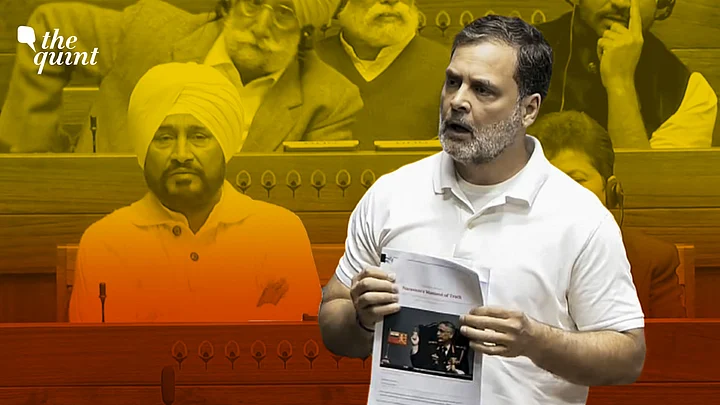
Lok Sabha proceedings continue to be disrupted for the third day consecutively over Speaker Om Birla’s ruling that Leader of the Opposition Rahul Gandhi cannot quote from an unpublished book of former Army Chief (retd) General MM Naravane.

Disruptions are not new to either House of Parliament, nor are the verbal clashes between the treasury and the Opposition benches. Even disagreements with the Chair are not a new phenomenon in our parliamentary functioning.

What is, however, surprising, is the lightning speed with which the Lok Sabha Speaker disallowed none less than the Leader of the Opposition from raising a matter.

He cited two rules from the Rules of Procedure and Conduct of Business in Lok Sabha, which prima facie do not appear to be relevant to the current scenario, leading to this impasse in running the House.
ADVERTISEMENTREMOVE AD

What Triggered The Lok Sabha Standoff

Let us try and make sense of what happened in the Lok Sabha on Monday, 2 February that led to such a situation.

Gandhi, while participating in the Motion of Thanks on the President’s address to the Parliament, referred to an article in the latest issue of The Caravan magazine, which carried excerpts from Gen Naravane’s unpublished memoirs, Four Stars of Destiny, which details the happenings on Indo-China border in August 2020 post the bloody Galwan clash, in which 20 Indian soldiers had lost their lives.

As soon as Gandhi began reading the excerpts, there were vociferous protests from top government ministers, including Defence Minister Rajnath Singh and Home Minister Amit Shah. Both senior ministers pointed out that anything unpublished cannot be made a part of the House proceedings.

When the ruckus continued and Gandhi insisted on reading the excerpts—with Opposition members supporting him and arguing that nothing in the rules prevented the Leader of the Opposition from raising the issue—the Speaker intervened.

Speaker’s Ruling And The Rules Cited

Speaker Om Birla stepped in to give a ruling disallowing Gandhi from mentioning excerpts of Gen Naravane's book published in the magazine article.

Strangely, the two rules cited by the Speaker actually did not appear to apply in the current context.

Gandhi could have been disallowed from raising this issue only on two grounds:

  1. If The Caravan magazine had objected that the quoted text did not belong to it, or

  2. If Gen Naravane had denied that the quoted content belonged to his book.

Even after three days, there has been no denial from either The Caravan or the retired general.

Do Rules 349 and 353 Actually Apply?

The matter, naturally, generated a debate. The Speaker’s view was that Gandhi should restrict himself strictly to matters mentioned in the President’s address and not raise anything “irrelevant”.

So, what are the facts?

During the debate on the Motion of Thanks to the President’s address, national security and foreign relations were explicitly covered by the President. Moreover, before Gandhi spoke, BJP MP Tejasvi Surya had already attacked the Congress on issues of national security.

Therefore, no member participating in the debate could reasonably have been prevented from speaking on these issues or on specific matters connected to them. The only limitation the Lok Sabha Speaker could have applied was to direct the Leader of the Opposition to authenticate and lay on the table of the House the material he was quoting from The Caravan magazine.

The Speaker was also empowered to warn the member of consequences if the material turned out to be factually incorrect. Nowhere, however, did the Speaker have the authority to disallow a member from speaking on the matter altogether.

What MPs Are Allowed To Discuss

It is surprising that nobody from the Opposition benches raised a point of order regarding Rules 349 and 353 of the Conduct of the House. These rules did not apply in the current case, and moreover, nowhere does the wording of these rules prevent any member from quoting from anywhere, so long as the member can authenticate.

Parliament is a forum for debating and law making, not for curtailing members rights on fallacious grounds.

Let us look at the wording of Rule 349 first. It states, “Whilst the House is sitting, a member—

  1. Shall not read any book, newspaper or letter except in connection with the business of the House.”

The debate on the Motion of Thanks, followed by the general discussion on the Union Budget, are the two parliamentary debates where almost any subject under the sun is liberally permitted. In fact, when the Opposition presses for short-duration discussions on matters of urgent public importance, the ruling dispensation often advises them to utilise either the Motion of Thanks or the general Budget debate. This routinely occurs in Business Advisory Committee meetings chaired by the Speaker or the Chairman.

Moreover, how can anyone be prevented from discussing issues of national security? The only caution traditionally advised is that such debate should not strain India’s relations with other countries.

ADVERTISEMENTREMOVE AD

Allegations, Authentication And Parliamentary Rights

Now, let us look at the wording of Rule 353:

“No allegation of a defamatory or incriminatory nature shall be made by a member against any person unless the member has given adequate advance notice to the Speaker and also to the Minister concerned so that the Minister may be able to make an investigation into the matter for the purpose of a reply: Provided that the Speaker may at any time prohibit any member from making any such allegation if the Speaker is of opinion that such allegation is derogatory to the dignity of the House or that no public interest served by making such allegation.”

Was the member, in this case, really making an allegation by himself? If the member was merely bringing to the notice of the House a published report from a news magazine, even if it is construed as allegation against someone in the government, he cannot be prevented from doing so or from seeking the government’s response on the veracity of such reports.

If a member is quoting from a published text and is willing to authenticate it, preventing him or her from doing so is not in accordance with the Rules of the House. Rule 353 applies only when a member makes a defamatory or incriminatory allegation on their own, without prior notice.  

In India’s parliamentary proceedings, the ruling of the Presiding Officers of both Houses—the Lok Sabha Speaker and the Rajya Sabha Chairperson—is final and binding on members, though it is subject to judicial review. 

Since the Lok Sabha Speaker has already delivered his ruling and the Opposition is, for now, unwilling to accept it, it remains to be seen how this logjam will be resolved. 

It is, however, not in the interest of a parliamentary democracy to disallow a member from raising an issue of national security that is already in the public domain.

(The author is a former BBC and Hindustan Times journalist, who has covered judiciary related matters for a long time. This is an opinion piece, and the views expressed are the author’s own. The Quint neither endorses nor is responsible for them.)

Speaking truth to power requires allies like you.
Become a Member
Monthly
6-Monthly
Annual
Check Member Benefits
×
×