When does an ordinary man become a "Hero"? I'm not talking about soldiers, doctors etc who everyone believes are heroes but your average Joe.
Many vs One
Remember how in Hindi films the hero, accompanied by four-five or even 100 people, would beat up one man—could be an old shopkeeper or a young shawl seller? That was so cool, wasn't it? All of us imagined that one day, we too would grow up and be part of a mob or even better, lead a mob. This was the ultimate masculine bravado performance.
Wait, that doesn't sound right. No, no, it was the opposite. It was always one man against many. Much like Deepak Kumar/Mohammad Deepak.
In Deewaar, Amitabh Bachchan enters the godown alone to fight almost a dozen goons. He is sick of coolies being bullied and harassed.
"Tum log mujhe dhoondh rahe ho aur main tumhara yahan intezaar kar raha hun."
What is worse, he raises the stakes. He locks the door. He's not running. It's already one against 10-12, but he raises the stakes. He throws the keys at the chief goon and says, "Ise apni jeb mein rakh le Peter. Ab ye taala main teri jeb se chaabi nikaal kar hi kholunga."
A short while before this dialogue, there is another. "Dukaan kya Bajrang Dal ke baap ki hai, Vakeel chacha?
No, that's not it. It's, "Sadak kya Peter ke baap ki hai, Rahim chacha?"
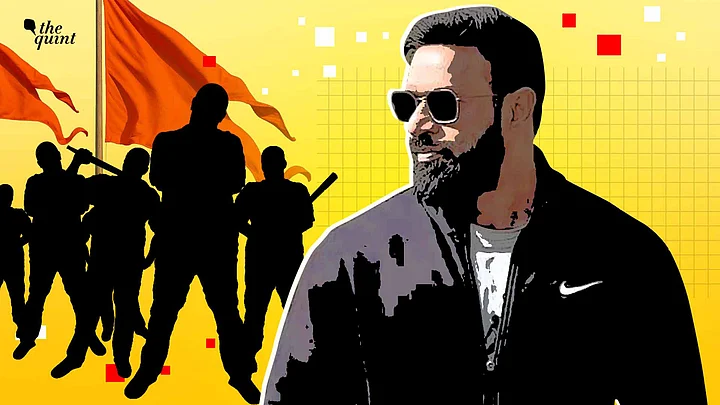
I was reminded of the scene when I saw the video of Deepak speak up for Vakil Ahmed, who was being harassed by a bunch of Bajrang Dal goons and told he will have to change the name of his shop.
They must not have seen the same films I watched, because their idea of bravado was to come back with 100+ goons five days later, to show how strong they are against one Deepak Kumar. If they had seen the same movies, they would have felt quite embarrassed, no?
In Sholay, Dharmendra tells Sanjiv Kumar, "Agar mauka mile to dekh lena thaanedaar sahab, hum dono 15-20 par to bhaari padenge."
I imagined the Bajrang Dal goons thinking to themselves, "Waqt aane par hum 100-150 ek par bhaari padenge." Lame.
In the contest between one man and a mob, the mob was the villain.
Speaking of shops, I am reminded of another angry young man in movies. Sunny Deol. In Ghatak, Kaatiya is the goon, played by Danny Dengzongpa. His henchmen want shops to be shut down. Sunny Deol fights all his henchmen, his brother, fights Kaatiya.
In the middle of the film, Kaatiya tells him to join his gang and that he will be rewarded with money, and izzat. Sunny Deol doesn't think fear equals respect. "Daraa kar logon ko wo jeeta hai jiski haddiyon mein paani bhara hota hai," he tells Danny.
Man vs System
In Ghayal, Sunny Deol's brother, played by Raj Babbar, is murdered by a criminal who pretends to be a respectable businessman, Balwant Rai, played by Amrish Puri.
A fascinating thing happens when Deol is at the police station. A constable brings in a student and says that he spends more time participating in protests and less studying. The inspector slaps the student to show bravado and that's when Deol tells him, "Is chot ko apne dilo dimaag par kaayam rakhna, kal yahi aansu, kranti ka sailaab bankar is mulk ki saari gandgi ko baha le jaayenge."
He doesn't want the student to spend five years behind prison without trial like Umar Khalid is doing.
The police accuse Deol of having an affair with his sister-in-law and conspiring to murder his brother. The court sends Deol to prison. The viewer's sympathy is firmly with Deol, not the cops. It is clear that a rich businessman is manipulating the state to protect himself and and harm an innocent man. The cops aren't patriots. The system is corrupt. It lies. It frames innocent people. It is protecting Balwant Rai till the very end. No one says Sunny Deol is accusing Balwant Rai to harm India's economy.
In Damini, Sunny Deol is the lawyer standing up for Meenakshi Sheshadri, even as the system works overtime to first kill the rape survivor and then prevent Sheshadri from testifying in court. He is not one of many tweeting abuses to women, accusing women wrestlers of lying, or saying that women frame men in false cases.
Powerless vs Powerful
In Kaala Patthar, Prem Chopra is the owner of a coal mine. His deputy tells him that if they continue with the mining operations, the lives of 400 workers is at risk. Chopra asks him—how much money will we lose if stop?
Rs 40 lakh, comes the answer. "Saxena, tumhara hisaab itna kamzor hai ke ye bhi nahin jaante ke 40 lakh 400 se bohot zyaada hote hain," Chopra says. This is the logic of the villain, not the hero.
The heroes in the film risk their lives to save others. Much like Moninder Jatav, the flipkart gig worker who dived in and tried to save Yuvraj Mehta, even when countless Uttar Pradesh Police, State Disaster Response Force members, and many others stood by and watched quietly.
When his employee suggests that Chopra reward Amitabh Bachhan, a mine worker who risked his life to save other mine workers, Chopra scoffs and says "Kabhi kabhi tum badi natajurbe ki baaten karte ho. Jis majdoor mein doosron ko bachaane ke liye, apni jaan khatre mein daalne ki himmat hai, kal ko wahi majdoor hamaare saamne sar uthaane ki himmat bhi kar sakta hai. Aur tum aise khatarnaak aadmi ko inaam dilwaana chaahte ho? Hamaare kaam ka majdoor wahi hai jo mara-mara jiye aur sar jhuka kar sab kuch sehta rahe. Maalik ko bhi, aur maut ko bhi.
No, I repeat, in the film Chopra is the owner of a mine, not a tech platform which hires gig workers and calls striking workers "miscreants".
But What About...?
We started with Deewaar. What about its most famous dialogue?
"Jaao pehle us aadmi ka sign le kar aao jisne mere baap se sign liya tha. Pehle us aadmi ka sign le kar aao jisne meri maa ko gaali de ke kaam se nikaal diya tha. Jaao pehle us aadmi ka sign le kar aao jisne mere haath par ye likh diya tha. Uske baad, uske baad mere bhai tum jis kaagaz par kahoge main uspar sign kar dunga."
These days, when you simply point out that someone was lynched or harmed, you are asked, "What about what happened in Bangladesh? What about what happened in so and so year?"
Shashi Kapoor, the most moral hero in the film, has a response: "Doosron ke paap ginaane se tumhare apne paap kam nahin ho sakte. Doosron ke jurm saabit karne se ye sachaai nahin badal sakti ke tum bhi ek mujrim ho."
A sentiment which is echoed moments later by their Ma:
"Wo aadmi jisne tere baap ke sign liye wo tera kaun tha? Koi nahin.
Wo aadmi jisne teri maa ko gaaliyaan de kar nikaala wo tera kaun tha?
Koi nahin.
Wo aadmi jisne tere haath par likh diya ke tera baap chor hai! Wo tera kaun tha?
Koi nahin."
Magar tu.. tu to mera apna beta tha..mera apna khoon..tune apni maa ke maathe par kaise likh diya ke uska beta ek chor hai?"
Bacchan says: "...Ma, maine ye sab tumhare liye kiya."
But she isn't impressed.
What have you written on the forehead of your motherland? Is her son a villain who forms a mob and scares the weak or a hero like Moninder Jatav and Mohammad Deepak?
(The author is a lawyer and research consultant based in Mumbai. This is an opinion piece, and the views expressed are the author’s own. The Quint neither endorses nor is responsible for them.)