
ADVERTISEMENTREMOVE AD

New FCRA Rules Tighten State Grip on Civil Society While Shielding Corporates

The new FCRA Bill blurs lines of religious education and political action, leaving civil society in the crossfire.

Published
story-hero-img
i
Aa
Aa
Small
Aa
Medium
Aa
Large

The Communist Party of India’s veteran parliamentarian, Bhupesh Gupta, arguably the sharpest debater the Rajya Sabha produced in the first three decades after Independence, rose to speak on the Foreign Contribution (Regulation) Bill in 1976 with characteristic precision. He accepted the concern that the proposition that foreign money could distort India’s public life as he had watched Cold War money flow in both directions across the developing world, buying allegiances, shaping press coverage, funding street agitators..

But Gupta drew a line. The Bill, he argued, must not become a cudgel against educational, religious and charitable organisations whose only offence was receiving support from their institutional counterparts abroad. Civil society was not the enemy.

The organisations serving the poor, running schools for Dalit children, staffing hospitals in districts that the government had abandoned — these were not agents of foreign interference. They were the Republic’s conscience, he argued, suggesting regulation, not strangulation.

He also asked the corporate power, multinationals, the foreign capital flowing through the commanding heights of the Indian economy, the concentrated economic interests capable of shaping development policy, infrastructure contracts and social legislation far more comprehensively than any village charity. 

If Parliament was serious about protecting Indian sovereignty from external influence, why was it training its legislative rifle on Mother Teresa’s missionaries, while ignoring the boardrooms?

ADVERTISEMENTREMOVE AD

How the 2026 Rules Expand State Control

Fifty years later, the Foreign Contribution (Regulation) (Amendment) Rules, 2026, notified on 22 June, require FCRA-registered organisations to select their permitted activities from a government-prescribed schedule of 105 approved purposes, specify the States or Union Territories where they are authorised to work, and notify authorities of any intended expansion before proceeding. 

Key functionaries — now defined broadly enough to encompass Bishops, trustees, directors, partners and office-bearers — become subjects of disclosure obligations that extend to websites, social media accounts and publications. News and current affairs are prohibited territory for any organisation receiving foreign funds.

The 2016 Finance Act — introduced not through Parliamentary debate but tucked into a money Bill that bypassed the Rajya Sabha entirely — redefined what constitutes a “foreign source” under the FCRA framework. Companies in which the foreign ownership stake remained within government-specified sectoral investment limits were reclassified as Indian entities, no longer subject to FCRA restrictions, regardless of the proportion of foreign capital they carried. 

In effect, a mining conglomerate with majority foreign shareholding could fund political parties with impunity, while a diocesan hospital receiving a grant from a German Catholic relief agency faced registration requirements, purpose classifications, geographical restrictions and the ever-present threat of cancellation.

Who Comes Under Scrutiny—and Who Doesn't

India’s largest media organisations are Facebook and Google, entirely foreign-owned and managed. The media in print, television and online can not only receive foreign investment but can be dominated by it. Yet none of this attracts a single clause of FCRA scrutiny.

Bhupesh Gupta raised exactly this point in 1976, and Parliament buried it then as governments have buried it since.

The Rashtriya Swayamsevak Sangh and its affiliated formations — the most extensive ideological communication network in the country, operating publications, schools, think tanks, digital platforms and a social media ecosystem of staggering scale — have no FCRA registration to lose because they receive no foreign contributions regulated under the Act. Their freedom to publish, advocate, educate and mobilise remains constitutionally undisturbed. The new Rules do not touch them.

The contrast with what the Rules impose on faith-based civil society could scarcely be starker.

The Catholic Bishops’ Conference of India has expressed deep concern about the implications for community journalism. Christian newspapers — The Examiner, founded in Bombay in 1850, among the oldest continuously published Christian periodicals in Asia; Indian Currents; the Herald — are not commercial media empires. They are community papers sustained by modest subscriptions, diocesan support and, in some cases, assistance from partner churches overseas. Their purpose has been to give minorities a voice in a public square that commercial media has never consistently provided them.

Under the amended rules, any connection between a publication and an FCRA-registered entity becomes a matter of regulatory disclosure. The prohibition on using foreign contributions for news and current affairs content casts a shadow of uncertainty over any publication that touches communal violence, anti-conversion legislation, displacement, custodial deaths or constitutional rights. 

The distinction between journalism and advocacy, between religious education and political activity, between charity and proselytisation, is nowhere defined with precision.

The Amendment's Sharpest Edge

Since 2010, approximately 22,000 FCRA registrations have been cancelled, while an estimated 15,000 registrations had expired and not been renewed as of April 2026. The chilling effect of that record precedes any new enforcement action. 

Alongside the Rules now in force sits the Foreign Contribution (Regulation) Amendment Bill, 2026, pending before Parliament, whose proposed Designated Authority provisions represent the sharpest edge of this legislative direction.

Under Section 16A as proposed, if an organisation’s FCRA registration is cancelled, surrendered or expires without renewal, its foreign funds and related assets may be taken over by a government-appointed authority. That authority may transfer assets to government bodies or sell them, with proceeds going to any ministry, department, authority or agency of the Central or State governments, or to the Consolidated Fund of India.

A government-appointed authority could assume control of foreign contributions and certain organisational assets through an administrative process, without prior judicial adjudication. Critics argue this raises serious due process concerns and limits opportunities for organisations to challenge the initial transfer of assets.

The implications for India’s Christian institutions are not abstract.

Schools built over a century through sacrificial giving — by Indian Catholic families, by missionaries who died in the field, by partner churches in Germany, the United States and Korea who understood that education in a tribal district was evangelism made flesh — are not government property held in trust pending licence renewal. They are permanent public trusts, created for the poor and built on theological conviction. 

The Church has always understood that love of God finds expression in love of neighbour, and that neighbour-love is not silent.

To treat those schools and hospitals as assets conditionally held, subject to administrative expropriation when a government official decides a registration has lapsed, is to fundamentally misread what they are and why they exist.

The Constitutional Test Ahead

Article 300A protects against deprivation of property saved by authority of law. Articles 25 and 26 protect the right of religious denominations to manage their own affairs. Articles 29 and 30 give minority institutions constitutional standing that does not depend on the pleasure of the Ministry of Home Affairs. The courts will be asked to speak to all of this, and when they do, the constitutional questions will be inescapable.

Bhupesh Gupta warned in 1976, that foreign influence in India came primarily through corporate channels, not through charities. The Finance Act amendments effectively allow companies compliant with foreign direct investment sectoral caps to contribute freely to persons in India without adhering to FCRA restrictions, since they are excluded from the definition of foreign source. 

Crony capital — domestic conglomerates intertwined with foreign equity, infrastructure contractors shaping policy, media houses with beneficial foreign ownership — operates in a regulatory environment that the FCRA does not meaningfully touch.

Civil society, on the other hand,  does not.

ADVERTISEMENTREMOVE AD

Protests Ahead

The Church that Bhupesh Gupta defended by implication — the Church of public service, public witness and public speech — is not an obstacle to Indian sovereignty. It is one of the oldest and most consistent expressions of the Republic’s pluralist promise, the first civil society, so to say, in the country.

The Gazette of 22 June 2026 has removed compassion, love and charity almost entirely from its work.

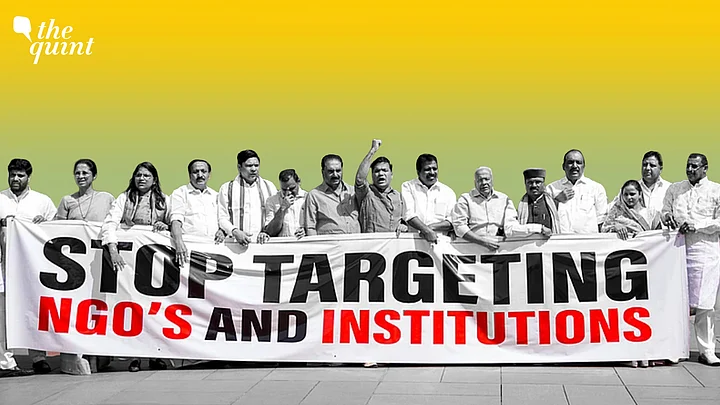
The Bishops are planning a series of protests, beginning with a day of Fasting and Prayer called by Catholic Bishops Conference president Cardinal Poola of Hyderabad. There is also a proposal to close all schools for a day and possible protests across the country. Legal teams are mulling approaching high courts and finally the Supreme court as these are rules based on the old law a challenge does not await the passing of the controversial amendment.


(The author is a writer and activist. He is the former President of the 102-year-old All India Catholic Union. This is an opinion piece. The views expressed above are the author’s own. The Quint neither endorses nor is responsible for them.)

Speaking truth to power requires allies like you.
Become a Member
Monthly
6-Monthly
Annual
Check Member Benefits
×
×