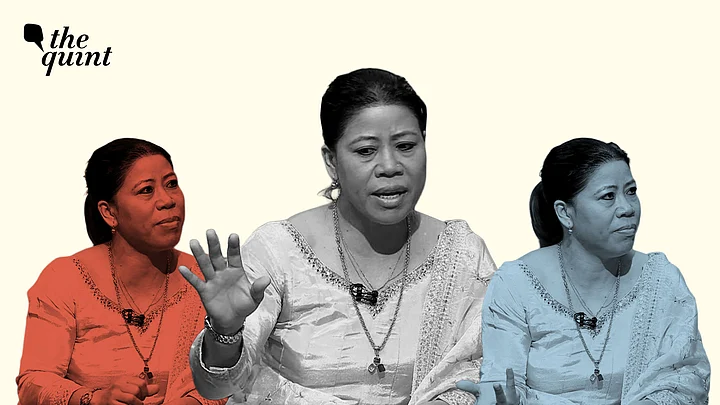
“Mary Kom mildly insults her husband and becomes a villain. Johnny Depp talks about burning his wife alive and remains a hero,” a Reddit user wrote, summing up the moral asymmetry of the internet with brutal precision.
This comparison, albeit about wildly different cases and contexts, speaks to the pattern of men’s cruelty being endlessly softened, contextualised, and defended, while women’s candour is cast as cruel, ungrateful, and emasculating. The contrast has little to do with individual morality and everything to do with whose anger is considered legitimate, whose speech is policed, and whose actions are endlessly excused.
The epicenter of this outrage is a short, selectively edited clip that is being circulated on social media as evidence of Kom’s supposed moral failure. Detached from her recent, longer interview with Rajat Sharma, and therefore, stripped of surrounding context, the clip is being presented as a definitive character judgement.
By isolating a brief remark about earning capacity, the clip has transformed a complex marital breakdown into a moral spectacle that feeds right into the kind of algorithmic misogyny that rewards content aligning neatly with patriarchal grievance.
In this social context, the outrage surrounding Mary Kom’s divorce was never going to be about the specifics of her marriage because, as outsiders, we can neither fully know nor fairly adjudicate what transpired between them.
Instead, the vitriol directed at Kom is about the fact that she’s a woman, who is publicly championing choosing herself, thereby threatening patriarchy’s beloved tenet that is accurately captured in this song, “Bhala hai, bura hai, jaisa bhi hai, mera pati mera devata hai (My husband, whether good or bad, is my God)” from Naseeb Apna Apna (1986).
When Women Choose Themselves
A significant part of Kom’s vilification also hinges on the idea that since her husband, Karung Onkholer, is believed to have ‘given up’ traditional masculine roles for her success, his ‘sacrifice’ should eclipse all other considerations, rendering her permanently indebted to him.
According to the Indian internet, which is dominated by male users and masculine norms of credibility, grievance, and entitlement, Kom owes him lifelong loyalty and gratitude, since care work—long naturalised as women’s unpaid, unremarkable duty to be performed without recognition or reward—suddenly becomes an act of moral heroism when performed by a man. The implication, then, is that once a man has ‘supported’ a woman, she forfeits any right to leave him.
This, of course, resonates with the familiar incel refrain that no amount of male sacrifice can ever satisfy women since they will always choose themselves over men, and therefore, female autonomy is, by definition, anti-men. In this worldview, a woman’s success is tolerable only if it is accompanied by obedience.
Leaving, regardless of how justifiable the reason behind it may be, is the ultimate transgression, which also makes it amply clear that the public outrage isn’t nearly as much about whether Onkholer has been treated unfairly by his wife, but about Kom’s refusal to reward male martyrdom with lifelong endurance.
Reflecting the values of the society we live in, social media platforms consistently amplify narratives that flatter male resentment and reduce nuance into easily consumable outrage. A fuller account—one that complicates the story and demands empathy—is less clickable and not nearly as rage-inducing, which also makes it less valuable from an engagement perspective.
And so, what travels instead is the edit that confirms patriarchal ideas about women’s financial independence being the tool that enables the sacrifice of men—and, perhaps, some imaginary notion of manhood, too—at the altar of female ambition.
As such, the clip that didn’t go viral despite its editing, but because of it, has assumed the function of a narrative shortcut that’s allowing audiences to hate on a ready-made villain.
Virality as Moral Policing
Virality on the internet, then, is not only political and gendered, but actively doing the heavy-lifting to convince patriarchal audiences that their anxieties are justified and that women’s departures need not be understood as long as they can be collectively condemned.
This is a system where the algorithm decides whose actions deserve explanation and whose deserve condemnation, with that asymmetry setting the stage for how harm, accountability, and credibility are subsequently assigned along gendered lines.
Here, even allegations of harm by men are routinely treated as context and men are afforded the benefit of nuance and the luxury of being seen as more than their worst actions, while women are required to perform pain to earn the right to leave, because anything short of visible brutality is treated as negotiable.
The result, unsurprisingly, is a rigged moral trial where women are presumed guilty of ingratitude the moment they choose themselves, and men are presumed wronged even in the absence of scrutiny. In fact, faced with this kind of public suspicion, many women find it safer to endure abuse in private than to leave and be punished for it in public.
The question, then, is not whether Mary Kom met some abstract threshold of justification when she chose to walk out of her marriage, but why women are expected to meet one at all.
The Price of Female Autonomy
This uneven moral calculus becomes even more pronounced when the woman, in question, is a public figure.
Recently, when cricketer Smriti Mandhana called off her engagement with a man who is believed to have been unfaithful, public sympathy initially aligned with her—buoyed, in part, by her recent World Cup victory and her status as a national hero. But that solidarity proved short-lived, and soon, images of Mandhana’s muscular arms (which had, not too long ago, powered India’s success) began circulating online, reframing her fiancé’s infidelity as understandable—inevitable, even—because she was ‘too masculine.’
Evidently, in a patriarchal society, a woman may be celebrated for her excellence, but only as long as that excellence does not disrupt acceptable notions of femininity.
Within this framework, divorce ceases to be a private decision and is transformed into a public referendum, where men are allowed incoherence, contradiction, even silence, while women are required to narrate their exits flawlessly, or else… In short, women must justify divorce in ways men never have to; the question is never simply why a marriage ended, but whether the woman’s reasons for it were ‘good enough.’
And much like fame, financial independence, too, serves to weaken a woman’s credibility, rather than strengthening it. A woman who earns well, succeeds publicly, or does not face immediate economic precarity is presumed to be insulated from harm, implying that a woman’s suffering only counts if it is accompanied by visible dependence on the man.
In an ecosystem where a woman’s autonomy becomes grounds for suspicion rather than respect, women are required to narrativise their pain—by cataloguing betrayals, quantifying abuse, and exposing private wounds—to be believed. And even then, their accounts are treated as exaggerated or self-serving because there really is no winning for women in the court of public opinion if silence is taken as guilt, explanation as manipulation, and refusal to over-disclose as moral deficiency.
What this moment ultimately reveals is an anxiety about women refusing to live their lives according to patriarchal values. And so, the mass outrage on display is about disciplining and reminding women, especially the more visible, successful ones, that autonomy comes at a reputational cost so that every other woman who's watching thinks twice before disobeying patriarchal norms.
And while this is not a failure of empathy so much as the success of a system designed to withhold it, the fact remains that Mary Kom does not owe the public proof, performance, or permission for ending her marriage—and neither does any other woman.
(DevRupa Rakshit is a queer, autistic individual, ARTivist and independent multimedia journalist based in Bangalore. This is an opinion piece. All views expressed are the author’s own. The Quint neither endorses nor is responsible for them.)