
ADVERTISEMENTREMOVE AD

Rubio’s Visit Showed How Far the India-US Relationship Has Slipped

For all the recent turbulence, it would be premature to write off the India-US relationship.

Published
story-hero-img
i
Aa
Aa
Small
Aa
Medium
Aa
Large

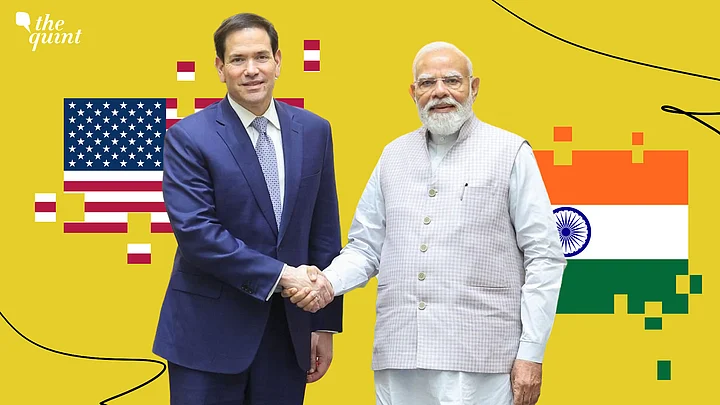
There has been a defensive and performative element to the visit of Secretary of State Marco Rubio to India. He landed in Kolkata on Saturday and visited the Missionaries of Charity facility founded by Mother Teresa. The visit was clearly an unusual gesture for an important diplomatic visit.  

The defensive element was obvious in his remarks at the press conference following the talks with his Indian counterparts.

This is not surprising since there is a perception, backed by a lot of real evidence, that relations between the two alleged strategic partners have not been too good since the government he represents came to power in January 2025.

ADVERTISEMENTREMOVE AD

Tariffs, Trade and Economic Pressure

To list the complaints,

Trade and Tariffs: In mid-2025, the US imposed peak tariffs of up to 50 percent on Indian goods, which included a 25 percent reciprocal tariff and an additional 25 percent punitive duty due to India's continued purchase of Russian crude oil. While these were later reduced to 18 percent during an interim trade agreement in February 2026, the initial tariffs heavily squeezed Indian exports and disrupted supply chains. In addition, the US has “persuaded” India to buy $500 billion worth of American products in the next three years.

Sweeping Green Card & Visa Restrictions: The Department of Homeland Security announced restrictive new rules for US permanent residency, requiring applicants to return to their home countries to finalise their Green Cards. This abruptly halted the long-standing "adjustment of status" practice, severely affecting thousands of Indian tech professionals and families stuck in the employment backlog.

General Visa Processing Cuts: The US implemented broad visa cuts that drastically reduced the total volume of work, student, and exchange visas processed globally, with India experiencing some of the sharpest declines. Indian External Affairs Minister S Jaishankar formally raised these mobility challenges in his talks with US Secretary of State Marco Rubio on Saturday in New Delhi.

Operation Sindoor and fallout: Perhaps the most unpalatable of the issues was that of the US handling of Pakistan in the wake of Op Sindoor, the strike launched by India in retaliation for the terrorist massacre of civilians at Pahalgam. The US intervention probably compelled India into accepting a ceasefire instead of sustaining its offensive and inflicting more damage to Pakistani infrastructure. This enabled Islamabad to somewhat improbably claim victory, internationalise the dispute and even nominate Trump for a Nobel Peace Prize.

Rubio’s Assurances Leave Questions

These were the points that Rubio had to respond to directly or indirectly in his meetings with Indian officials and the media. He said that the US actions on trade and visas were with a global perspective and not specifically targeting India. As for Pakistan, without mentioning it by name, he said that US ties with any country will not come at the expense of the “strategic alliance” with India.

This does not quite explain the US sanctions on Russian and Iranian oil which effectively spared the big importers like China and Europe and hit India. The US has instead pushed India to buy its oil and gas from the US and Venezuela, even though this works out to be more expensive because of freight costs.

Trump’s ‘Friendship’ With Modi Rings Hollow

There was also a performative edge to the occasion in a major social event to mark the 250th year of American independence held at the Bharat Mandapam facility.

The highlight of the event was an appearance by Donald Trump via video where he again expressed his “love”  for Prime Minister Modi, termed him “great” , “friend” and adding   “We’ve never been closer to India and India can count on me 100 per cent and on our country. If they ever need help, they know where to call—they’ll call right here.”

Considering he has repeatedly insulted, pressured and penalised India on various counts, his use of his “love” and “friendship” with Modi as a cover has worn thin. Indeed, they have led to Modi discreetly avoiding a face-to-face meeting with him and confining his conversations to the telephone. His whimsical ways have brought  the once flourishing India-US relationship to a juddering stop.

Whether the Rubio visit, his explanations and excuses can change things is the big question now becoming even more urgent given the major strategic shift in the US-China relationship. Let there be no doubt that the Indo-US bonhomie of the last three decades owed themselves to a common concern over the rise of China. With the US and China arriving at what has been variously described as a “strategic stalemate” , “strategic stability” “diplomatic pause”, “managed co-existence” there is little doubt that the relevance of India to US calculations has diminished.

A Faltering Quad

This raises a big question-mark on the future of the Quadrilateral Dialogue (Quad) grouping comprising of the US, Japan, Australia, and India. The ostensible purpose of the Rubio visit was to participate in a meeting of Quad foreign ministers on Tuesday. The meeting comes at a time when the Quad is visibly faltering, with no summit held in 2025 and so far with no indication as to whether one will take place this year (2026) .

It was in Trump’s first term that the grouping was revived and its status was soon boosted to a leadership-level arrangement. It set out an ambitious agenda of vaccine diplomacy, cooperation in developing quality infrastructure, critical and emerging technologies, climate change and maritime security.

But the grouping seems to have lost steam with little to show for in the items listed above, except in the case of maritime security. With China no longer clearly identified by the US as an adversary country, the logic of backing the Quad weakens.

ADVERTISEMENTREMOVE AD

Why the Relationship Still Endures

For all the recent turbulence, it would be premature to write off the India-US relationship. The two countries remain bound by ties that go well beyond any single administration's whims.

The Indian-American diaspora — nearly four million strong, influential in business, technology, academia and increasingly in politics — constitutes a living bridge between the two democracies. Bilateral trade, even after the tariff disruptions, runs into hundreds of billions of dollars, and American corporations from Apple to Google have deepened their manufacturing and services footprint in India in ways that are not easily unwound.

Defence cooperation has quietly but steadily grown, with India now among the largest buyers of American military hardware and joint exercises becoming routine. People-to-people ties, educational linkages and the sheer scale of Indian students in American universities add further ballast.

At the level of values, however imperfectly realised, both remain large, plural democracies with a shared interest in a rules-based international order. These are not ornamental talking points — they are structural realities that will outlast the present difficulties and any particular occupant of the White House.

(The writer is a Distinguished Fellow, Observer Research Foundation, New Delhi. This is an opinion piece and views expressed are the author's own. The Quint does not endorse or is responsible for them.)

Speaking truth to power requires allies like you.
Become a Member
Monthly
6-Monthly
Annual
Check Member Benefits
×
×