
ADVERTISEMENTREMOVE AD

Inside India’s Prisons, Caste Still Decides Who Cleans Human Waste

India cannot claim to have abolished untouchability while sustaining it behind prison walls.

Published
story-hero-img
i
Aa
Aa
Small
Aa
Medium
Aa
Large

Across India’s overcrowded prisons, where more than 5.7 lakh people are confined at an average occupancy rate of over 131 percent, a quiet but entrenched form of violence continues unchecked.

It is not the spectacle of riots or brutality, but the slow, routine violence of caste. It operates through everyday prison labour, through classifications embedded in jail manuals, and through language that continues to rank dignity and work according to inherited social status.

As the Supreme Court’s 2025 report Prisons in India: Mapping Prison Manuals and Measures for Reformation and Decongestion makes clear, nowhere is this structural injustice more visible than in the persistence of manual scavenging and caste-based labour allocation inside prisons.

ADVERTISEMENTREMOVE AD

Not Mere Administrative Oversight

Despite constitutional guarantees under Articles 14, 17 and 21, despite the prohibition under the Prohibition of Employment as Manual Scavengers and their Rehabilitation Acts of 1993 and 2013, and despite explicit judicial directions in Sukanya Shantha vs Union of India (2024), prison administrations across India continue to compel inmates — disproportionately from Scheduled Castes, Denotified Tribes, and other marginalised communities — to clean latrines, drains, and sewers by hand.

As the Supreme Court’s report documents, several states still admit that prison drains and sewers are cleaned manually, often with nothing more than gloves or bleaching powder, citing lack of mechanised alternatives.

In a constitutional democracy, this is not an administrative oversight. It is a direct constitutional breach by the State in spaces it fully controls.

The roots of this injustice are historical and institutional. As the Court’s report traces in detail, colonial prison administration consciously incorporated caste hierarchies into penal governance.

Nineteenth-century jail committees held that forcing prisoners of “higher castes” to perform manual labour would amount to cruelty, while prisoners from “lower castes” were expected to continue their hereditary occupations inside jail walls.

Food, labour, bathing, and even segregation were organised to prevent “loss of caste.” This logic was codified into provincial jail manuals and carried forward almost intact into Independence.

What is striking—and deeply troubling—is how much of this architecture survives today.

The Supreme Court’s mapping exercise shows that several state prison manuals continue to use expressions such as “suitable caste,” “good caste,” “habitual caste,” and “high caste.” Until recently, Rajasthan explicitly mandated that sweepers be selected from the Mehtar or Hari caste.

Uttar Pradesh still allows “high caste” prisoners to request separate cooks. West Bengal retains rules that indirectly legitimise caste-segregated kitchens. These are not symbolic remnants.

As the Court notes, language shapes administration: when prison rules label sanitation work as “menial,” “degrading,” or “humiliating,” they constitutionalise caste ideology through subordinate legislation.

An 'Invisible' Scourge

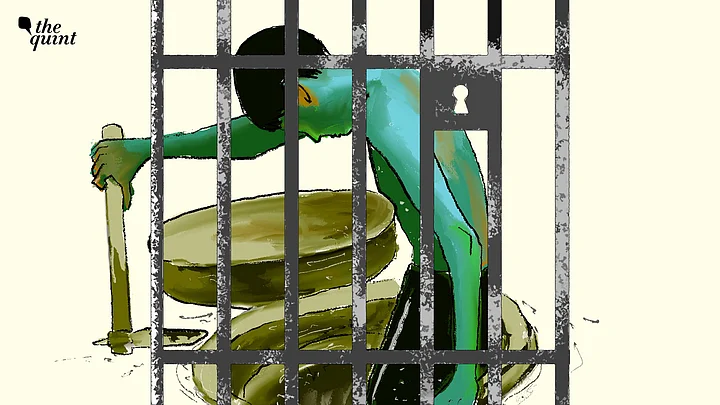
Manual scavenging inside prisons remains largely invisible in public discourse. Municipal deaths inside septic tanks trigger outrage; custodial scavenging does not.

Yet, the Supreme Court report records manual cleaning of drains, dry latrines, and sewage systems in prisons across Manipur, Nagaland, Arunachal Pradesh, Mizoram, Himachal Pradesh, Maharashtra, Gujarat, Odisha, and Madhya Pradesh.

Some states still retain dry latrines in law. In the coercive environment of prisons—where refusal to work can result in punishment, loss of remission, or solitary confinement—the claim that such labour is “voluntary” collapses entirely.

The Court is unambiguous: this practice violates domestic law, international obligations under the Nelson Mandela Rules, and the core guarantee of human dignity.

The harm is compounded by overrepresentation. Marginalised communities already form a disproportionate share of India’s prison population, particularly undertrial prisoners. When these same prisoners are then channelled into caste-marked labour—cleaning human waste, carrying excreta, maintaining sewers—the prison becomes a site where caste oppression is not merely reproduced but enforced by the State.

As the Supreme Court’s report notes, this is the continuation of colonial logic under constitutional governance.

The Court also highlights a crucial but often ignored dimension: the role of terminology. The Model Prison Manual 2016 itself used phrases such as “menial work” and “work of degrading character.”

The Kerala High Court has already held that describing labour as “menial” undermines the dignity of the worker. The Supreme Court’s report treats this not as a semantic issue, but as a structural one. Without removing caste-coded language from prison manuals, reform efforts remain cosmetic.

Reform, therefore, must be structural and enforceable. The Supreme Court has already directed all states and Union Territories to revise prison manuals to eliminate caste-based classifications.

But the report makes clear that revision on paper is insufficient. Dry latrines must be abolished without exception. Sanitation must be fully mechanised. Prisoners must never be compelled to handle human waste. Where sanitation work is unavoidable, it must be performed by trained personnel with protective equipment, under municipal or specialised services—not coerced inmates.

ADVERTISEMENTREMOVE AD

Labour & Dignity in Jail

Labour allocation must be rotational, skill-oriented, and dignity-affirming, as envisaged in the Model Prisons and Correctional Services Act, 2023.

Equally important is oversight. The Court calls for regular judicial and executive audits of prison labour practices, wage parity with minimum wages, and monitoring of the language used in prison records. Prison labour must be rehabilitative, not punitive; corrective, not caste-affirming.

India cannot claim to have abolished untouchability while sustaining it behind prison walls.

As the Supreme Court’s own research demonstrates, prisons remain one of the last institutional spaces where caste operates openly and administratively.

If constitutional protections fail in places of total State control, their promise elsewhere rings hollow.

Caste-based manual scavenging in prisons is not a marginal anomaly. It is a structural injustice, a constitutional betrayal, and a moral failure of governance. Until the last dry latrine is dismantled, the last caste-coded rule erased, and every prisoner treated as a bearer of equal dignity, India’s prison reforms will remain incomplete.

Inside India’s prisons today, caste is not just present—it is operational. Dismantling it is not optional. It is a constitutional obligation.

(Rejimon Kuttappan is an independent journalist from Kerala. He is a workers’ rights researcher, forced labour investigator, and author of 'Undocumented'. This is an opinion piece, and the views expressed above are the author’s own. The Quint neither endorses, nor is responsible for the same.)

Speaking truth to power requires allies like you.
Become a Member
Monthly
6-Monthly
Annual
Check Member Benefits
×
×