
For days before Eid-ul-Adha, social media profiles of Hindutva outfits in and around Mumbai were buzzing. The festival was an opportunity, and they weren’t going to let it pass.
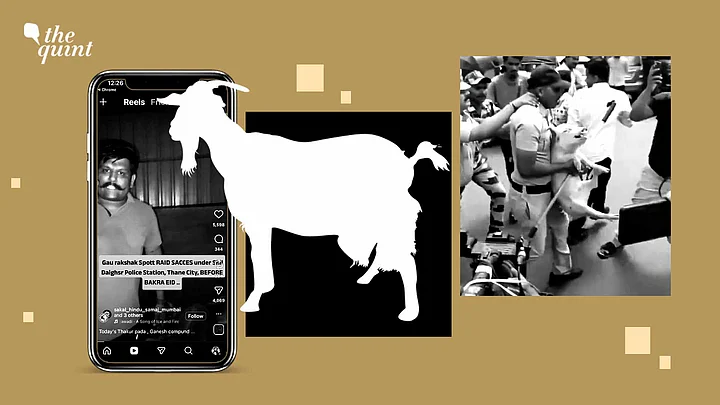
Reel after reel showed foot-soldiers dishing out threats to Muslims, conducting ‘raids’, searching vehicles in the dead of the night—all in a bid, they said, to ensure that Muslims do not slaughter cows.
There is little evidence to show that Muslims in Maharashtra had been sacrificing cows during Eid. Yet, the vigilantes continued to insist that they wouldn’t let cows be sacrificed. Even the Maharashtra government chimed in. Apropos of nothing, it issued a resolution insisting that anyone found to be repeatedly guilty of transporting cattle without the requisite paperwork, would be treated akin to an organised crime syndicate under the stringent Maharashtra Control of Organised Crime Act (MCOCA).
It was an escalation that didn’t fit in.
But what happened days later made it clear: it was never about the cows.
First the Cows, Then the Goats
Last week, Maharashtra made news for yet another communally charged incident, as it often does these days—when Hindutva vigilantes protested outside a housing society in Mira Road which had allowed its Muslim residents to tend to goats in the days leading up to the festival. Some of them even carried a pig, threatening to release it among Muslims if the goats were not evicted. The housing society, with its mixed Hindu-Muslim composition, had consented to this goat shelter, media reporting showed.
This consensus seems to have rattled Hindutva outfits in the area who insisted that they won’t allow goats to be slaughtered in the society. When told the goats were never going to be slaughtered there, just tended to till the festival, the outfits changed tacks: it didn’t matter if the goats weren’t going to be slaughtered, they shouldn’t even be kept in the shelter.
Similar scenes played out in other parts of Mumbai.
For two days, the media, the police, the politicians and the citizenry of the country’s richest city, its economic nerve centre, were fixated on one task: dragging the goats out of their shaded enclosures in Mumbai’s housing societies.
Who would have imagined that Hindutva foot-soldiers break into Jai Shri Ram slogans and cheer the visuals of goats? But they were.
But it didn’t matter. Because it was never about the goats, either.
Festivals as a Political Battleground
Last week’s antics were only the latest iteration of a strategy that has been unleashed by the Hindu Right over the last two years—to target festivals of the country’s religious minorities and reiterate Hindu supremacy on such occasions.
Hindutva outfits now see festivals as a platform to assert their superiority. In marketing terms, targeting celebrations is a high-visibility, high-impact strategy, one designed to jolt minorities into submission through quiet, closed celebrations, and remind them that they are on borrowed time in this country.
It isn’t without a historical precedent: A 2023 research paper by Harvard academic Feeyad Allie maps out a century of Hindu-Muslim riots in the country to find that festivals historically heightened communal tensions and led to riots. Allie found that Hindu festivals like Ganesh Chaturthi and Dussehra—featuring large idols of Gods, in contrast with Islam’s non-idolatry belief—as well as Muslim festivals like Eid-ul-Adha, which traditionally featured the sacrifice of cows, were traditionally ripe for such violence since they promoted religious beliefs that were “incompatible” for the other religion.
Where the present deviates from history is that it is no longer about incompatibility.
The Hindu Right’s desire to invisibilise Muslims from the public sphere is brazen and frequent: it shuts down medical colleges to protest Muslim students outnumbering Hindus, it openly campaigns for Muslims to be boycotted economically and socially, and floats labels like ‘UPSC Jihad’ to try and wipe them out of competitive exams. It criminalises their protests, seeks to wipe them out of the sphere of political movements.
To attack these celebrations, then, is another step in that invisibilisation that Hindutva desires, except this one is more potent than others. To strike at a festival is to strike at a community, not individuals — and to do so at a time when the community unites in joy. To do so too at a time when the community mobilises, comes together unites in joy, to convert that moment of joy and celebration into fear and submission, is not a by-product, but the goal of such campaigns in our New India.
From Christmas to Ramzan
We saw this playing out first in December last year, when Christmas festivities were under attack in at least seven different Indian states—from Delhi to Madhya Pradesh, to far-flung Assam and Kerala, people were harassed, abused and attacked for celebrating Christmas.
In at least two cases, the attacks had direct links to Bharatiya Janata Party (BJP) and the Rashtriya Swayamsevak Sangh (RSS) leaders.
In Madhya Pradesh, for instance, a BJP leader led a mob that attacked a Christmas lunch meant for visually impaired children. Some schools in Kerala reported receiving threats from RSS officials, warning them against organising any celebrations.
We also saw this playing out in the way Muslims were targeted during the month of Ramzan earlier this year. From abusing fasting students to assaulting a man praying at an empty field, to lodging criminal cases against Muslims merely for praying in public spaces, these events played out across at least six different states of India.
The difference between the attacks on Christmas and Ramzan festivities was a significant one: the attacks on Christians largely came from faceless mobs and vigilantes. In extension, the attacks during Ramzan saw the mob being backed by the might of the State, readily registering police complaints against Muslims who were found praying in public spaces in Maharashtra’s Malegaon or protesting the unannounced closure of a mosque, like in Lucknow.
When the State Follows the Mob
What happened in Mumbai with Bakri Eid celebrations was an escalation.
In Mumbai, after pressure from Hindutva mobs and BJP leaders, the Brihanmumbai Municipal Corporation (BMC) ended up cancelling permission to societies to house goats, without any explanation.
To hand over the power to mobs to decide, overriding laws and regulations in place, is a sign that governance and policing will bow to the mob.
Like in Allie’s 2023 paper, which maintained that incompatible rituals were at the root of the violence around festivals, some of the voices against the Eid celebrations also pointed to similar incompatibilities.
Mumbai BJP leader Kirit Somaiya, at the forefront of this campaign, likened animal sacrifices to India turning into Pakistan. On social media, Hindutva sympathisers posted videos bemoaning the cruelty of animal sacrifice, and painting themselves as ‘saviours’ of ‘innocent’ animals.
If their fears were around hygiene or community consensus, wouldn’t they want to try to mediate? Could civic authorities not have been pressed into making hygiene conditions more stringent, before handing out permits to tend to goats? This didn’t happen, because hygiene or consensus wasn’t the aim. The aim is to invisibilise and assert supremacy.
Suresh Chavhanke, the founder-editor of the hate-spewing Sudarshan News, called Muslims marking Eid-ul-Adha as “jihadis” and asked Hindus to fight back even more vigorously, since “jihadis were getting even more aggressive” without explaining how.
His final suggestion was: Hindus must already start preparing to “target” the next Eid-ul-Adha.
Chavhanke revealed what BJP leaders like Somaiya felt coy to.
Never About the Cows
Historically, through the 19th and parts of the 20th century, Indian Muslims would sacrifice cows during Eid. This, however, did not go down well with Hindus, who have revered the cow. This discord would, often, spill onto the streets and result in violence between Hindus and Muslims, a fact that Allie’s research paper also notes.
Back then, many believed that if only Muslims stopped sacrificing cows, these tensions and divisions between the two communities would dissipate, and Eid-ul-Adha would no longer be a bone of contention. In the past, RSS leaders have also voiced similar reassurances, asserting that relations between the two communities would improve, if only Muslims stopped cow slaughter.
Those Hindutva goons carrying a pig outside the Mira road society last week and threatening to release it among Muslims, was the ideology’s way of shattering those illusions of harmony. It was their way of reinforcing the plain truth: it was never about the cows, nor about the goats.
Hindutva wants to decide how minorities must celebrate their festivals.
(Kunal Purohit is an award-winning independent journalist, writing on politics, gender, development, inequalities, and the intersections between them. He is an alumnus of the School of Oriental and African Studies, University of London. The views expressed above are the author’s own. The Quint neither endorses nor is responsible for them.)
