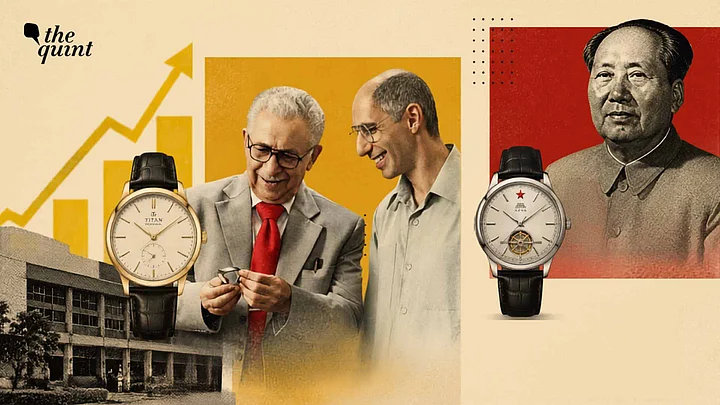
There is something very endearing about the way the new OTT show, Made in India: A Titan Story, available on Amazon MX Player, has enthralled critics and viewers alike.
The show, based on a book by Mr Vinay Kamath,'Titan: Inside India’s Most Successful Consumer Brand', with its calm earnestness and nostalgic playlist, softens the lens through which we view a giant company; in this case, Titan Company Limited (set up as Titan Watches Limited in 1984).
The show is about the manufacturing of the first quartz wristwatch in India, but it gives the subject a wholesome treatment. The tale of a private sector company taking on the project of quartz watchmaking in India because its benevolent head/owner thinks that a country and its people deserve to be "happy", not just prosperous. A simple premise on the face of it, but when the layers are peeled back, important milestones clocked the growth of the Indian economy are revealed.
Tracing the Evolution of a 'Status Symbol'
Today, a symbol of status—ask your lawyer/banker friends about their collection—the wristwatch is an emblem of decades of human progress, worn casually on a strap. (The tools to create watches were the same ones used to manufacture high-precision scientific instruments).
In some cases, that progress was a story of migration due to religious persecution. For example, in 17th-century Geneva, the arrival of Huguenot refugees from France helped boost the watchmaking industry in Switzerland. After the industrial revolution, manufacturers in the UK found ways to produce pocket watches on a large scale. The US, too, experienced a boom in manufacturing of watches, albeit of lower quality. The Naugatuck Valley in Connecticut started producing many clocks and watches, earning the title of “Switzerland of America”.
Timex is a relic from this era (its predecessor, the Waterbury Clock Company, was set up in 1854). The world’s first wristwatch was likely created for royalty (perhaps for Caroline Murat, the Queen of Naples, in 1810). But it was the series of wars and conflicts of the 19th century that helped prove its utility. Unsurprisingly, even today the British and the American armies are amongst the many that issue watches to their troops.
The watch industry was revolutionised by Project 59A, initiated by the Japanese company Seiko in the year 1959, leading to the creation of a portable quartz watch in 1964. In a stroke of luck, the quartz technology was developed concurrently in various countries, as the technology was initially not patented. The proliferation of inexpensive quartz-movement-powered timepieces led to a decline in the demand for Swiss mechanical watches in the 1970s.
Titan Company Limited was set up by the Tamil Nadu Industrial Development Corporation and the Tata Group after identifying a gap in the market—the lack of quartz watches.
By the 2000s, Titan was amongst the largest manufacturers of watches in India, with most of the manufacturing processes being done at their factory in Hosur.
The show depicts the quest to have a homegrown quartz watch brand as an almost patriotic endeavour. It underscores the point of pride in this make-in-India project. This is driven home in the show superbly in the scene where the Swiss watchmakers refuse to collaborate with the Tatas to create a watch. The impact of the show was so profound that I paused the show midway to browse the Titan website!
Three Turns, One Sound—Bicycles, Sewing Machines, Wristwatches &Radios!
In China, under Chairman Mao, a similar project was being developed. The expression ‘three rotations and one sound’ (depicting bicycles, sewing machines, wristwatches and radios) refers to the four consumer goods coveted by the Chinese as a sign of pride and progress.
The wristwatches were of particular value given their importance with respect to military movement. Until 1955, China was known as a nation where watches were repaired, not built.
This changed with the first watch called “Five Star”. In 1958, there were only eight watch factories in China. The country lacked a homegrown watch manufacturer, which led to the creation of Seagull by the Seagull Watch Company based in Tianjin, northeastern China. While based on a Swiss movement, reportedly, Soviet watchmakers too helped with the creation of an improved later version of the Seagull watch.
Seagull was also responsible for developing the first military chronograph for the People’s Liberation Army (PLA). Named Project 304, 1,400 of these chronographs were provided to their pilots.
The Growth of China's Watchmaking Industry
Till 1970, the various watch factories in China could produce their own specific movements. This practice was discontinued when the Chinese Standard Movement was introduced during the fourth five-year plan. Since then, the indigenous watchmaking industry in China has gone on to scale incredible heights, such as the creation of a watch with triple minute repeaters and a perpetual calendar. In 2010, a wristwatch was launched that integrated the complications of a tourbillon, a perpetual calendar and a triple minute repeater at the price of over RMB 1 million.
Dongfeng was the original Chinese brand name, which was rebranded as Seagull for the overseas market. Dongfeng translates to “East Wind”, and for the logo of the brand, Chairman Mao Zedong's calligraphy symbolising “east wind supresses west wind” was used. The early Dongfeng watches are collectibles since they were printed with the slogan "serve the people”.
Bharat Ratna JRD Tata and Mr Xerxes Desai—the first Managing Director of Titan so deftly portrayed by real-life acting titans Naseeruddin Shah and Jim Sarbh, respectively—will surely approve of the message!
What of Chairman Mao, though? He who owned two Rolex watches is now a part of horological kitsch! Fratello Watches makes the Chairman Mao Waving Watch! And, in China today, the proverb "the poor play with luxury cars and the rich play with luxury watches" (穷玩车 富玩表) holds true.
(Sangeeta Chakravorty is a Mumbai–based writer and lawyer. She is a recent graduate of the School of Advanced International Studies at Johns Hopkins University, Washington, DC. This is an opinion piece and the views expressed above are the authors' own. The Quint neither endorses nor is responsible for them.)