
On most mornings in Thiruvananthapuram, Palayam Junction slowly fills with the sounds of the city waking up. The call to prayer rises from the Palayam Juma Masjid. A few steps away, bells ring inside St Joseph’s Metropolitan Cathedral. Just across the road, devotees walk into the Sree Maha Ganapathy Temple with flowers and coconuts in hand.
All three stand within metres of one another. The mosque, the church and the temple share the same stretch of road in the heart of Kerala’s capital. For people who live here, this arrangement rarely feels remarkable. It is simply how the city has always been.
For many visitors, however, Palayam is a quiet lesson in coexistence. It was into this city that Monalisa Bhosle arrived yesterday.
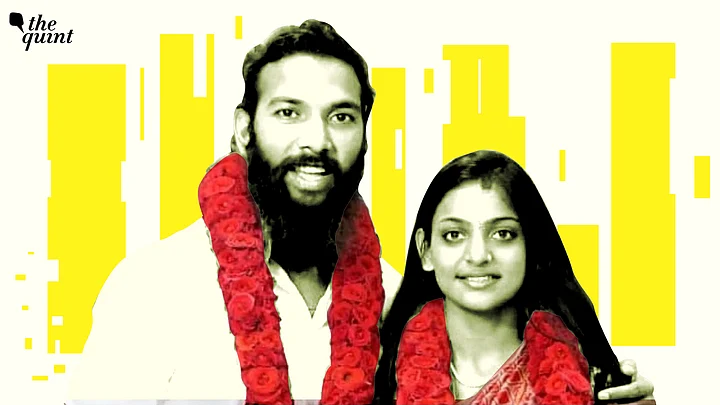
Until recently, she was unknown outside her town in Madhya Pradesh. That changed during the Maha Kumbh Mela when short videos of her selling rudraksha beads began circulating online. Within days she became an unlikely internet personality. Social media users dubbed her the “kumbh mela girl”, and for a brief moment, she became part of the endless stream of viral stories that dominate the internet.
But the attention soon shifted to something far more personal. Her relationship with Farman Khan, a Muslim man from the Baghpat district of Uttar Pradesh, had become known to her family. What followed was familiar across large parts of India: disapproval, pressure and the possibility of being forced into a marriage she did not want.
Rather than confront that situation at home, the couple decided to leave. They travelled nearly two thousand kilometres south, eventually reaching Kerala.
Their first stop in Thiruvananthapuram was not a temple or a home but a police station. At the Thampanoor station, they asked officers for protection. The police confirmed that Monalisa was legally an adult and therefore entitled to make her own decision about marriage.
Soon afterwards, the couple solemnised their wedding at the Nainar Temple in Vizhinjam and completed the registration process in nearby Poovar. Outside the state, the story drew attention online. Inside Kerala, it was hardly unusual.
A Journey Other Couples Have Taken
Monalisa and Farman are not the only couple to travel across state lines in search of a place where they could marry without interference.
Earlier last year, another interfaith couple arrived in Kerala under similar circumstances. Mohammad Galib and Asha Verma had left their hometown in Jharkhand after receiving threats linked to allegations of “love jihad”. The two eventually reached Kayamkulam in Alappuzha district and got married there.
Even after their wedding, the fear of retaliation remained. The couple approached the Kerala High Court asking for protection. Justice C S Dias directed the police to ensure their safety and ordered that they should not be forcibly taken back to Jharkhand while the case was being heard.
Stories like these do not always make national headlines, yet they reveal something important: for couples whose relationships cross religious or caste boundaries, Kerala increasingly appears as a place where institutions are more likely to protect them than punish them.
The Long Roots of Pluralism
Part of that reputation is tied to history. For centuries, the Malabar coast maintained close connections with the wider Indian Ocean world. Arab traders sailed to its ports long before the arrival of European powers. Jewish merchants settled in the region. Christian communities trace their traditions to the arrival of St. Thomas in the first century. Islam also arrived through trade networks rather than conquest. One of the most cited symbols of that history is the Cheraman Juma Masjid in Kodungallur, believed to date back to the seventh century.
These encounters shaped the social landscape of Kerala in distinctive ways. Religious communities grew alongside one another and gradually became part of the region’s economic and cultural life.
Even today, Kerala’s demographic structure reflects that layered past. Hindus form the majority, but Muslims and Christians together make up a substantial share of the population. In such a setting, everyday interaction between communities became unavoidable.
Over time, coexistence turned from necessity into habit.
Reformers Who Challenged the Old Order
Yet, religious diversity alone did not make Kerala the society it is today. In the nineteenth and early twentieth centuries, caste discrimination remained deeply entrenched. Social reform movements played a decisive role in challenging that hierarchy.
Sree Narayana Guru became one of the most influential voices of that period. His message, “One caste, one religion, one God for humankind,” resonated widely among communities that had long faced discrimination. Another reformer, Sahodaran Ayyappan, pushed those ideas into everyday practice. In 1917 he organised an event known as misrabhojanam, where people from different castes sat together and shared a meal. At the time it was a bold challenge to the social rules governing caste interaction.
Ayyappan also spoke openly in favour of inter-caste marriages. His argument was straightforward: if families began crossing caste lines, the rigid boundaries that sustained the system would slowly weaken.
These movements did not erase social divisions overnight. But they shifted the direction of public conversation and expanded the possibilities available to individuals.
When the State Steps In
In recent decades, Kerala’s institutions have also developed mechanisms to support couples who face threats after choosing their partners.
One example is the safe homes project, created after several honour-related violence cases in India drew national attention. The programme provides temporary accommodation for couples who fear retaliation from families or communities after inter-caste or interfaith marriages. The government also offers financial assistance schemes aimed at helping such couples establish independent lives.
These policies signal a particular understanding of the state’s role. Marriage based on personal choice can sometimes place individuals in vulnerable situations. In those cases, public institutions are expected to provide support rather than indifference.
For couples from different religious backgrounds, the Special Marriage Act of 1954 remains the main legal pathway for marriage without conversion.
Yet, the law contains provisions that critics say can expose couples to danger. The most controversial is the mandatory 30 notice period before the marriage can be registered. In many places that notice becomes public, giving families or vigilante groups an opportunity to intervene.
Activists across India have raised concerns about the risks this creates. Kerala has also seen debates on the issue, particularly from civil society groups that argue for greater privacy protections. At the same time, the state has attempted to modernise its administrative procedures. Through the K-SMART digital platform, couples can now complete marriage registrations online using video verification, reducing the need for prolonged visits to government offices.
India Today GDB Survey data suggest that attitudes toward interfaith marriage in Kerala differ from those in many other states. The survey found that a majority of Indians remain uncomfortable with marriages across religious lines. In Kerala, the level of acceptance was significantly higher.
Researchers often attribute this difference to the state’s literacy levels and its long tradition of social reform movements. Education has historically played a major role in shaping public discussion and challenging rigid social hierarchies.
None of this means Kerala is free from conflict. Caste discrimination still exists in parts of society. Honour-related violence has occurred in the past. Political rhetoric surrounding interfaith relationships, particularly the narrative known as “love jihad” has also entered public debate.
Investigations by national agencies have repeatedly said they have not found evidence of organised networks forcing women into religious conversion through marriage. Yet the political conversation around the issue continues.
Kerala, like the rest of India, remains a society negotiating its own contradictions.
Beyond the Viral Headlines
Stories like Monalisa’s spread rapidly online because they appear dramatic. In reality, they reflect a broader social tension across the country. Couples who cross religious or caste boundaries often find themselves confronting families, communities and sometimes even local authorities.
But there are also places where institutions respond differently.
In Kerala, police stations, courts and government programmes have increasingly become places where couples seek protection rather than fear harassment. That is why individuals from states such as Jharkhand, Madhya Pradesh, and Uttar Pradesh have travelled to Kerala to marry.
Monalisa’s journey from the Kumbh Mela to a temple wedding near Thiruvananthapuram is therefore more than a passing internet story. It highlights a question that continues to shape modern India: who ultimately decides whom a person can marry?
In Kerala, at least for now, the answer often leans toward the individual. And perhaps that is the real Kerala story.
(The author is a policy analyst and independent researcher specialising in international relations, public policy, and global governance. This is an opinion piece, and the views expressed above are the author’s own. The Quint neither endorses nor is responsible for the same.)
