
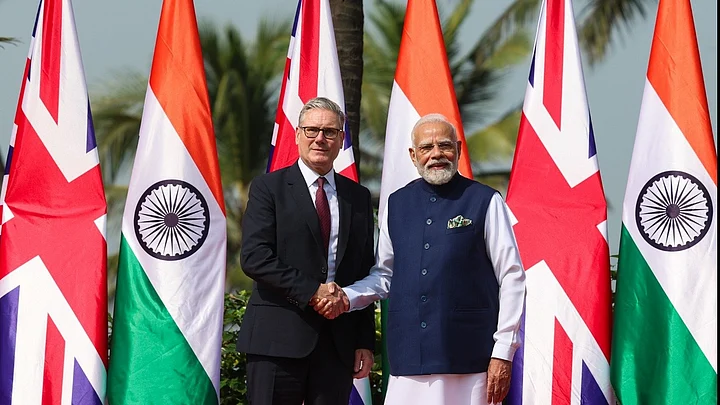
British Prime Minister Keir Starmer’s visit to India marks a turning point in the United Kingdom's foreign outlook, a moment when a Labour government re-engaged with India at a depth unseen for decades. More than a symbolic return to high diplomacy, it represents a strategic redirection: a government seeking to ground foreign policy in economic and technological pragmatism and geopolitical realism rather than political nostalgia.
Starmer’s decision to begin in Mumbai, not Delhi, underscored that shift, placing commerce before ceremony and partnership before protocol.
This visit comes amid mounting pressures on both, India and Britain. Post-Brexit Britain faces sluggish growth, strained public finances, and an electorate weary of austerity, while India navigates its own economic and diplomatic complexities in a volatile global climate. Global turbulence—from a resurgent Donald Trump in the United States to the deepening Gaza—Israel crisis, is testing the resilience and adaptability of both nations’ leadership.
Starmer’s journey to India was not merely about foreign policy optics; it represented a joint strategic effort to demonstrate how the UK and India, through strengthened partnership, can restore economic relevance and global credibility for each other in a rapidly changing world.