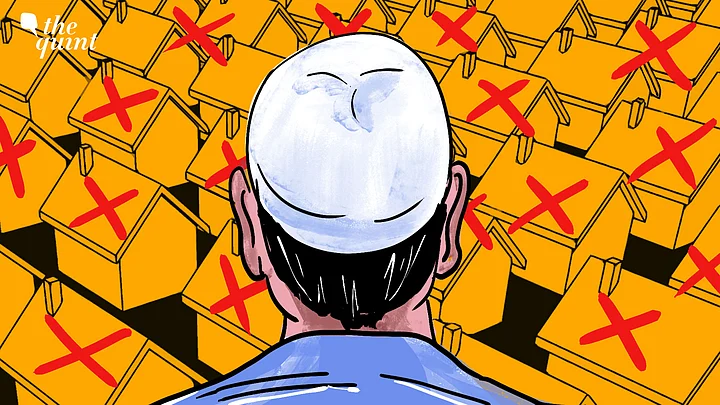
While speaking at a seminar on “Constitutional Morality and Role of District Judiciary” earlier this month, Justice Ujjal Bhuyan recounted a personal anecdote—later reported by LiveLaw—that landed precisely because it did not sound unusual.
A young woman pursuing her PhD in a private university in Noida was looking for accommodation. She approached a landlady running a working women’s hostel in her building in South Delhi. The landlady asked her name. Justice Bhuyan said the name sounded “ambivalent”, and the landlady then asked for her surname. When the surname revealed her Muslim identity, the landlady told her—“quite bluntly”, in his words—that accommodation was not available and she should search elsewhere.
No abuse. No threat. No written denial. Just refusal—delivered in a way that leaves almost nothing behind.
The question that follows is not rhetorical. It is practical: what happens to equality when discrimination becomes deniable?
Because this is not just one story. It has been measured.
A Delhi–NCR audit study, reported by The Indian Express and conducted across Delhi, Faridabad, Ghaziabad, Gurgaon and Noida (January–March 2012), tested rental responses where applicants had the same credentials but different names signalling upper-caste Hindu, Dalit, and Muslim identity.
In the telephonic audit (1,469 seekers), upper-caste Hindu applicants received no negative responses, while about 18 percent of Dalit applicants and 31 percent of Muslim applicants faced outright rejection. In the face-to-face audit (198 seekers), 97 percent of upper-caste Hindu applicants received a positive response, while 44 percent of Dalit applicants and 61% of Muslim applicants faced rejection.
Those numbers do not describe a “few bad landlords.” They describe a pattern.
A second study—based on a large online house-renting portal dataset—found the same direction of bias. The United Nations University World Institute for Development Economics Research findings were reported in plain terms: a Muslim applicant must respond to 45 listings to receive 10 callbacks, while an upper-caste Hindu applicant needs to respond to 28.6 listings for the same number—meaning Muslims must apply to about 60 percent more houses to receive equal response.
So discrimination exists. It is documented. It is quantifiable.
Which brings us to the uncomfortable part: why does the law still struggle to meet it where it actually happens?
Where the Constitution Stops
India’s equality guarantees are strongest against the State. Housing discrimination, however, largely occurs in the private rental market—through landlords, brokers, and housing societies. The result is a structural mismatch: constitutional ideals remain lofty, while everyday exclusion operates through private power.
That mismatch becomes more severe because rental discrimination rarely arrives as a written policy. It arrives as refusal without record. If a public authority denies housing based on religion, constitutional remedies are imaginable. If a private landlord does it, the pathway is far less clear—especially when the rejection is informal, verbal and deniable.
India still lacks a comprehensive, enforceable anti-discrimination law governing private housing on grounds like religion. That absence matters because modern discrimination has adapted—it avoids paperwork, avoids explicit statements, and therefore avoids proof.
Discrimination That Leaves Almost No Evidence
This is where the problem turns from moral to procedural.
When discrimination is structured to leave no trace, the victim is pushed into an impossible position: prove intent, prove bias, prove that “no vacancy” was not genuine. Litigation becomes expensive, slow, and uncertain. Many simply move on—because they need a room more urgently than they need a lawsuit.
This is why field research matters. The Housing Discrimination Project, based at Jindal Global University’s Centre for Public Interest Law, documents how rental discrimination operates in practice, including its mechanisms and effects.
Older survey work linked by the Centre for Civil Society—summarising an India Today report, found that 56 percent of surveyed landlords expressed unwillingness to have Muslims as tenants, with respondents citing stereotypes and suspicion. That number does not prove every rejection is discriminatory. But it establishes something important: bias is not rare, and it is not unspeakable. It is socially present—and therefore predictably reflected in market outcomes.
When Rejection Redraws the City
A refusal is not only an individual injury. Over time, it becomes a spatial pattern.
When people are repeatedly turned away across neighbourhoods, they cluster where housing is attainable and where rejection is less likely. Over years, this hardens into segregation—not by statute, but by repetition.
The Sachar Committee Report (2006) discussed ghettoisation and shrinking shared spaces, and recommended institutional mechanisms such as an Equal Opportunity Commission and a legal mechanism to address discrimination complaints including in housing. When enough private choices line up in the same direction, the outcome becomes public: segregated cities, unequal access, and a thinner experience of citizenship.
What Must Change
If we treat this only as social prejudice, we guarantee permanence. If we treat it as a constitutional problem, we at least create the possibility of remedy.
At minimum, two interventions are unavoidable. First, India needs enforceable standards that recognise and prohibit identity-based exclusion in housing, and a complaint mechanism that can respond even when discrimination is informal. The Sachar Committee’s proposal of an Equal Opportunity Commission was rooted in exactly this problem: discrimination that is real, patterned, and difficult to prove case-by-case.
Second, the law must become more realistic about proof. If discrimination is systematically deniable, enforcement models must be able to recognise patterns—through audits and defined presumptions in appropriate cases—rather than demanding a written confession.
Justice Bhuyan’s anecdote matters not because it is extraordinary, but because it is ordinary enough to be narrated as a life example by a sitting Supreme Court judge. A surname became a filter. A door closed. And the law, as it stands, largely shrugs—because it struggles to see what cannot be neatly proven.
If equality stops at the landlord’s door, then we should stop congratulating ourselves on how complete our equality is. The Republic cannot keep outsourcing dignity to private discretion.
(The author is Sahil Hussain Choudhury, a lawyer and Constitutional Law Researcher based in New Delhi. The views expressed above are the authors' own. The Quint neither endorses nor is responsible for the same.)