
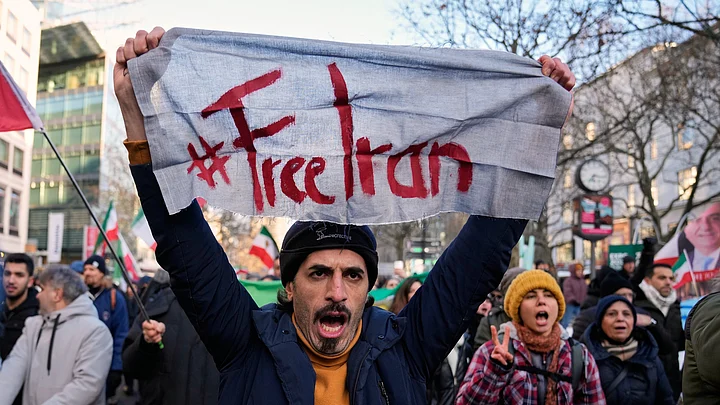
Normalcy is the new collective dream.
This is the notable shift in the present protests in Iran: from the previous protests of zan-zindagi-azadi to a more generalised politics of demanding normalcy. It is now all about bazaar and zindagi; but the seeds of a desire for normalcy was already a part of the Zina Amini protests, with one anthem lyricising “Longing for a normal life” (hasrat-i yik zindigi-yi ma'muli).
But this trend has taken the foreground now. This is exemplified by the class shift of the shopkeepers—usually the most stabilising force of petit bourgeois in society—and the bazaar street as the site of protests. All that the people of Iran want is an ordinary life, with only the usual troubles and devoid of abnormal troubles like being victims of global sanctions and the constant threat of war and repression.
Apart from the immediate triggers of price rise, shortage of goods, and currency crash, the paranoid persecution of its own citizens by the Islamic Republic has fed into these protests.
There was an alarming rise in executions after the conflict with Israel last year, with citizens suspected of collaborating with Israel facing indiscriminate arrests, reportedly with a bias against minorities. This permanent abnormality is what people are against; a situation created through the systemic pathologisation of economy and society, a tendency that utopian regimes are prone to.
As Azar Mansuri, a reformist politician in Iran, puts it, normalcy is now a “fundamental issue [that is] directly linked to national security, political stability, and public trust.”
The cumulative effect of past repressions and the present situation of helplessness, both in the face of the market and the state, have created a grand coalition of ordinary people beyond particular professions.
"What we're seeing is a sign that people have reached a shared understanding," says an activist. "This is no longer just teachers protesting or a single social group. This time, the voiceless have formed an alliance."
There are clear signs of the protests losing their class character and engulfing everyone who wants normalcy.
Normalcy as a Style of Life and Politics
Just as in Nepal, there is an unspoken Gen Z undercurrent in Iran too. This is the coming of age of what Roula Khalaf called the ‘Generation Normal’ of Iran. In a prescient article published in Financial Times over a decade ago, Khalaf identified a trend among young people just wanting to be normal—“to have a secure job, control over their own destiny and the freedom to dream.”
Khalaf quotes Hamid-Reza Jalaipour, a professor of sociology at Tehran University, who narrated the episode of the death of a popular Iranian singer. The funeral was attended by over one lakh youngsters, who did not follow customary morality and held hands. This was a “silent movement”, defined by a style of life rather than politics, which left the “hardliners [in the regime] very confused.”
The confusion was indicative of the gulf that had developed between a new generation of citizens and a regime that was the relic of the twentieth century in the worst possible way.
Ordinary things like engaging in social media appeared to the Ayatollah Khamenei as “a culture war” capable of corrupting the youth by spreading “dangerous thoughts” among them.
Some of the regime’s officials, though, caught on to the changes early on, according to Khalaf. She quotes a former official: the post-revolutionary society that Iran had become was now “swimming in the direction of the river” of normality. “Normality hasn’t been practised in Iran,” says the official. “The new generation understand they need to have a normal life.”
This desire for normalcy would have seeped into regime top-brass too, with even insiders secretly wanting a normal life. This became apparent when a top regime functionary’s daughter got married last year, and the video went viral—for its absolute normalcy and its freedom from rigid conservatism.
There was outrage in Iran: while the regime forced the people to live an "abnormal" life, its own elite were marrying off their children in normal ways. Normalcy was now an “elite excess.” It is likely that the daughter, a part of the generation normal, convinced her father to relax the rules for her, and he could not say no.
This generation has now come of age. Unlike in Nepal, it is not isolated from the rest of society by an unbridgeable generation gap; rather, its values and norms have been adopted by its elders. The Iranian Bazaar best exemplifies this shift. They are now the central sites of the ongoing protests.
The Iranian Bazaar
In Persian culture, the Bazaar is different from the logic of the free market. It is a vibrant place of life, for cultural gathering and intellectual exchange, not limited to the boundaries of moneyed transactions. Its heritage as the unique centrepiece of the Islamic city has meant that it is ordinarily a conservative and religiously orthodox institution, regardless of governmental imperatives.
“Bazaaris are known to be a tightly knit community, which is one of the main reasons for their power”, writes the scholar and entrepreneur Soheil Torkan, “And during Iran’s history this integration has acted in support of many social movements. Groups in the Bazaar have played a significant role in social movements and recently have even engaged in protests and strikes.”
Torkan goes on to describe the economic conservatism of the Bazaar community, which resists outside intervention in their spaces. This prudential use of their power means that their support for a movement often turns out to be decisive.
The overwhelming nature of the protests has resulted in two cities being “captured” in Kurdish-majority parts of western Iran, and the regime is reported to have invited in allied militia from Iraq to help quell the uprising. Previous protests of similar stature were quelled by the use of brute force, but this time it may well be beyond control.
At the very minimum, the abnormal repression of the morality police is bound to end. Mansuri is more optimistic and said in a speech that “the government in this situation is no longer sustainable."
Radicalised Political Classes
What lesson does Iran hold for others? Both the regime and its present opponents offer templates for understanding societies around the world.
We are once again living in the times of an extreme radicalisation of ruling classes, creating a global politics of disruptions of nature, everyday life, and civility. The last time such a radicalisation happened, we ended up with two world wars back to back.
Tariq Ali’s book, The Extreme Centre, made the novel and correct argument that there has been a neoliberal radicalisation of centrists over the past couple of decades. However, this process is no longer limited to the centre, or to the West. Now we have extremes of all sides—extreme queer politics, extreme environmental politics, extreme far left, and extreme far right.
To take only the top leadership, Trump, Modi, Maduro, Erdoğan, and Putin are all radicalised in their own ways and intransigent in many ways; they want to create the world around them in their own images. So, a politics of quotidian normalcy looks both irrelevant and threatening—exactly like the gentle politics of Uddhav Thackeray, Rahul Gandhi, or Keir Starmer does. Irrelevant to those who fall into the trap of enchanted politics, and threatening to those who wish to enchant the people.
In the ‘Venezuelan Exodus’, more than 25 percent of the population have been made refugees, and the last election was stolen blatantly; and leftists think everything is normal. Not seeing such abnormalities is the sign of being a radicalised elite of this or that politics.
The utopianism of enchanted politics, be it from the left or the right, eventually creates too much suffering in everyday life. Modernity is the preference for a disenchanted life of ordinary troubles against the exalted suffering of utopian pursuits. In India too, the BJP’s policies of calculated disruptions have time and again come up against this aversion to exalted suffering, with even devout Hindus preferring not to trade their ordinary lives with the promised but distant Rama Rajyas.
The current wave of radicalised ruling classes differs from the Iranian rulers in one way: as opposed to a top-down imposition of a preconceived social order, the new ruling class prefers a creative destruction of old norms.
Joseph Schumpeter famously defined capitalism’s energy as that of creative destruction in the economy, but we are finding that it more and more applies to politics as well.
Our politicians are changing from the mould of respectable statesmen to bourgeois adventurists, who embody an explorer-pioneer logic rather than that of a stabilising patriarch. This creative destruction of norms and normality is fuelled not necessarily by innovations or inventions, but by their fantasies of remaking the world order. Commonly with the Iranian ruling class, however, the new ruling classes too insist on the suspension of normalcy.
Why Would People Prefer Normalcy?
Against these global disruptions, ordinary people have rallied to protect everyday life against regime utopias. The common thing about protests against Trump in the US, Modi in India, and Maduro in Venezuela—and the protests in Iran—has been their insistence on returning to norms-based discourse in politics and society.
Therefore, such uprisings might lack a program or set of demands, because people don't want anything from the regime; they just don't want the regime to be doing things impossible for life, or the regime itself. And if these struggles do not look revolutionary, it is because they aren't.
Paradoxically, this is both an enchanted and disenchanted condition for the masses. Living only a simple, normal life is an act of disenchantment from larger projects. But it is quite magical to live a good middle-class life of comfort and prosperity. The enchantment of middle-class life is a big dream and aspiration for the majority in the developing world. Incidentally, Indian Maoism too was defeated by the desire for quotidian normalcy. Once people realised that normal life is possible without armed struggle, the project began to lose support, and the political environment changed.
People just wanting normalcy means there is a grassroots post-ideological condition. Contrary to the intellectuals’ search for revolutionary energy among the ordinarily oppressed classes, it is the classes which are ordinarily contented that are turning up in these movements. These are the people who say: “our life isn't great, but we are content with what we have, and don't take away whatever little we have.”
Among them, there is less and less interest in political ideologies and their grand promises. People tolerate or reject parties not because of their ideologies, but irrespective of their ideologies. This attitude stems from the general disillusionment with all ideologies and, particularly, the extremities of all ideologies, and their tendency to take normalcy lightly.
So, the new uprisings are not for revolutionary change; they are just against ceaseless, manifold disruptions caused by ruling classes that run amok on the foundations of normal human life.
(Kuriakose Mathew teaches politics and international relations at the School of Liberal Arts and Management Studies, P P Savani University, Surat. His research focuses on democratic forces in transitional polities. Arjun Ramachandran is a research scholar at the Department of Communication, University of Hyderabad. This is an opinion piece and the views expressed are the author's own. The Quint does not endorse or is responsible for them.)
