As missiles arc across the skies of West Asia and the rhetoric between Iran, Israel, and their ever-attentive American ally grows louder by the day, it is difficult to imagine that this same land once produced a king who saved the Jewish people of Jerusalem from near extinction.
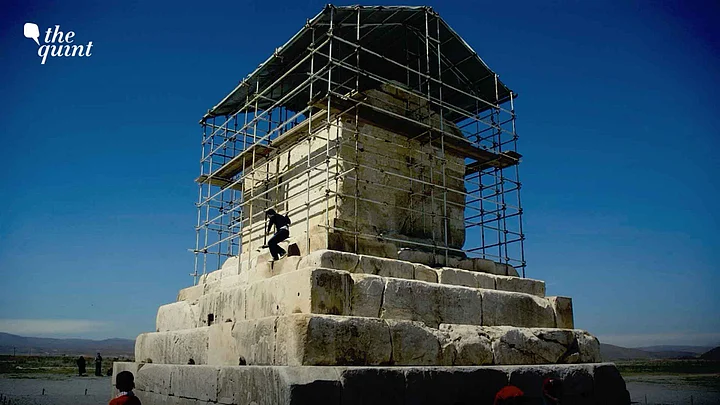
A few years ago, far removed from the thunder of modern warfare, I stood in the quiet plains of Pasargadae, in Fars Province of southern Iran, before the modest tomb of Cyrus the Great—a man whose idea of victory was not annihilation, but restoration. The contrast between then and now is not merely striking; it is almost embarrassing.
A King Unlike Conquerors
Cyrus (580-529 BC) was the first Achaemenian Emperor and historians have praised him to the skies. He founded Persia by uniting the two original Iranian tribes—the Medes and the Persians.
Under him, Persia’s land area grew at a sizzling rate. He never “conquered”—just intervened to “liberate” nations from slavery. That made him the darling of the masses. After liberating Asia Minor, his “Look East” policy added Drangiana, Arachosia, Margiana, Bactria, and Jaxartes to the Persian crown.
With no more nomadic tribes to be freed in the east, he formulated the “Look West” policy and attacked Babylon and Egypt. His social model was tempered by his tolerant, secular and generous nature. He respected the religious beliefs and cultural traditions of other races. These qualities earned him the respect of all the people over whom he ruled and entrenched him firmly on the throne.
In Jewish scripture, Cyrus is not merely remembered, he is revered. In the Hebrew Bible, he is called “the anointed of the Lord.” A Persian king, a Zoroastrian by faith, was seen as an instrument of divine will.
The Destruction of Jerusalem
To understand Cyrus’s place in Jewish history, one must first turn to Nebuchadnezzar II, ruler of Babylon.
Nebuchadnezzar II, who built the celebrated Hanging Garden, ruled Babylon from 605 BC to 562 BC. In 597 BC, he besieged Jerusalem. After three months of resistance, Jerusalem surrendered. As it had capitulated, Nebuchadnezzar did not destroy the city but contented himself by plundering the Temple of Solomon and deporting the Judean leadership and skilled workers to Babylon. Only the poor were left behind, governed by Nebuchadnezzar’s nominee.
A few years later, when this governor also rebelled against Babylon, Nebuchadnezzar showed no mercy. Jerusalem became a heap of rubble. The Temple was looted and burnt.
The deportees longed for vengeance and dreamed of smashing the heads of Babylonian babies against a rock. Their hopes were realised when in the autumn of 539 BC Cyrus defeated the Babylonians at Opis on the River Tigris.
Cyrus and the Return from Exile
Within months, Cyrus issued a decree stating that the Temple of Solomon should be rebuilt and its vessels and cultic furniture restored. Accordingly, he handed over the gold and silver vessels stolen by Nebuchadnezzar to the Judeans and sent 42,360 of them back to Jerusalem.
The Jews of Jerusalem remained loyal vassals of Persia for over 200 years—until Alexander of Macedonia defeated Darius III in 333 BC. Had it not been for the Persians, Jews and their religion might have become extinct. But with the passage of time, memories fade, equations change.
Today, Iran and Israel are the worst enemies. Their descendants stand on opposite sides of a divide so deep that even memory hesitates to cross it.
At Cyrus’s Tomb
The tomb of Cyrus the Great, raised on a three-stepped platform, stood lonely and forlorn, enveloped in a rusted scaffolding. I walked around the tomb, paying my homage to Cyrus, just as Alexander had done when he visited the site in 330 BC.
Accompanied by Aristobulus, who gave an account of their visit to the tomb, Alexander stepped inside the royal burial chamber, where they found "a golden couch and table with drinking cups, and a golden coffin." There was also an inscription stating: “Oh man, I am Cyrus, who founded the empire of the Persians and was king of Asia. Grudge me not therefore, this little earth that covers my body”.
The humble tomb gives the true measure of Cyrus’s character.
Cyrus’s actions were not merely political—they were civilisational. He demonstrated that power need not annihilate identity; that strength could coexist with compassion. His empire thrived not because it crushed diversity, but because it accommodated it.
If Cyrus were inclined to offer advice today, it might be this: that power is best exercised not in crushing one’s enemies, but in ensuring they need not remain enemies at all.
The Burden of Selective Memory
As I left Pasargadae that day, the tomb receding into the Iranian landscape, one thought lingered: nations, like individuals, often suffer from selective memory.
We remember grievances. We forget generosity.
We catalogue betrayals. We overlook salvation.
In an age where war drums echo once again across West Asia, the story of Cyrus offers a sobering counterpoint. It reminds us that the relationship between Persians and Jews was not always one of enmity—it was once defined by one of history’s most extraordinary acts of restoration.
And perhaps, buried beneath layers of politics and prejudice, that memory still waits—like Cyrus himself—for someone to rediscover it.
(The author is a Fellow of the Royal Geographical Society and Explorers Club USA, and Editor of ‘Indian Mountaineer’. He is also the founder of Bharatiya Yuva Shakti, an organisation that ensures good leadership at the village level. He tweets @AkhilBakshi1. This is an opinion piece, and the views expressed above are the author’s own. The Quint neither endorses nor is responsible for the same.)