
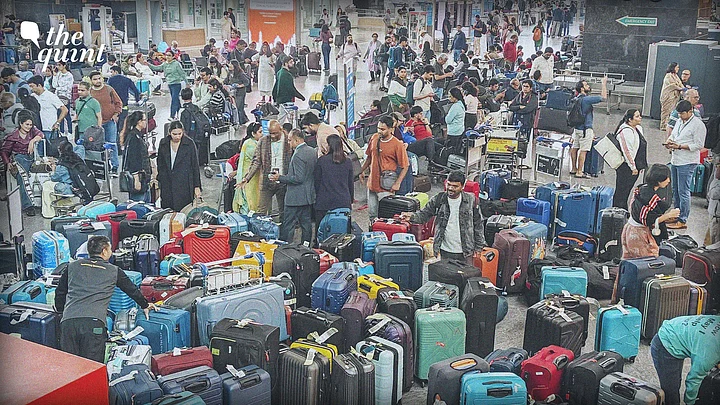
India has not merely witnessed an airline malfunction. It has witnessed a systemic collapse, a regulatory abdication, and a corporate failure of staggering scale.
Hundreds of cancellations daily for nearly a week. Tens of thousands stranded. New airports created spending Rs 70,000 crore descending into chaos—because the keys to the kingdom were effectively held by one airline.
Aviation, the spine of any modern, mobile nation, cracked not due to war, weather, or sabotage, but because one private carrier was allowed to become too big to fail and unaccountable.
This went far beyond inconvenience. It was a national shame.
The Independent Directors Who Vanished
IndiGo is no garage startup. It is a quasi-public utility with a market share (63 percent) larger than all its competitors combined. Its board—especially its independent directors—carries a fiduciary duty that extends well into the national interest.
In the months leading up to the meltdown, where were they? Did they flag rising fatigue levels? Demand a credible Flight Duty Times Limitations (FDTL) compliance plan? Did they Probe worsening crew shortages or question the reckless route growth? Or Insist on a risk audit before peak-season traffic? Or were they content signing attendance registers, sipping tea, and offering polite nods as the operational skeleton disintegrated?
Worse, several “independent” directors sit on IndiGo’s Crisis Management Group, the very body that made or allowed the decisions that culminated in this collapse. That is not oversight. That is complicity disguised as governance. They are culpable and it’s a clear cut case of either dereliction of duty or incompetence. They ought to resign and be declared unfit to serve on any board connected to essential national infrastructure.
DGCA’s Failure
The crisis shows that the Directorate General of Civil Aviation's (DGCA) FDTL norms—designed to prevent pilot fatigue—failed spectacularly.
Because, rules don’t work when the regulator:
Lacks enforcement power: pilots were over-rostered, leave denied, fatigue reports ignored; norms were even rolled back under pressure.
Functions reactively: FDTL monitors duty hours but ignores operational safety, staffing discipline, training, and governance.
Lacks independence: constrained by corporate and political influence, unable to intervene decisively.
India does not need more circulars. It needs a regulator with power, independence, and real-time oversight authority.
Why India Must Benchmark Against EASA
The European Union Aviation Safety Agency (EASA) is the global gold standard: scientifically grounded, operationally holistic, audit-driven, independent and proactive rather than post-mortem. India cannot merely tweak FDTL norms. It needs a regulatory architecture that functions like EASA—or it must prepare for repeat disasters.
Pilot shortages don’t appear in a week. Morale doesn’t collapse overnight. Fatigue doesn’t spike without months of strain.
IndiGo knew the following:
fatigue reports were surging
Attrition rising
Rosters becoming impossible
Leave being denied
Morale collapsing
Schedules turning mathematically unsustainable
Yet, management kept adding routes and block hours while pilot strength shrank.
Meanwhile, in just 12 months, IndiGo paid its top five executives Rs 185 crore—an average of Rs 37 crore each—while reportedly freezing pilot hiring. This is not misjudgment. It is wilful negligence.
With pilots revealing they were kept “idling”—deliberately left off rosters—the picture darkens further, suggesting manipulative planning. A court-monitored investigation is now essential. Minutes, emails, rosters, incentive structures—all must be frozen before anything becomes “accidentally unavailable.”
At the same time, Parliament must investigate the regulator—a parallel track focused on systemic oversight failures.
A single question forces transparency: “Will the government place on the table of both Houses the complete correspondence between DGCA and IndiGo from 1 July 2025 to 5 December 2025?”
There is no Official Secrets Act barrier. Reluctance itself becomes an answer.
When Selling Food Becomes More Profitable Than Flying
A fact that should shame policymakers: IndiGo earns more profit from selling food than from flying aircraft. This is not an amusing quirk. It is a structural warning.
When bonuses and snack sales outperform investments in pilot strength and safety, cost-cutting becomes doctrine, fatigue becomes a negotiable metric, pilots become expendable, and resilience becomes optional.
Indigo’s meltdown is not just an operational crisis — it is the clearest evidence that market incentives alone cannot safeguard essential national services. When the country’s largest airline prioritises ancillary sales and executive payouts over pilot strength and fatigue control, it signals a system where public safety and national continuity are subordinated to short-term profit and quarterly results that the market forces and investors demand.
India Needs “Eminent Domain for Business”
Telecom has emergency provisions. Banking has them. Power has them. Aviation — astonishingly — has none.
India must enact a narrow, surgical Eminent Domain for Business statute. Not nationalisation. But temporary, court-supervised intervention when a dominant private entity threatens national stability.
NCLT should be empowered to:
Appoint emergency administrators
Override negligent management
Enforce time-bound corrective action
Protect continuity of essential services
A nation of 1.4 billion cannot be held hostage by one airline’s internal chaos.
Breaking the Duopoly
India’s aviation structure is a duopoly masquerading as a competitive market. When two airlines dominate, fares can be engineered, labour squeezed, service rationed, and safety buffers eroded.
Hoping for new entrants without making concrete supportive moves is somewhat naïve. India must rebuild the ecosystem with airport-level market share caps, transparent slot auctions, priority access for regional carriers, protections against predatory pricing
If the duopoly is not dismantled, every crisis will feel like a re-run.
Why Three Airlines Collapsed in a Decade
Three major carriers dying in ten years is not bad luck. It is bad architecture. Indian aviation runs on wafer-thin margins, high Aviation Turbine Fuel (ATF) taxation, opaque slot allocation, chronic pilot shortages, an overburdened underpowered regulator, unpredictable fare regimes, and high capital costs.
Airlines don’t compete. They bleed, merge, or collapse.
Reform must be foundational:
National ATF policy
Transparent, merit-based slots
A national pilot and manpower strategy
Capital incentives for stability
A regulator with investigative teeth
Mandatory resilience buffers
India needs an independent fatigue-monitoring authority, monthly public safety dashboards, board Key Performance Indicator’s tied to resilience, not revenue, ring-fenced national pilot-training funds, verified pilot-strength matrices linked to route approvals, reengineered slot allocation, EASA-aligned norms, and a statutorily independent DGCA
Without these, India is flying on sheer luck, not policy.
The Lessons India Cannot Ignore
• Scale without governance becomes a time bomb.
• Dominance without accountability becomes a national liability.
• Fatigue is a safety hazard, not an HR issue to be swept under the carpet .
• Regulators must regulate — especially when incumbents resist.
• Transparency is existential, not optional.
Aviation cannot be run on crisis management and cost-cutting. It needs redundancy, buffers, and respect for human limits. Ignore this, and the next collapse will not be surprising. It will be inevitable. And with higher costs all across. This meltdown is the cumulative failure of boards that slept, regulators that surrendered, managements that overreached, incentives that rewarded snacks over safety, and a nation with no aviation contingency architecture.
India must send an unforgiving message. For its own sake and its place on the global stage: If you dominate a critical sector, you will and must be accountable. This must be aviation’s 1991 moment and needs be seized — the cataclysmic shock that breaks barriers and forces structural reform.
Fix aviation now. Pass an Aviation Resilience Bill by January 2026. The skies demand it. Fail, and the next meltdown may write its warnings in utter Chaos with wreckage strewn.
(Manoj Mohanka is a businessman who serves on several corporate boards. This is an opinion piece and the view's expressed are the author's own. The Quint neither endorses nor is responsible for the same.)
