
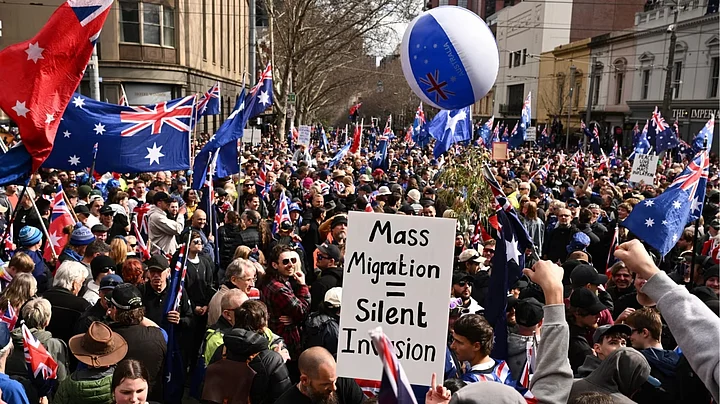
"Unfortunately, there's a lot of misinformation going on in terms of the migration numbers and the idea that there's mass migration occurring in Australia—which is simply untrue," Riona Moodley, a refugee lawyer who moved to Australia as a young child, told this writer's Sydney-based local media company Indian Link.
"It has been rather disheartening for me to see this sort of rhetoric being used again in Australia. It is incredibly divisive," she added.
It was just under a fortnight ago that Australia’s Indian community came into mainstream focus. In a provocative claim on national TV, Opposition MP Jacinta Price, a member of the upper house in Parliament, the Senate, alleged that Indian migrants are brought to Australia by the ruling Australian Labor Party (ALP) in exchange for votes.
Called out immediately, she was quick to retract, but quicker to refuse an apology—claiming she had nothing to be sorry for, citing poll results from the past. For eight days, she remained in the headlines, defiant in her refusal to appease Australia’s influential Indian community.
Alongside her in the news were Indian-origin Australians, speaking out against being reduced to a votebank, defending their place in the national story. Her remarks had landed at a particularly sensitive moment. Anti-immigration rallies in Australia’s major cities had already laid bare a rising hostility, with anti-Indian sentiment surfacing prominently. Against this backdrop, her comments only deepened the sense of unease.