The recent Afghanistan-Tajikistan border clashes or rather, attacks, which killed five Chinese workers in the bordering region of Tajikistan is a serious escalation and an alarming development for the region, including for India.
According to Tajik state media, two attacks on Takijistan from Afghan territory took place — first on the night of 26 November, killing three Chinese citizens, and the second occurred on the night of 1 December, killing two Chinese road construction workers. Afghanistan and Tajikistan share a 1357 km long border.
The timing is curious. It comes against a backdrop of escalating Pakistan-Afghanistan conflict.
Two rounds of talks — first in Doha and then in Istanbul failed, while a just concluded third round in Riyadh has yielded a fragile ceasefire. The borders are closed and fed up with Pakistan’s frequent closure of border crossings, Afghanistan has halted trade completely with Pakistan. It also comes at a time when Tajikistan and Afghanistan had just begun a process of normalisation of relations.
Tajikistan’s Longstanding Wary Relationship with the Taliban
Tajikistan has been the last of Afghanistan 's neighbours to normalise ties with the Taliban regime, a process which has just begun. While ethnic and cultural ties with Afghanistan's minority Tajik community is a major cause, Tajikistan had also suffered a brutal islamist insurgency as the Afghan jihad spilled over into its territory.
It has remained wary of the Taliban, against whom it had in the early 2000s helped the Northern Alliance led by Tajik Ahmed Shah Massoud, together with Russia and India. The representative of the Islamic Republic of Afghanistan continues to represent Afghanistan in Tajikistan, and now represents the National Resistance Front (NRF), led by Ahmed Massoud, son of the late Massoud, and is currently the main Afghan group that opposes the Taliban.
China is Tajikistan’s main economic partner. Attacks on Chinese interests and nationals in Tajikistan emanating from Afghan territory has the potential to damage not only China's relations with Tajikistan, but also with Afghanistan 's relations with both China - a necessary ally, and Tajikistan - with whom it had just started a dialogue four years after seizing power in Kabul.
Taliban Under Pressure as Regional Scrutiny Intensifies
The Taliban has vociferously condemned these attacks and has even offered joint patrolling of the borders with Tajikistan and a thorough probe into the incidents. But Pakistan has used it to condemn the Taliban. It's Foreign Office issued a statement expressing sympathy and solidarity with Tajikistan, as "repeated use of Afghan soil by terrorist elements......under the patronage 9f Afghan Taliban regime, is a matter of serious concern...."
These attacks, seen in conjunction with the terror attacks on security guards in Washington, allegedly by Afghan national Rahmanaullah Lakanwal are damaging for the Taliban just as it was expanding its diplomatic outreach both in the region and beyond, with increasing number of countries allowing it to open embassies in the capitals and promoting robust trade and economic ties with it.
Uzbekistan, for instance, has just reopened the Termez-Hairatan border crossing with Afghanistan, four years after shutting it down in August 2021, when the Taliban seized Kabul.
Taliban Governance Gains
This is not just a reflection of geo-political pragmatism. It is also an indication that after four years of governance, though far from ideal, the Taliban have started gaining the trust and confidence of its neighbours on several parameters. Since their takeover, no country has faced any security threats from Afghan territory, except for the recent attacks on Tajik soil. The conflict with Pakistan is of an entirely different genre.
Over the past four years, a major achievement of the Taliban government has been the year on year success in the drop in opium poppy cultivation, which had earlier made Afghanistan a major node in narco trafficking. Add to it the fact that almost all of Afghanistan is now under the Taliban's control and there is no viable opposition. All these factors combined have incentivised states, including those like the UAE and Saudi Arabia to recognise the Taliban as the legitimate rulers in Kabul. This is exactly what has driven India's engagement with the Taliban.
India's decision to engage with Kabul and provide it with direly needed humanitarian and economic aid is anchored both in pragmatism as well as in its centuries old friendship with the Afghan people.
India's heightened tensions with Pakistan, in grip of a military autocracy, and with chaos on its Easter borders where the ISI and its protege Jamaat-i-Islami Bangladesh is digging in its heels as well as with a range of extra-regional powers entering the Bay of Bengal region, engaging with the Taliban will give India strategic depth in a tense and strategically important region.
Attempts to destabilise the Taliban government just when it is stabilising, enlarging its diplomatic outreach and taking nascent steps for nation building should be alarming for India as well as for the region. A just released damning report by the US Special Inspector General for Afghanistan Reconstruction (SIGAR) states that Washington’s two decades-long effort to build stability and democracy in Afghanistan failed despite an investment of more than $148 billion.
The Taliban came back to power. There is no reason to believe that regime change in Afghanistan now would be a cakewalk. Even if disparate opposition groups can be galvanised by Pakistan as rumours have it. Even if US President Donald Trump makes good his threat that "bad things would happen to the Taliban" if they did not hand over the Bagram airbase to the Americans, the Taliban are sure not to go quietly into the night. They are in a far stronger position now than they were in 2000, and another period of bloodshed would ensue and India's influence in the region would diminish.
Why Modi and Putin Must Coordinate to Prevent Destabilisation
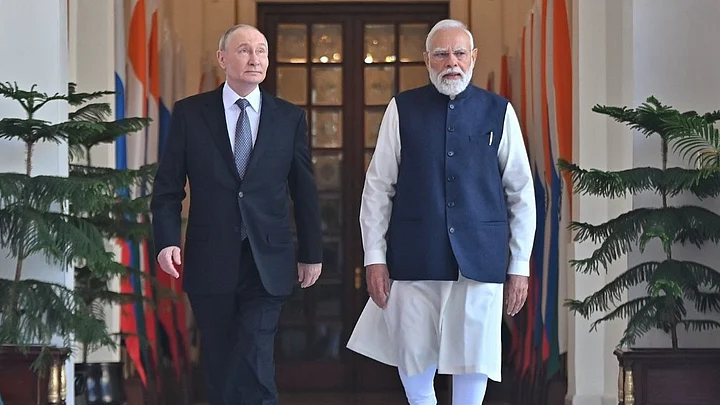
As President Vladimir Putin comes visiting, Afghanistan should be a major item on the agenda. The attacks on Tajikistan should be a major concern for Moscow as Tajikistan is a member of the Moscow-led Collective Security Treaty Organisation (CSTO) and houses one of Russia’s largest military bases. So should attempts at destabilising Afghanistan concern Russia.
It took the lead in reaching out to the Taliban even when America-propped up regimes were in power in Kabul, and ISIS-KP was enlarging its footprint in the region, as it evaluated that only the Taliban could effectively counter the latter.
The Moscow Format of talks provided India the platform to begin its engagement with the Taliban. This year Russia officially become the first country to recognise the Taliban regime as the legitimate representative of Afghanistan and has generously supplied the country with much needed energy supplies and humanitarian aid. The Taliban now want to offer Russia labour resources from Afghanistan for Russia’s agricultural sector. It is an indispensable partner for the Taliban.
Central Asian states, even China, followed Russia’s lead in reaching out to the Taliban, as later did India. None of them want to see Afghanistan destabilised again, understanding that strategic patience is needed to deal with the Taliban. This was most strongly articulated in the joint statement that was released at the end of the consultations on Afghanistan in Moscow earlier this year. Signatories, which included Russia, India, Iran, the five Central Asian states, and even Pakistan, unequivocally rejected foreign interference in Afghanistan and pledged support "...for strengthening counter-terrorism cooperation at both bilateral and multilateral levels...." with Afghanistan.
India should work in tandem with Russia, even include neighbouring countries, to fend off regime change in Afghanistan and stabilise the Taliban government. This, in turn, can be a leverage to the creation, even if incrementally, to a more inclusive government there.
(The author is an award-winning journalist specialising on Eurasian affairs. This is an opinion piece and the views expressed above are the author’s own. The Quint neither endorses nor is responsible for the same.)