Recent rumours of former Pakistan Prime Minister Imran Khan's alleged death drew global attention, including from neighbouring India. The swirl of speculation became more serious when Khan’s sisters and children appeared in the media, issuing statements over his well-being.
The reality, however, was quite different, as Khan was safe in jail. But an undeclared restriction had been imposed on his meetings in prison, which fuelled the confusion.
The rumours had led Khan's supporters to hold demonstrations in Islamabad and Rawalpindi last week. This, despite the fact that Section 144 had been imposed in both cities.
Politics in Pakistan is intensely heated at the moment. To understand what is happening, one must grasp the broader landscape.
Power in Pakistan Rests With Asim Munir
Historically, Pakistan has never been able to build itself into a strong democracy. The military establishment has always played an influential role, sometimes openly and sometimes from behind the scenes.
The current situation is that the country appears to have a democratic government headed by Prime Minister Shehbaz Sharif. He holds all executive powers. Above him sits the President, Asif Ali Zardari, the co-chairman of the Pakistan Peoples Party (PPP), while the command of the Army rests with Field Marshal and Chief of Defence Forces Asim Munir, a figure who has emerged as the most powerful personality in the state. He does not have formal administrative authority, yet real power largely revolves around him.
Out of Pakistan’s four provinces, three are governed by the ruling coalition of the PML-N (Pakistan Muslim League Nawaz) and the PPP. The key province of Khyber Pakhtunkhwa, which borders Afghanistan, is governed by Khan's Pakistan Tehreek-e-Insaf (PTI). This arrangement took shape after the general elections of February 2024.
The credibility of those elections was questioned both inside and outside the country. Critics argued that the polls were rigged on a large scale to defeat the PTI, through controversial means, resulting in his party forming a government only in Khyber Pakhtunkhwa. Khan, now 73 years old, has been in jail since August 2023.
Imran Khan Vs Asim Munir
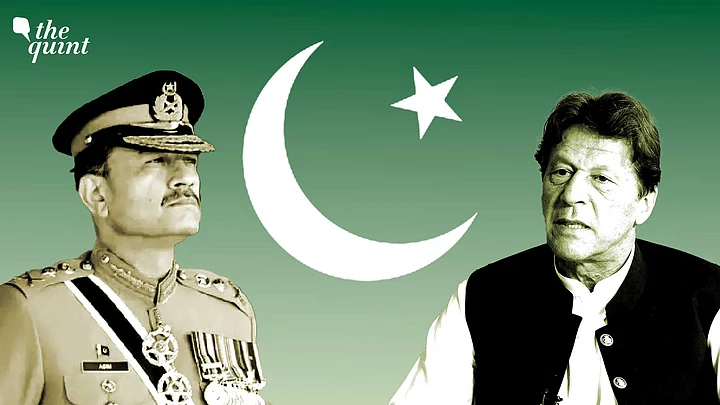
Pakistan’s political landscape remains highly fluid, but the core conflict centres on the confrontation between the military and Imran Khan. Even though Khan is in jail, his X account remains active, where critical posts appear against the Army and especially its powerful chief. This theme has dominated Pakistani politics for nearly three years. The military commands institutional power and has earned public respect due to its professional performance, particularly after the India-Pakistan conflict earlier this year.
Khan, on the other hand, still enjoys substantial public strength. His followers around the world maintain his political relevance, especially on social media. They continue to fiercely criticise the Army and its leadership.
Within Pakistan, however, Khan’s provincial government supports dialogue with both the Taliban and the Tehreek-i-Taliban Pakistan (TTP), while the federal government and the military favour strong action against them. In Balochistan too, an insurgency continues with frequent attacks on security forces.
On social media, Khan’s supporters often cross all limits of civility and decorum while targeting the Army and its chief, leading to strict administrative responses (like unannounced bans on his meetings in jail). Recently, after a harsh post from Khan’s X account directly naming the Field Marshal, the Army’s spokesperson Lieutenant General Ahmed Shareef Chaudhry held a press conference and declared Khan "mentally unstable". Such a strong reaction from the military is rare in Pakistan’s history.
Khan projects the image of a political and democratic struggler, but in practice he refuses to sit with any political party or work toward creating a climate of political harmony that could support a stable democratic system. He labels all parties except his own as "corrupt" and tools of the establishment.
From prison, he seeks direct negotiations only with the Field Marshal, insisting that all other political forces be removed from power so he may return to office.
Power Struggle Overshadowing Real Threats
At its core, this battle is about power, for which the principles of democracy and decency have been cast aside. His attitude has pushed the traditional political parties, the PML-N and PPP, closer to the military. Their own interests matter, but another reason is that Khan’s "harsh" language has repeatedly targeted their leaders personally, and now they, too, are determined to counter him.
In all this, the grave issue of terrorism is being sidelined. Instead of focusing on democracy and counterterrorism, both national and international discussions revolve around the fight between Imran Khan and the military.
Recent constitutional amendments have ensured that unless something extraordinary happens, Asim Munir will remain in office until at least 5 January 2031. This means that Khan’s release depends entirely on negotiations and the goodwill of the powerful Field Marshal—which, for now, appears unlikely.
Pakistan also faces a serious threat internally from terrorism. The banned TTP continues to carry out attacks on police and security forces. Pakistan believes that the Taliban government in Afghanistan supports the TTP, since the group’s leadership and sanctuaries are based across the border.
Pakistan continues to wage its internal war against terrorism to stabilise its economy. Any weakness or failure on this front would not only harm Pakistan, but also India and the rest of the region.
(Azaz Syed is a journalist and author based in Islamabad, Pakistan. This is an opinion piece and the views expressed above are the author’s own. The Quint neither endorses nor is responsible for the same.)