New Delhi: The Narendra Modi government has taken a bold and decisive step towards formulating an immigration policy to contain the flow of illegal immigration, mainly from Bangladesh.
This will be the first time in post-independence India that any government has involved itself in putting together a policy on the potentially explosive issue of illegal immigration from Bangladesh.
Highly placed government sources revealed to The Quint that the Home and Law ministries, along with the Prime Minister’s Office, are putting together a comprehensive immigration control policy which will determine immigration patterns and whether the inflow of people from some neighbouring countries, especially Bangladesh, can take place and of what kind.
A law is being framed to enable the operationalisation of the policy. For this purpose a bill will be introduced in Parliament and depending upon the outcome of the debate, if any, and consultations with some state governments, the final legislation will enable the government to determine future immigration patterns which, in turn, have a tremendous impact on the demography, culture, economy and politics in India.
— Senior government functionary
The proposal initially involved conducting a survey across Assam, West Bengal, Meghalaya and Tripura which share their borders with Bangladesh to determine the immigrant population, with March 25, 1971, as the cut-off date of entry. While the survey – the National Register of Citizens is now in the process of being updated in Assam – will still be conducted, the ministries involved in drafting the proposed legislation will take into account the implications of the 1974 Land Boundary Agreement which was recently ratified by Parliament before being inked between India and Bangladesh during Prime Minister Narendra Modi’s visit to Dhaka earlier this month.
Three Categories of Migrants
The focus of the survey will be to ascertain at what points in time people from Bangladesh moved to India. Union Law Minister D V Sadananda Gowda recently said in Bangalore that the government would try to find out about people who moved during Partition, those who immigrated during 1971 Bangladesh liberation war and those more recently.
The Modi government’s decision to institutionalise an immigration policy appears to be more nuanced compared to the BJP’s traditionally high-octane stand on “infiltration” from Bangladesh. The BJP has always distinguished between Muslim and Hindu immigrants, describing the latter as people who emigrate because of religious persecution in Bangladesh, while seeing a threat to national security from the former.
Two-fold Objective
While the BJP has historically adopted incendiary rhetoric that aims not only to completely stop the flow of Bangladeshi nationals into India but also identify and deport (read push back) illegal immigrants to that country, the government’s objective is two-fold, and more importantly, a realistic approach to deal with a highly controversial issue.
First, the Centre, fully aware that deporting millions of illegally settled Bangladeshi immigrants from different parts of the country is not only impossible but could provoke widespread violence, would prefer to slow down the virtually unending inflow, thereby using its authority to decide who can or cannot be allowed in.
The policy’s second aim is to devise a scheme which will enable the government to issue work permits to Bangladeshi immigrants residing in various parts of India but especially those living in border states such as West Bengal, Assam and Meghalaya which have faced the brunt of illegal immigration from the eastern neighbour.
Restrictive Regime
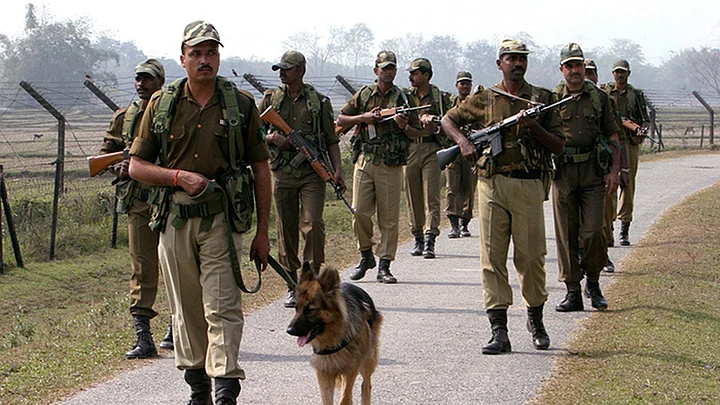
In some ways, the Centre has a partial policy on immigration, but that is directed mostly to prevent illegal immigration from Bangladesh. This is centred around a restrictive regime – physical barriers such as barbed wire fencing along the 4,096.7 kms of the highly porous India-Bangladesh border. Border fencing has not quite served the avowed purpose because Bangladeshi nationals determined to cross over bribe BSF jawans. Besides, an extensive network of middlemen or dalals are involved in the lucrative business of helping Bangladeshis cross over.
In the past, there have been other piecemeal efforts to contain illegal immigration, mainly in the form of proposals such as multi-purpose national identity cards for citizens, and more recently operationalisation of the hitherto irregular updating of the National Register of Citizens and the National Population Register.
Massive exercise to identify illegal immigrants, even from the March 25, 1971, cut-off date is going to be problematic. The government should instead use the 2011 census as a new cut-off date. Those who do not feature in the census or are unable to produce citizenship document(s) should then be asked to explain how they came to India.
—G K Pillai, former Union Home Secretary, to The Quint.
Pillai agreed that an immigration policy is indeed helpful, but added that the “government must have the political will to institutionalise and execute it.”