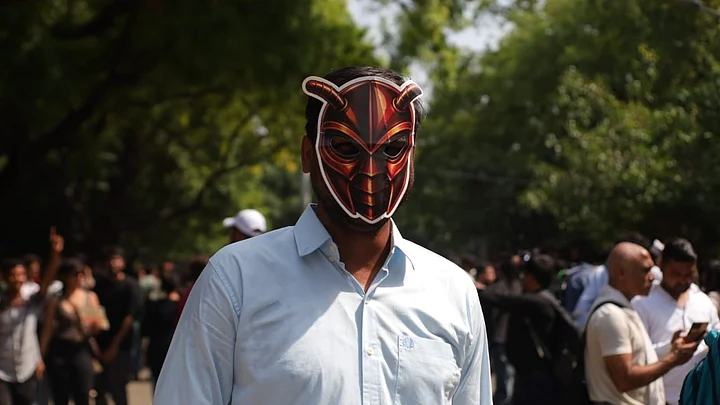
Born from a remark by the Chief Justice of India that many young people interpreted as describing them as "cockroaches", the Cockroach Janta Party (CJP) began as internet satire. Within weeks, however, the joke had marched out of social media and onto the streets.
Thousands of students adopted the cockroach as their emblem, protesting against the NEET paper leaks, examination irregularities and official indifference. Thirty-six days later, the movement had achieved what few opposition parties have managed in recent years: the resignation of the Union Education Minister and a promise of sweeping reforms to India's examination system.
That's not a bad political career for an insect most of us try to kill with a slipper.
An Unlikely Political Mascot
The success of the Cockroach Janata Party illustrates one of politics' oldest tricks: reclaim the insult before your opponent can weaponise it.
It is hardly a new strategy.
Ask any Australian. What was once "Yank" became a badge of pride. Ask the LGBTQ movement, which reclaimed the word "queer". Even "suffragette", intended as a sneer, became a banner under which women marched for the vote.
The CJP simply chose a rather less photogenic mascot. And yet, the cockroach has enjoyed an extraordinary political career. Long before hashtags, it was already starring in revolutions.
During the Mexican Revolution (1910-1920), the famous folk song La Cucaracha (“The Cockroach”) became a musical editorial page. Every faction rewrote its lyrics to lampoon generals, presidents and rival revolutionaries. Governments changed. Verses changed. The cockroach remained.
The cockroach has also found employment in cartoons, theatre and protest art across Latin America, where activists have often embraced it as the symbol of ordinary people who simply refuse to disappear despite repeated attempts by those in power to stamp them out.
In Oaxaca, Mexico, artist Mario Guzmán has created a series of prints called "Cucaracha Fascistas" (Fascist Cockroaches) in which authoritarian leaders — including Donald Trump — are portrayed as cockroaches.
Thailand offers another curious example.
For decades, the country's Democrat Party has carried the nickname "the Cockroach Party." It was coined by political opponents, but over time acquired an unintended compliment. The party survived military coups, collapsing coalitions, constitutional crises and electoral defeats with the stubborn persistence of its namesake.
Unlike traditional political symbols — the lion, eagle, lotus or hand — the cockroach makes no heroic claims. It isn't majestic. It doesn't soar. It doesn't roar. It merely survives.
The Dark Side of the Cockroach
But every political symbol has a shadow. The history of the cockroach also contains some of humanity's darkest chapters.
In Rwanda, before the 1994 genocide, Hutu extremists repeatedly referred to Tutsis as inyenzi — cockroaches. Radio broadcasts urged listeners to "crush the cockroaches." The language was not colourful rhetoric; it was psychological preparation. Once an entire community is no longer described as human beings but as vermin, extermination begins to resemble pest control rather than mass murder.
Around 800,000 people were killed in roughly one hundred days. The insect had become an instrument of genocide.
The Nazis employed exactly the same technique.
Their propaganda depicted Jews as rats, lice, cockroaches and other infestations contaminating German society. Posters, newspapers and films presented persecution not as cruelty but as public hygiene. Eliminate the pests, the propaganda suggested, and the nation would become healthy again.
History has repeatedly shown that before human beings are physically destroyed, they are often linguistically reduced.
Words arrive before bullets.
Reclaiming the Cockroach
Unlike the Rwandan and Nazi examples, where "cockroach" was used to strip people of their humanity, India's Cockroach Janata Party did something remarkable. It seized the insult, turned it on its head and wore it as a badge of defiance. In doing so, it joined a long tradition of protest movements that have reclaimed words meant to demean and transformed them into symbols of solidarity.
That, perhaps, is why the movement struck such a chord with young Indians. It was never really about an insect. It was about refusing to let someone else define who you are. If the establishment calls you a cockroach, then become the cockroach that refuses to be crushed.
Political parties spend crores hiring consultants to devise the perfect symbol and slogan. The BJP has the lotus. The Congress has the hand. The Aam Aadmi Party has the broom.
The Cockroach Janata Party had no branding experts, no focus groups and no advertising agency. It had an insult, and turned it into an identity. There are few symbols more powerful than one reclaimed by the people it was meant to humiliate.
After all, lions can be hunted, eagles can be shot, elephants can be captured and horses eventually tire.
But anyone who has ever flicked on a kitchen light in the middle of the night knows one uncomfortable truth: Never underestimate a cockroach.
(The author is a Fellow of the Royal Geographical Society and Explorers Club USA, and Editor of ‘Indian Mountaineer’. He is also the founder of Bharatiya Yuva Shakti, an organisation that ensures good leadership at the village level. He tweets @AkhilBakshi1. This is an opinion piece, and the views expressed above are the author’s own. The Quint neither endorses nor is responsible for the same.)a