
“In the region of Hariyanau which has numerous villages, and whose inhabitants are ever happy, there is the large city called Dhilli, favoured by Indra, destroying hostile armies, a mass of wealth, boiling the blood of the enemy.”
This is how Delhi is described in 1132 by the Agravala Digambara poet Shridhar in his hagiography of the 23rd Jain Tirthankara Parshvanath, as one of the big cities of the "Haryana region".
In the beginning of the 20th century, the British official George Grierson, in his Linguistic Survey of India (1916), mentions a single language spoken in the districts of Delhi, Rohtak, Karnal, and Hisar, along with the South East corner of the state of Patiala (present day Narwana).
The Hariana tract at this time referred to the tehsils of Hissar, Fatehabad, and Hansi, and the eastern part of Bhiwani tehsil. The language, what is today called 'Haryanvi', was known as Jatu in Delhi and Rohtak due to the bulk population of Jats speaking the language in Hariani, Deswali or Desari in the Hariana tract. It was also called Bangaru language in Karnal and Narwana. The survey returned 2.36 lakh speakers of the language from Delhi district.
Haryanvi Was Never Limited to Just Haryana
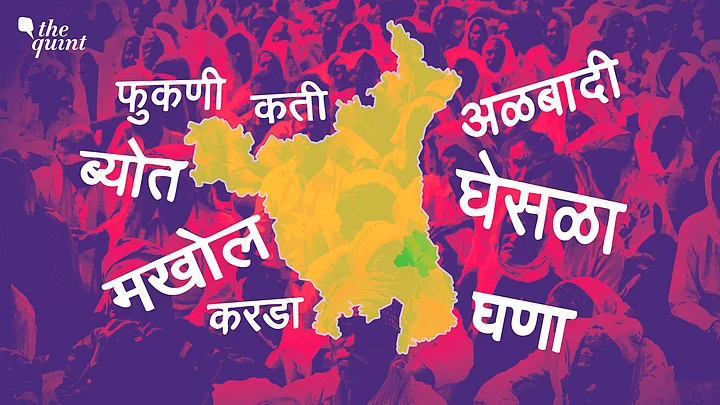
Geographically, Yamuna is the eastern boundary of the Haryanvi language, hence the Haryanvi-speaking region occupies the majority area west of Yamuna in Delhi. Haryanvi-speaking villages fall in the North, North West, West, South West and Southern parts of Delhi, along with many villages of what is now marked as ‘New Delhi’ in district classifications.
The area is simply a continuation of the Sonipat-Rohtak-North Jhajjar linguistic belt, coexisting with the power concentration in areas like Shahjahanabad where Urdu was the native language. Similar situations existed in other power centres, be it Agra, where Urdu was spoken by the townsmen, while others spoke Braj Bhasha.
Grierson for this very reason separates ‘Delhi City’ and ‘Delhi Mufassil’, where the city had a Urdu speaking population, while the Mufassil was of Haryanvi majority. Even many Muslims of Karnal city and some villages are reported to speak Urdu, while the majority spoke Haryanvi.
The separation of Delhi District as a territory from this contiguous region as it acquired capital status, and the creation of the state of Haryana out of the other districts speaking the language began a saga of confusion. The language became singularly known as Haryanvi and became associated with the boundaries of the modern Haryana state. While Urdu, Hindi and Punjabi became official languages of Delhi, Haryanvi was nowhere to be found.
Delhi Must Recall its Linguistic Diversity with Pride
The language today is in a peculiar situation in Delhi. There is a growing number of children who are not learning Haryanvi from their parents in their formative years, as parents fear the language is unsuitable to be taught. There was a proposal to create a Haryanvi Academy in a similar fashion to the Bhojpuri-Maithili and Garhwali-Kumaoni-Jaunsari academy, but no action was taken.
People think that Haryanvi speakers have come from Haryana, and some are surprised to see the existence of Haryanvi speaking villages of Delhi. People confuse sites of the powers bygone with the totality of the erstwhile ‘Delhi District’.
Without revitalisation and recognition, Haryanvi will be forgotten in Delhi. My mother, who studied till Class 10, and my father, who studied till Class 8, made sure I learnt English and spoke “proper” standard Hindi.
Haryanvi, the language of my village Devli in South Delhi, was not encouraged.
I remember once saying, “कि त जावेह?” (Ki ta javeh?) meaning “Where are you going?” to my cousin. My mother immediately scolded me, saying they were wasting their hard-earned money on my education. I do not see this as their fault. It was the mirror of a society that had taught them to see their own language as a burden.
For Delhi’s villages, education meant distance from Haryanvi. Standard Hindi brings respectability while speaking English is the ultimate ladder to be seen as success.
This article has inputs from Akshay Kumar, who runs the project Bhashakosh, documenting the regional languages, cultures, and geographies of India.
(Puneet Singh Singhal is the Founder/Curator of Dilli Dehat Project, a community-led archive and storytelling initiative that documents the rural histories, cultures, and lived realities of Delhi’s villages. This is an opinion piece and the views expressed are the author's own. The Quint does not endorse or is responsible for them.)
