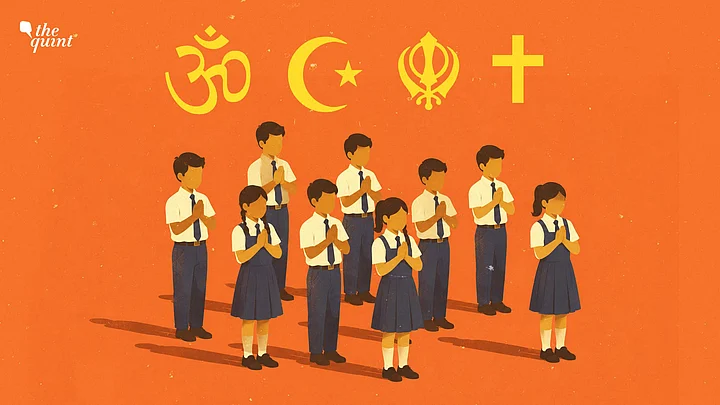
Imagine a child standing in a government school assembly. Teachers are present. Classmates are reciting together. The programme has been prescribed by the State. The State told the Court that no punishment was prescribed for a student who chose not to recite. Yet, the judgment identifies no express opt-out or explains how a child would know that remaining silent is permitted.
Is the child participating voluntarily? Or do the authority of the school and the visibility of refusing to join everyone else create their own pressure?
This is the constitutional question beneath the Chhattisgarh High Court’s decision concerning the Gayatri Mantra, Saraswati Vandana, Guru Mantra, and other Sanskrit invocations in government schools.
Can Compulsory be Voluntary?
The controversy arose from a School Education Department order dated 12 June 2026, prescribing invocations at different points in the school day. The State defended them as exercises in discipline, concentration, gratitude and social harmony. The petitioners argued that government schools were being made to conduct prayers associated with one faith, contrary to freedom of conscience, Article 28 and secularism.
The Court did not hold that students may be compelled to recite these prayers. Nor did it conclusively declare each invocation non-religious.
It found no express direction forcing students to act against their conscience and no material showing any individual or direct injury. It dismissed the petition as premature, while permitting a fresh challenge supported by cogent material if an actual grievance arises.
Yet, the Court also observed that Article 28(1), which bars religious instruction in educational institutions wholly maintained out of State funds, does not prohibit moral instruction detached from denominational doctrine.
The result is narrow, but its reasoning is consequential. Once the Court invoked the distinction between religious and moral instruction, it had to explain on which side these prayers fell.
The judgment records the State as acknowledging that the order used words such as “compulsory” and “ensure”, while arguing that they referred only to internal school administration and discipline—not to compelling individual students to recite.
That distinction could matter to the question of coercion: the government might require every school to conduct the routine while claiming that individual participation remains voluntary. But genuine voluntariness would require, at minimum, a clear right to abstain and protection against adverse treatment.
Even then, a separate Article 28 question would remain: whether organising such recitation in a wholly State-funded school is compatible with the constitutional prohibition on religious instruction.
The judgment identifies neither safeguard. It does not explain what was compulsory, upon whom the obligation fell, or how students would know whether recitation was optional. Although the Court concluded that no express requirement obligated participation, it did not explain how voluntariness would work in practice.
Even accepting the State’s assertion that no punishment was prescribed, the absence of formal punishment does not automatically create choice. In a supervised assembly, silence may mark a child as different or disobedient. Pressure can operate through expectation, embarrassment and fear of standing apart.
When Does a Prayer Stop Being Religious?
The State supplied a pedagogical explanation for every invocation. Saraswati Vandana was said to encourage academic excellence; the Guru Mantra, respect for teachers; the Gayatri Mantra, concentration and memory; and the Shanti Mantra, peace, and environmental consciousness.
These are worthy objectives. But prayers across religious traditions often communicate values that can also be expressed in secular language. A Christian prayer may teach compassion; a verse from the Quran, justice; a Sikh hymn, equality; and a Buddhist chant, non-violence.
Moral content does not, by itself, remove religious character.
The question is whether the State may select the devotional language of one tradition as the official vehicle through which government schools convey those values.
The texts reproduced in the judgment make the issue unavoidable. Saraswati Vandana invokes a goddess of knowledge. The Guru Mantra identifies the teacher with Brahma, Vishnu and Maheshwara. The Gayatri Mantra involves meditation upon the divine. They may also carry philosophical and cultural meanings. But their devotional dimension is not so plainly absent that the inquiry can end with the State’s descriptions.
The Court stated that moral instruction must be detached from denominational doctrine; it did not explain how these invocations met that test.
The Constitution does not require public education to ignore religion. Students may study religious traditions, philosophies and ethical teachings.
In Anjum Kadari vs Union of India, the Supreme Court explained that “religious instruction” involves inculcating the tenets, rituals, observances, ceremonies and modes of worship of a sect or denomination. Education about religious thought may be permissible when it does not indoctrinate children or restrict their freedom to think and choose.
A lesson explaining the Gayatri Mantra is therefore different from organising its daily collective recitation. In the first, the child examines a religious text. In the second, the child performs it.
Article 28 separately refers to “religious instruction” and “religious worship”. The High Court asked whether the programme amounted to religious instruction; it did not closely examine whether organised recitation could itself constitute participation in religious worship or observance.
The uncertainty is not new. In 2019, a two-judge Bench of the Supreme Court directed that a challenge concerning prescribed prayers in Kendriya Vidyalayas be placed before an appropriate Bench, observing that it raised questions of “seminal importance” about Article 28(1). The order did not decide the merits.
Who Will Bell the Cat?
The State relied on the absence of complaints. But silence does not necessarily prove acceptance. Minority families may not know whether participation is optional or how to object, and may fear that an objection will expose their child.
In Bijoe Emmanuel vs State of Kerala, children belonging to the Jehovah’s Witnesses respectfully stood during the National Anthem but declined to sing because of their faith. The Supreme Court protected them, holding that their respectful silence showed no disrespect and that their conscientious refusal was protected by the freedoms of speech and religion.
An anthem and a prayer are not identical. The lesson is that schools cannot assume uniform participation to be voluntary merely because the activity is institutionally valued.
The High Court was entitled to notice that no affected student had approached it. But, on the State’s own account, the policy was already operating. Must the first child be questioned, isolated or punished before the Constitution can ask whether the arrangement is coercive?
The Karnataka hijab litigation involved a different form of State action. It concerned Muslim students seeking to wear a headscarf they understood as part of their faith. Chhattisgarh concerns the State itself introducing religiously identifiable practices into the official routine.
In the hijab litigation, uniformity, discipline and secularism were invoked to justify restrictions. In Chhattisgarh, discipline and educational purpose are invoked in support of a State-prescribed practice.
The Supreme Court’s hijab decision was split: one judge upheld the restriction, while another emphasised choice, dignity and access to education. The contrast poses an unavoidable question: can secularism demand that minority religion become less visible while allowing majority religion to become the institution’s common culture?
The answer is not to prohibit the Gayatri Mantra because the hijab was restricted. It is to demand consistency. The State cannot treat minority faith as a private difference requiring regulation while treating majority faith as a neutral public inheritance.
Should Majoritarianism Dictate Education?
The opposition’s allegation is politically charged; it should not substitute for analysis.
The constitutional concern becomes clearer through three steps. The State selects invocations drawn from one broad religious tradition, universalises them as common Indian culture or morality, and institutionalises them as part of the daily routine of government schools.
The problem is not Hindu philosophy or Sanskrit literature entering the classroom. India’s education would be poorer if its religious and philosophical traditions were excluded. The problem begins when one tradition represents the whole nation, while others appear only as minority religions seeking accommodation.
The State also relied on the constitutional duty, contained in Article 51A(f), to value and preserve the rich heritage of India’s composite culture. But composite culture cannot be reduced to the culture of the majority. Government schools can teach India’s religious and philosophical inheritances comparatively and critically. They can teach students about the Gayatri Mantra without making its recitation part of the official routine and offer moral education without attaching morality to the devotional vocabulary of one faith.
(Sahil Hussain Choudhury is an advocate and constitutional law researcher based in New Delhi. This is an opinion piece and the views expressed above are the author’s own. The Quint neither endorses nor is responsible for the same.)