The Quint is telling the full story of how climate change is reshaping lives in India. Help us do more. Become a member.
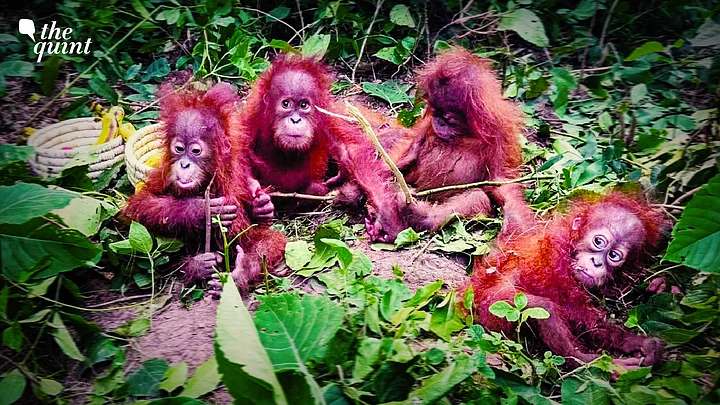
On 8 September, villagers in Odisha’s Balasore district came across five infant orangutans in the Ranakantha Reserve Forest. They were only six to eight months old, three females and two males. They should have been high in the rainforest canopies of Indonesia, clinging to their mothers. Instead, they were in Odisha.
This is not merely an unusual wildlife story. It is a story about us.
The orangutan is not native to India. The three recognised orangutan species—Sumatran, Bornean, and Tapanuli—are found only in Indonesia and Malaysia, and they all are critically endangered. The circumstances strongly suggest that the five infants were illegally trafficked into India, and authorities are now investigating how they arrived in India.
A report from The Wire has highlighted one possibility, that they were brought by sea from Indonesia’s Aceh province, an area where orangutan trafficking and confiscations have been documented. But the most disturbing question is not how they crossed the ocean.
If these babies were taken from the wild, conservation researchers say their mothers may have been killed while the infants were captured. That possibility changes the way we should look at those five small animals. They are not simply five rescued orangutans. They may be five survivors of a chain of violence that began in a rainforest far from India.
A Wildlife Trade With a Human Cost
There is another cruel irony here. Orangutans reproduce extraordinarily slowly. A female may have her first infant at around 15 years of age and may reproduce only once every seven to nine years. Infants remain with their mothers for eight or nine years.
In other words, the loss of a single infant is not easily replaced by nature. When we take a baby orangutan from the forest, we are not taking something that nature can quickly replace. We are removing a future generation from an already disappearing population.
This is why the Odisha incident should trouble us far beyond the fate of five animals.
India has traditionally been a country struggling to protect its own wildlife from poaching, habitat loss, and illegal trade. But the orangutans in Odisha force us to confront another reality: India is also becoming part of the international market for exotic wildlife.
Mongabay has reported growing concerns over the trafficking of gibbons and other primates into India. In 2024 alone, there were reported seizures of endangered gibbons from Malaysia and Thailand destined for India. The recent orangutan case suggests that the problem may be broader than isolated smuggling attempts. There is a growing urban demand for animals that look unusual, rare, and beautiful.
That is perhaps one of the saddest transformations in our relationship with wildlife. An animal that has spent millions of years evolving to live in a forest becomes in our imagination an object that can be owned.
A photograph with an exotic animal can become a status symbol. A rare primate becomes something to display. Its very rarity can perversely make it more desirable. Behind the photograph of a cute infant can be a dead mother, a destroyed family, a trafficking network, and an ecosystem losing one more member.
Wildlife trafficking is also not some romantic trade carried out by individuals who simply love animals. Conservationists have pointed out that the networks can overlap with the trafficking of other illicit goods, including weapons, drugs and humans. That should make us pause.
When Wildlife Becomes a Commodity
I have thought about Jane Goodall and her work many times since she passed away, but today I remember her like never before. Her work with chimpanzees challenged the comfortable idea that humans stand completely apart from the rest of the animal world. She insisted on observing animals as individuals with personalities, emotions, and complex social relationships.
She also spent the later decades of her life warning us about what happens when humanity forgets that it is part of nature. One of her most enduring messages was simple: “The greatest danger to our future is apathy.” That warning feels particularly relevant to the five orangutans in Odisha.
Apathy does not always look like cruelty. Sometimes it looks like scrolling past a photograph of a wild animal being held as a pet. Sometimes it looks like believing that because an animal has been rescued, the story has a happy ending. We cannot claim to love wildlife while remaining indifferent to the demand that makes wildlife trafficking profitable.
Goodall’s great contribution was not merely that she studied chimpanzees. She helped humanity recognise something uncomfortable: the boundary we have drawn between ourselves and other animals is much thinner than we like to believe. And orangutans make that uncomfortable truth even harder to ignore. They are intelligent, deeply social great apes with extraordinarily long childhoods. A baby orangutan does not simply need food and shelter. It needs to learn how to survive from its mother what to eat, where to move, how to navigate the forest and, eventually how to live independently.
Rescue Is Not the End
The five infants are currently at Nandankanan Zoological Park, where they have been quarantined and placed under medical supervision. Odisha has also constituted a technical committee to oversee their care. The immediate priority should obviously be keeping them alive and healthy. But survival inside a zoo should not automatically be mistaken for conservation success.
Indonesia has formally urged India to take steps to return the animals if investigations and DNA evidence establish that they originated there. The Indonesian government has said it is ready to work with India’s CITES authorities on their repatriation.
There is a strong conservation argument for doing so. Indonesia has specialised rescue and rehabilitation centres with experience in preparing confiscated orangutans for eventual return to the wild. Conservation organisations there have already rehabilitated and released hundreds of rescued orangutans, including animals that now form breeding populations in restored forest habitats.
That gives these five infants something more valuable than a permanent enclosure. It gives them a possibility of becoming part of a wild population rather than spending their lives as reminders of what humans took from them.
More Than Five Orangutans
It would be easy to end this story with a call to return the animals to Indonesia. They should be returned if that is established as their country of origin and if experts determine that repatriation and rehabilitation are in their best interests. But that cannot be the end of the conversation.
We also need to ask why they were here in the first place, and what does our fascination with exotic pets say about a society that is increasingly disconnected from the wild animals it claims to admire? There is an important difference between loving an animal and wanting to own one.
The five baby orangutans found in Odisha should, therefore, not become another viral wildlife story that disappears from our feeds in a few days. They should make us uncomfortable.They should make us ask what happened to their mothers. They should make us think about the forests they came from. They should make us question the idea that rarity makes an animal more desirable.
Because the tragedy of wildlife trafficking is not only that animals are stolen from nature.
It is that humans have become so detached from nature that we can look at a frightened infant, separated from its mother and transported across an ocean and still call it something we would like to own.
(Kanwal Singh is a writer and political analyst. This is an opinion piece and the views expressed are the author's. The Quint does not endorse or is responsible for them.)