
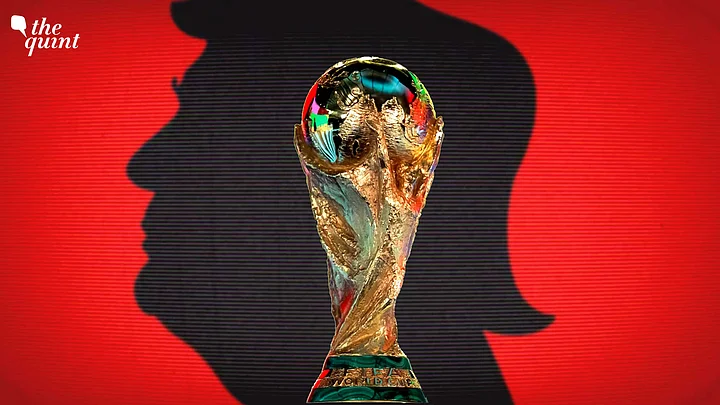
FIFA World Cups are often remembered through iconic moments that transcend generations. For some, it's Diego Maradona weaving past defenders before scoring the 'Goal of the Century' in 1986. For others, it is Zinedine Zidane’s headbutt in the 2006 final; or Andrés Iniesta’s winning goal in 2010; or Lionel Messi lifting the trophy in Qatar after one of the most dramatic finals.
Every four years, billions of people across cultures and continents participate in this shared spectacle that appears to momentarily dissolve borders. In this sense, the World Cup has long been imagined as a rare expression of a universal civic virtue—a global ritual of belonging.
This year's anthem, "Dai Dai" (meaning "come on"), invites the world to join this celebration.
Yet, for many fans, players, referees, and workers, the invitation ends at the border. As immigration restrictions, visa denials, and heightened border enforcement increasingly shape who can attend and participate in the tournament, the World Cup is becoming a reminder that even the world’s most celebrated sporting event cannot escape the politics of mobility and exclusion.
Not Everyone Gets to Cross the Line
Recent incidents expose this contradiction with the uncomfortable reality.
A Somali referee reportedly couldn't enter the US because of immigration restrictions. An Iraqi footballer was detained and questioned upon arrival before eventually being allowed entry.
Far from being bureaucratic anomalies, they are reflections of a deeper political order. They emerge from a global architecture of mobility in which the right to cross borders is unevenly distributed, mediated through hierarchies of citizenship, security, and geopolitical worth.
What appears as an administrative procedure is, in fact, the everyday enactment of a political logic that differentiates between desirable and undesirable movers, rendering some journeys effortless, while subjecting others to suspicion, scrutiny, and delay.
The irony is striking. The World Cup depends on the circulation of people. Players, coaches, officials, journalists, sponsors, migrant workers, and millions of fans must be able to cross borders for the tournament to work. Yet, the same event is increasingly constrained by immigration regimes that determine who is (un)welcomed.
The US, which will host the majority of matches, has in recent months expanded the travel restrictions affecting dozens of countries and tightened immigration procedures for several others. Consequently, many prospective World Cup attendees may encounter prolonged visa delays, additional scrutiny, or outright denial of entry.
Fans from Haiti and Iran, for example, cannot attend US-hosted matches unless they are US residents or dual nationals with another eligible passport. Citizens of some African states, too, face partial restrictions.
This raises a fundamental question: can a tournament legitimately claim to be global when access to it is mediated by unequal mobility rights?
Migration scholars have long contested the notion that borders simply separate territories. Border, in reality, also actively produces categories of belonging. Modern borders function as sorting mechanisms that distinguish between those deemed desirable and those considered risky and subject to surveillance. The passport, visa, and security interview have become instruments through which states allocate differential value to human mobility.
When Inclusion Becomes a Slogan
History suggests that this tension is neither new nor accidental.
During the 2014 World Cup in Brazil, security preparations included immigration enforcement and the increased policing of migrants in major cities.
During the 2018 World Cup, Russia introduced a Fan ID system, which simplified entry procedures for fans, but also expanded state surveillance capacities and data-collection mechanisms.
Qatar exposed another dimension of global mobility, with thousands of migrant labourers working day and night under precarious conditions to make the event a global spectacle.
What distinguishes the 2026 World Cup is the extent to which immigration politics has percolated in the tournament well before it started.
For example, US officials involved in planning the World Cup suggested that agencies such as Customs and Border Protection and the Immigration and Customs Enforcement could assist with security and operational coordination during the tournament.
Who Has the Right to Belong?
At the last World Cup in 2022, the dominant message was one of welcome and celebration.
FIFA President Gianni Infantino repeatedly spoke of football's ability to "unite the world" and urged fans to "enjoy and have fun."
Yet, in the lead-up to 2026, the language surrounding the tournament appeared markedly different: visitors are welcome to come and enjoy the spectacle, but are also reminded to go home afterwards.
Human rights organisations have already warned that this may deter attendance, particularly among the migrants. It's not just about the visa applicants anymore; it now surrounds the social atmosphere around the event itself.
FIFA’s promotional campaigns celebrate diversity, inclusion, and international friendship. But inclusion cannot exist merely as a branding strategy.
If supporters from certain nationalities are unable to attend, it travellers anticipate detention or invasive questioning, and if migrant workers who construct and service the infrastructure remain invisible within the official narrative, then the celebratory discourse of global unity begins to sound increasingly hollow.
The Cost of Exclusion
The 2026 World Cup is a test case now for mobility justice, i.e. the equitable distribution of opportunities to move, participate, and belong across borders. Who has the freedom to travel for leisure, sport, work or cultural events? Who is presumed legitimate upon arrival? Whose movement is celebrated as cosmopolitan and whose is treated as a security threat?
These questions sit at the heart of contemporary migration politics, and they are now shaping one of the world’s most visible sporting events.
It doesn't imply that states should abandon border control. Sovereign governments possess legitimate authority to control it. However, the exercise of that authority must be proportionate, transparent, and consistent with the true nature of the global event. Certain minimum standards like effective visa procedures, safeguards against discriminatory treatment, and humane treatment at ports of entry.
FIFA may be remembered for the goals scored on the pitch, but its legacy will also be shaped by the borders erected around it. The question is not whether the World Cup will remain spectacular, but whether it will remain genuinely global.
(Pulkit Buttan is a PhD Scholar at TISS Mumbai. This is an opinion piece and the views expressed above are the author’s own. The Quint neither endorses nor is responsible for the same.)
