The much-lamented, brilliant Indian diplomat Eric Gonsalves, around 1970 in Singapore, described the European Union (EU) as “a pain in the neck”. It continues to be so but is now also tormented by internal fissures.
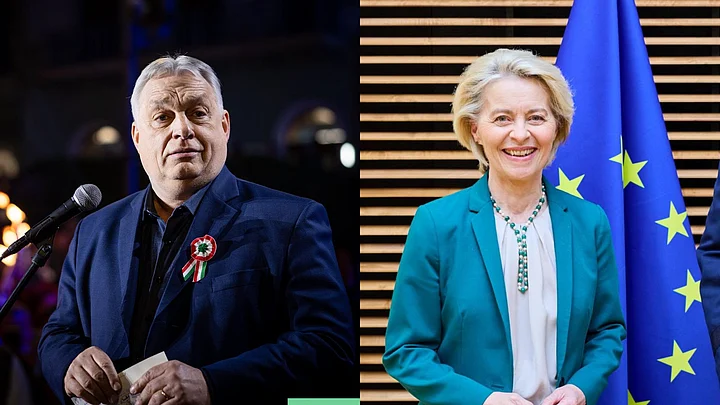
Former Hungarian Prime Minister Viktor Orban in April suffered defeat after 16 years in power. Gainsaying his reputation for being authoritarian and a dictator, he quickly conceded defeat in a speech to his supporters.
Amid the gloom of a splintering EU, Orban’s political demise was a cause for celebration but a Pyrrhic victory for the EU’s current leaders and the centrist, liberal-democratic cause they profess to represent. Orban’s political career might be dead, but ‘Orbanism’—dissent with the EU’s centralism and policies—is still alive and kicking.
EU's Worst Geopolitical Crisis
The EU is going through its worst geopolitical crisis in its history. Its inept leadership thinks in liberal cliches and tries to outdo its rivals in jingoistic tough talk, especially when it comes to raising fear of the ‘Russian threat’.
But, besides failing to deliver on promises to suffocate Russian President Vladimir Putin’s regime economically with innumerable sanctions and defeat it militarily in Ukraine with four-year support from NATO (North Atlantic Treaty Organization), it is now facing the agonising prospect of a political quarrel with the US and a major moral and economic crisis caused by US President Donald Trump’s decision to embark on an illegal ‘war of choice’ on Iran along with the notorious serial offender and reprobate Israel.
The European Commission President, Ursula von der Leyen, whose views need to reflect those of the member states, rushed to Israel in the wake of the Hamas attack in 2023, expressing solidarity and a more pro-Israeli stance than that acceptable to the 27 member states, thereby ignoring the division of powers by which the commission does not set foreign policy but reflects what member states have determined. It was observed that she made no appeal for Israel to respect international law as the UN and various European leaders had done.
The victory of Tisza, a more EU-inclined Hungarian party led by Peter Magyar, has therefore provided a rare opportunity for von der Leyen to rejoice, writing on X in hyperbolic language that Hungary “has chosen Europe” and that it “returns to its European path". Framing everything in messianic, civilisational terms that smack of Western supremacy is the current European Commission’s signature style.
EU's Shift To the Right
Hungary did not have an Eureka moment to ‘choose Europe’—it is a country in the heart of Europe that helped shape European politics for centuries. Under Orban, it did so disproportionally to its size and economic weight. It was Orban’s first government that brought Hungary into NATO in 1999 and which then conducted negotiations on Hungary’s accession to the EU.
Orban’s subsequent political move towards the illiberal political right, which eventually led him to embrace Trump, Putin, and Israeli Prime Minister Benjamin Netanyahu, corresponds to the entire continent’s overall shift to the right.
When it comes to militarism, von der Leyen’s presidency of the European Commission mirrors the same shift as acutely as Orban’s.
It is important to note that the winner of Hungary's elections, Magyar, a former ally of Orban’s, displays much the same political values when it comes to immigration and even geopolitics. Like the majority of his fellow Hungarians, Magyar is a Ukraine sceptic, reluctant for his country to aid Kyiv financially or militarily, even though his government has unblocked the EU’s 90-billion-euro ($105 billion) loan to Ukraine, which is crucial for sustaining the war with Russia in the next couple of years.
In an interview on the eve of elections and conscious of the problems of the ethnic Hungarian-origin minority in Transcarpathia in Ukraine, Magyar said that “nobody wants a pro-Ukrainian government in Hungary” and that Hungary’s dependence on Russian gas will compel him to get on with Putin.
A Slew of EU & Ukraine Sceptics Dominate Europe
Even before Orban’s defeat, Belgian Prime Minister Bart De Wever emerged as a new Ukraine-sceptic leader who successfully derailed the European Commission’s plan to tap into Russia’s assets, which is why the EU had to come up with the 90-billion-euro loan.
There are other like-minded political forces—Slovakia is ruled by Prime Minister Robert Fico, who was aligned with Orban on most issues, especially when it came to Ukraine. In the Czech Republic, a Ukraine-sceptic coalition under Prime Minister Andrej Babis is in charge. In Poland, the Ukraine-sceptic President Karol Nawrocki has been clashing with the pro-Ukrainian government of Prime Minister Donald Tusk.
In Romania, George Simion is a right-wing nationalist candidate for president who is against military support for Ukraine and sceptical about the EU. He won the first round of the presidential election and, with 40.96 percent of the vote, will go into the runoff on 18 May as favourite against the liberal mayor of Bucharest, Nicusor Dan. In Britain, Nigel Farage’s Eurosceptic Reform Party leads in the polls, as does the PVV of Gert Wilders in the Netherlands, a political force, as are the RN of Marine Le Pen in France and SALF and Vox in Spain.
The European Commission tends to frame all political issues in the context of Europe’s conflict with Russia, investing its future in defeating Russia. This hardly showcases the liberal values that the EU purports to uphold. The electoral defeat of a major Ukraine-sceptic like Orban does not change this situation.
The delusions of the European mainstream will keep throwing up political forces that will oppose them, which was the basis of Orban’s 16-year tenure of office.
(Krishnan Srinivasan is a former Foreign Secretary of India. This is an opinion piece. The views expressed above are the author’s own. The Quint neither endorses nor is responsible for them.)