
The Modi government had a massive problem at hand in 2018-19, caused ironically by extraordinarily high sugar production (32-33 million tonnes) amid global crash of sugar prices. Bulging foodgrain stocks with the Food Corporation of India (FCI) was adding to its woes.
Many measures were taken—subsidy on sugar export, increasing minimum price of sugar for domestic market, etc—to dispose of surplus sugar. Nothing worked.
Industry delayed paying sugarcane farmers. Arrears were piling up—about Rs 11,000 crore in December 2018—making farmers restive. A perfect political storm was brewing in politically sensitive states, Uttar Pradesh and Maharashtra included.
The Modi government was struggling to find a good way out. Ethanol emerged as the white night.
The government set up a game for raising ethanol production for blending in petrol 10 times, from about 2 percent in ethanol supply year (ESY) 2016-17 to 20 percent by 2030.
That game is faltering now.
What was the ethanol game? Why did blending ethanol in petrol become a big policy favourite for politicians? Who benefited most? Who bears the cost as the policy reversal takes place?
The Politics Behind the Ethanol Push
Ethanol can be produced from sugarcane, foodgrains, and quite a few other cellulosic residues. India had a massive oversupply of ethanol inputs in 2018.
Diversion of sugarcane products for ethanol production was not only expected to bring down the oversupply of sugar firming up domestic prices, but also obviate the need to export at loss-making prices.
If remunerative prices could be paid to the sugar industry for investing in the production of ethanol, this would improve cash flows and profits of sugar companies—and they would clear farmers' sugarcane arrears.
Such an ethanol policy made another good collateral sense as well.
Indigenous petroleum crude oil production was falling (from 37.8 million tonnes in 2013-14 to 35.68 million tonnes in 2017-18), hollowing out Prime Minister Narendra Modi’s promise (from 77 percent in 2015 to 67 percent by 2022) of reducing dependence on imported petroleum products. The dependence had increased to 83 percent in 2018.
Petrol consumption was about 25 percent of the total petroleum fuel (petrol and diesel) consumption in 2017-18 (26.2 million tonne petrol, 81 million diesel). If 20 percent of petrol consumption could be saved by blending ethanol (E20), about 4-5 percent of petroleum crude imports could be expected to be reduced.
The old Congress era ethanol policy was pulled out. An ambitious E20 policy was announced in June 2018, declaring the government’s aim to raise ethanol’s share in petrol consumption to 20 percent by 2030.
Who Won the Ethanol Game?
Three major stakeholders were/are in the ethanol game:
Sugar/ethanol industry
Oil marketing companies (OMCs)
Petrol vehicle owners/operators (PVOs)
The government decided to take care of the interest of the sugar industry and OMCs. PVOs were ignored.
The sugar industry wanted the sale of ethanol at attractive prices.
It was decided to administratively fix the sale price of ethanol produced from different sources at rates to assure excellent return to industry (about 20 percent on equity). For 2024-25ESY, ethanol produced from sugarcane juice, sugar, and sugar syrup was paid Rs 65.61 per litre. As an effective ethanol input purchase cost of about Rs 40 per litre, the ethanol producers made, like all other years, excellent return on equity in that year as well.
The governments, including states, provided numerous other incentives (interest subsidy on bank loans, cheaper land, and state promotional incentives) as well.
The industry was happy. It invested heavily in ethanol production.
The OMCs wanted procurement of ethanol (inclusive of taxes) at prices lower than the cost of procuring petrol. The basic procurement price of petrol (crude, refining, freight etc) for OMCs was about Rs 50-55 per litre (Rs 55.50 on 31 October 2024 in petrol sold in Delhi), much less than the ethanol price. Excise duty and state VAT cost about Rs 35 per litre (Rs 19.90 excise duty and Rs 15.39 state VAT).
To make it remunerative for the OMCs, the government decided to levy only 5 percent GST on ethanol.
Total procurement price (including taxes) of ethanol for OMCs became cheaper (Rs 68.89 as against Rs 90.89 in the example cited above). Ethanol is still cheaper after the Central government reduced excise duty by Rs 10 per litre in March 2026.
The OMCs were quite happy. The government was happy too, as it solved the political problem of farmers’ arrears and earned some talking points about reducing import dependency and saving foreign exchange.
The real stakeholders, the PVOs, were to face all the downside.
The Push to E20
PM Modi pushed the policy big as it ticked all political checkboxes. He lost no occasion to drumbeat the ethanol policy. India became an ethanol champion. Using its G-20 chair, India launched Global Biofuel Alliance (GBA) in Delhi in 2023,
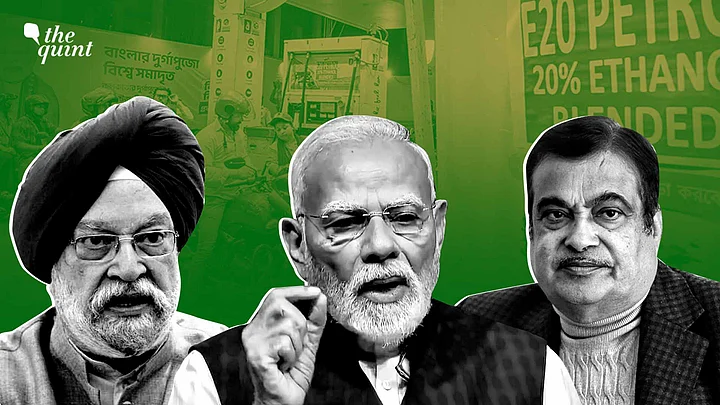
BJP ministers (Hardeep Puri and Nitin Gadkari most vociferously and enthusiastically) praised the ethanol programme. The officers pursued the vision to extremes.
The government mandated sale of only E20 petrol at the pumps.
The ethanol industry went overboard for creating new ethanol capacity. Sugar became secondary in the sugarcane industry.
By 2024-25, India witnessed establishment of ethanol manufacturing capacity of about 18 billion litres a year (exceeds 20 billion litres now). As 100 percent E20 ethanol blend needs about 10 billion litres of petrol, there is almost double ethanol capacity in India.
No wonder the E20 goal was achieved five years in advance by 2025.
Consumers Pay the Price
Ethanol is not an easy substitute/blend of petrol.
It requires a specifically designed vehicle engine (like diesel engines are specifically made for using diesel fuel). Ethanol blends in non-conforming vehicles create problems for the health of its parts and lining. Ethanol blended petrol also reduces average mileage per litre.
The government's forced mandate of only E20 petrol at pumps has created enormous problems for pre-2023 vehicles (E20 compliant vehicles produced only after 2023).
Consumer distress has acquired a major momentum by now. Ordinary people are rising against it suffering loss of average and damage to their vehicle. It is becoming a people’s movement against the forced use of only E20.
The E20 Rollback
The government is already on the backfoot.
Nitin Gadkari, who had a few weeks ago threatened to unleash 15 percent isobutanol blend for diesel vehicles as well, has gone silent. The talks/proposals of introducing isobutanol in diesel vehicles and higher versions of ethanol (E25 and E85) are off the table.
The government has accepted the claims of some average mileage loss. It may soon accept that there is damage to the vehicles.
The government has realised that there is a significant political downside to the ethanol campaign. Its defence of E20 petrol is sounding weaker by the day.
As more and more people find damage to their vehicles and realise the loss of average, their complaints and anger will blow up. The ethanol issue is a political quicksand. The government will not be able to stand up to its only E20 policy for long.
It will have to introduce both ethanol-free and E10 options in addition to E20. The government may rejig petrol prices as well. E20 petrol will have to be sold at a lower price (say about 10 percent lower).
The Bill Comes Due
The stakeholder which benefitted the most—the ethanol industry—will suffer the most as well.
The ethanol industry has begun to feel the heat. Many plants are operating at about 50-60 percent of its capacity.
As there is no likelihood of domestic ethanol blend consumption going up, beyond the current absorption of about 10-11 billion litres, it will have to find alternative markets outside India (not easy, will get much lower price).
If and when the government begins providing E10 and E0 petrol, ethanol consumption will decline further. There will be significant loss of investment. Banks loans may be non-performing. India has seen some such policy about turns earlier. Casein industry had faced a similar situation in 2010-12.
The goal of reducing dependence on imported petroleum production is moving further away every year (reached 89 percent in 2025-26) as well.
(The author is economic and fiscal policy advisor, SUBHANJALI, former Finance & Economic Affairs Secretary, and author of 'The $10 Trillion Dream'. This is an opinion piece and the views expressed are the author’s own. The Quint neither endorses nor is responsible for them.)
