
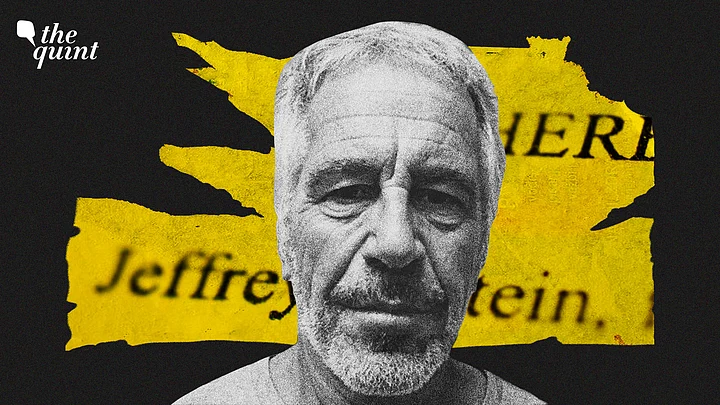
On 30 January, the US Department of Justice (DOJ) released the “Epstein files,” a staggering dump of more than three million documents, images, and videos exposing the machinery of sexual abuse, pedophilia, and child trafficking, built around Jeffrey Epstein, the American financier and convicted child sex offender who allegedly died by suicide in 2019 while awaiting trial on federal sex-trafficking charges.
The files reveal years of systemic abuse involving Epstein, his accomplice Ghislaine Maxwell, and a powerful social circle that enabled them to operate in plain sight.
Survivors, many underaged at the time of abuse, were promised transparency and accountability, but instead were re-victimised—their names unredacted, faces exposed, nude photographs made globally accessible and deeply sensitive personal details released into the wild.
For women who were trafficked, abused and silenced, the state became the latest institution to violate them. And then, we ask why survivors don’t speak up? Why they don’t come forward? Why it took them so long?
The Price of Re-Victimisation and Systemic Incompetence
This desecration of privacy was not a mere error of judgement. It was a colossal, outrageous failure, and one that reveals a familiar truth—how the identities and safety of survivors, particularly women, remain secondary and negotiable rather than essential.
What was framed as a historic act of transparency quickly devolved into a devastating breach of survivor privacy. Unredacted identities, exposed images, and institutional negligence left victims scrambling for safety, revealing how systems meant to protect can instead reproduce harm.
In a letter to the DOJ, attorneys Brittany Henderson and Brad Edwards, who are representing over 200 survivors, insist the government was provided explicit lists of individuals whose identities required protection. Citing the harm caused as “ongoing and irreversible,” the letter rightfully deems the error on the DOJ’s part as “what may be the single most egregious violation of victim privacy in one day in United States history.”
Some survivors learned of their exposure only after journalists or strangers contacted them, some with death threats. Others discovered their images, addresses and financial details circulating online as they scrambled to disable bank accounts and credit cards.
“I have never come forward. I am now being harassed by the media and others,” wrote a victim identified as Jane Doe. “This is devastating to my life.” Another stated that the exposure had risked her and her child’s safety.
It is institutional re-traumatisation, when systems meant to protect, instead replicate the dynamics of abuse by stripping control, overriding consent and making women’s safety optional.
Meanwhile, powerful men linked to Epstein remain protected by redactions, legal caution or institutional silence. The imbalance is unmistakable when the perpetrators are insulated and the survivors laid bare for the picking.
The Oldest Punishment for Women Who Speak Up
For women, public shaming has long been a tool of control. Publishing survivors’ names does not advance justice but reproduces humiliation, shifting attention from violence to morality. It warns women that speaking up may cost more than staying silent and even endanger their lives. In doing so, it can also serve to deflect scrutiny and shield perpetrators.
A devastating example of this is the life and death by suicide of Virginia Giuffre, who endured years of repeated dissection of her trauma while many of the men she implicated never faced comparable exposure. Giuffre’s allegations against Prince Andrew ended in an out-of-court settlement, yet it was she who paid the price of having her credibility questioned and her past relentlessly scrutinised.
In her posthumous memoir, “Nobody’s Girl,” Giuffre mentions fearing that she may “die a sex-slave” and of being brutally beaten and raped by a “well-known prime minister,“ whom she did not name out of fear of repercussions.
From public shaming to credibility trials, women who speak out against powerful men often pay the highest price. The Epstein fallout reveals how exposure, scrutiny, and moral policing continue to discipline survivors while shielding influence and status.
While recognisable figures such as Bill Clinton and Donald Trump are at least publicly known to have moved in Epstein’s orbit, many lesser-known men named in the files, including Glenn Dubin, Jean-Luc Brunel, and Lex Wexner have largely escaped public questioning. Their obscurity has acted as protection, allowing them to evade scrutiny altogether. Giuffre, meanwhile, was forced to relive her abuse repeatedly, deepening her PTSD. Her family later said the “weight of abuse she suffered throughout her life became unbearable,” describing a woman who fought relentlessly for justice but was ultimately crushed by trauma and institutional indifference.
If accountability means women exposed while insulating men, famous or obscure, then Giuffre’s death stands as a devastating indictment of a system that protects power and exhausts those who dare to speak.
Burden of Explanation
Additionally, the fallout also reveals a quieter pattern of women being treated as proxies for male guilt.
As scrutiny intensifies around powerful men, the burden of explanation often shifts to the women around them. From former spouses to public figures, women are pressed to answer for actions they neither committed nor controlled — revealing a persistent pattern of gendered displacement.
Melinda French Gates, divorced from billionaire and Microsoft co-founder Bill Gates since years, has repeatedly been questioned, including in a widely discussed NPR interview, about her ex-husband’s association with Epstein. This, despite allegations against Bill centring on claims that he covertly attempted to medicate his wife to conceal having contracted a sexually transmitted infection from one of Epstein’s victims, indicating that Melinda neither knew of nor participated in any wrongdoing. Yet, she is still asked to answer for a man she is no longer even married to.
Pushing back, Melinda said: “Whatever questions remain there of what — I can’t even begin to know all of it — those questions are for those people and for even my ex-husband. They need to answer to those things, not me.”
This is not accountability. It is gendered displacement that burdens women with moral responsibility. Meanwhile, the men involved are spared even the basic obligation to answer for their own actions.
When Power Makes Silence Convenient
On the flip side, women who moved in overlapping social or political circles with Epstein, including Melania Trump and Sarah Ferguson, have remained largely silent. Protected by extraordinary power and privilege, their voices could challenge the culture of impunity that shields influential men and affirm survivors.
Their support may embolden women to speak out against abuse while bolstering the case against the accused. Instead, their silence is deafening and a dismal reminder that proximity to power often dulls the urgency of moral responsibility.
While feminism should not make women answerable for men’s crimes, it must interrogate what happens when women with power choose silence to preserve stability, reputation, or access, and whether restraint becomes complicity when it shields systemic harm.
Transparency Without Care Is Not Justice
Transparency without care is a mockery that turns an abhorrent situation into a spectacle. True accountability centres survivors’ safety, agency, and consent. Privacy is not a courtesy but a right. When disclosure ignores this, it propagates violence rather than fighting it.
Accountability without safeguards is not reform but spectacle. The Epstein file release underscores a hard truth: when transparency ignores consent, privacy, and survivor safety, it ceases to be justice and becomes yet another instrument of harm.
Instead of empty platitudes that come too late and mean too little, the DOJ should be conducting audits to account for this egregious failure, offering reparative support to victims, and imposing real consequences for negligence—not having Deputy Attorney General Todd Blanche dismiss the redaction errors as merely “sporadic” and affecting “about .001 percent of all the materials.”
The Epstein Files were meant to expose abuse, instead, they revealed how easily women are sacrificed at the altar of institutional self-interest.
The question is no longer who knew what and when, but why women are still made answerable for crimes they did not commit—and punished for surviving the ones they were forced to endure.
(The author is a senior communications leader. This is an opinion piece and the views expressed are the author’s own. The Quint neither endorses nor is responsible for them.)
