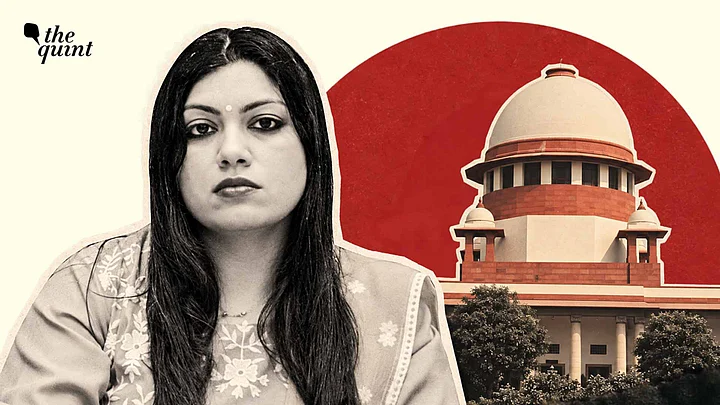
Last week, inside a Supreme Court courtroom, Justices Satish Chandra Sharma and N Kotiswar Singh swiftly ruled after hearing brief submissions from Solicitor General Tushar Mehta and Senior Advocate Mukul Rohatgi. The two-judge Bench stayed the Allahabad High Court's strongly worded order that had quashed the National Security Act (NSA) detention of Delhi University student Akriti Chaudhary and passed a Rs 5 lakh compensation order against Gautam Buddh Nagar District Magistrate Medha Roopam.
The HC, in its order, had described the DM's conduct as "worthy of derision"—and held her "guilty of violating her oath of allegiance".
The SC order on 23 September initially stated that "the operation of the impugned judgment, particularly paragraphs 27 to 33, shall remain stayed," which effectively stayed the entire HC judgment—including the core ruling quashing the NSA detention.
However, the Court subsequently revised its order the next day to clarify that the stay applied only to the strictures against the DM and the award of costs, not to the quashing of Chaudhary's NSA detention itself. The matter has been listed for further hearing on 7 October.
Roopam is the daughter of India's Chief Election Commissioner Gyanesh Kumar who's facing questions over his unilateral decision-making regarding the Special Intensive Revision (SIR) of electoral rolls.
There are two troubling questions, however, being raised in the aftermath of the SC order. One is the listing procedure itself. And, second, the cutting off of the courtroom audio midway through Rohatgi's submissions, isolating journalists, including court reporters, from the proceedings without warning.
Roasting the Roster?
According to the Supreme Court roster effective 13 July 2026, habeas corpus and preventive detention cases are explicitly assigned to the first four benches, including the bench led by Justice BV Nagarathna. Other detention cases related to the Noida workers' protest were already pending before Justice Nagarathna's court.
Yet, Roopam's petition was assigned to Justice Sharma, a bench that, according to the roster, does not handle such cases.
The roster is an internal division-of-labour mechanism of the Supreme Court. Its function is not merely administrative efficiency but a safeguard against case-specific assignment to particular judges.
The Roopam case involves preventive detention under the NSA, a harsh law that directly touches personal liberty. Under established roster rules, such cases do not fall within Justice Sharma's jurisdiction.
In connection to this incident, the Lawyers Association For Constitution (LAFC) has sent an open letter to the Chief Justice of India protesting the listing of two petitions filed over strictures passed against Roopam.
The letter, dated 24 September, objects to the matter being placed before a particular bench outside the ordinary roster, and to the muting of the video conferencing feed during the hearing.
“The out-of-turn listing of the case has received special treatment and tends to set a wrong precedent,” the LAFC wrote.
The letter noted that Roopam “also happens to be the daughter of the Chief Election Commissioner of India.”
LAFC wrote in its letter: "Special listing does not enhance confidence in the judicial process." When roster rules can be flexibly bypassed, when the basic judicial efficiency principle that "connected cases should be heard by the same bench" is ignored, the public has reason to suspect: for whom are the rules made, and for whom are they broken?
Audio Cut-Off: Who Is Afraid of the Record?
Cutting off courtroom audio midway is an act with substantive consequences, not a mere administrative oversight.
Between July and August 2026, the Supreme Court explicitly clarified that news organisations have the right to report courtroom proceedings. The relevant orders only restricted the use of audio-video clips, not textual reporting. If the purpose is to prevent "clip dissemination," why not inform journalists before the hearing begins? Why the sudden silence at a critical moment during a senior lawyer's submissions?
This selective, precisely timed silence produces exactly one effect: deterrence. It sends a signal to the journalists present—that certain content in this proceeding is not meant to be heard, recorded, or fully conveyed.
For courtroom reporting, real-time audio is the core tool for verifying statements, capturing tone, and confirming judges' reactions.
When audio is cut off, journalists can only rely on incomplete notes and after-the-fact recollection. This substantially weakens the accuracy and credibility of reporting.
LAFC pointed out in its open letter that cutting off remote access in a case involving a student detained under the NSA for participating in a workers' protest is "especially alarming."
The deeper problem is this: if a hearing about public official accountability can be "muted," what remains of the principle of open court? It is true that the Supreme Court's livestreaming rules grant the presiding judge the power to pause, mute, or stop the stream at any time using a remote control on the bench.
These rules were designed to protect "the dignity, security and privacy of judicial proceedings." However, the Roopam hearing was a full judicial proceeding about the conduct of a public official, not a sensitive matter involving personal privacy. No reason was recorded on the file. No explanation was provided. When proceedings can be selectively obscured, what the public sees is no longer justice, it is abuse of power.
The Supreme Court's 2021 judgment in Election Commission of India v MR Vijaya Bhaskar establishes that the freedom of speech and expression under Article 19(1)(a) extends to reporting judicial proceedings, and that citizens have a legitimate right to know what transpires in court.
A Bench of Justices DY Chandrachud and MR Shah held that the concept of an open court requires that information relating to court proceedings must be available in the public domain, and that arguments addressed before the court, the response of opposing counsel, and issues raised by the bench are matters on which citizens have a legitimate right to be informed.
The Court emphasised that public scrutiny is crucial to maintaining transparency and accountability, and that an open court system ensures judges act in accordance with law and with probity.
Rejecting the Election Commission's plea to restrain media from reporting oral remarks, the Court held that real-time updates about hearings are an extension of the concept of an open court and "not a cause of apprehension, but a celebration of our constitutional ethos."
The judgment is directly relevant to the Supreme Court's own conduct in the Roopam case.
The 2021 judgment also noted that courts in foreign countries, and even the Gujarat High Court, have started live-streaming proceedings, and warned that it would be "retrograde" for the Supreme Court to promote the rule of law on the one hand while gagging reporting of proceedings on the other. The audio cut-off in the Roopam case thus raises a troubling question: has the Court forgotten its own landmark ruling on the very freedom it now appears to be restricting?
What Was Stayed Is Precisely What Should Be Heard
The Allahabad High Court judgment deserves serious attention not because of the severity of its language, but because of the soundness of its reasoning. The division bench comprising Justices Atul Sreedharan and Achal Sachdev found that Chaudhary's detention under the NSA "lacked material support and was passed without application of mind."
The High Court specifically noted that Roopam, when the police report contained only allegations without credible evidence, failed to carefully examine the record before invoking the NSA, which is an "oppressive provision."
The Court's exact words were that Roopam's "conduct is worthy of derision" and that she "desired to set an example" out of the petitioner to deter others from exercising their right to freedom of speech and expression in public spaces in support of labourers.
More benchmark-significant is that the High Court not only quashed the detention but also ordered Rs 5 lakh in compensation to be recovered from Roopam's salary and from officers from the SHO upward.
This direction of pursuing individual liability breaks the bureaucratic convention of "collective decision-making, no one responsible."
The High Court also reminded IAS and IPS officers that their loyalty "is to the Constitution, not to the political executive." The Court warned that if the bureaucracy continued its "despotic" conduct, Uttar Pradesh could descend into an "Orwellian Dystopia."
Justice Sreedharan is not a radical activist. His judicial record shows a judge consistently concerned with the boundaries of public power.
During his time in Jammu and Kashmir, he repeatedly quashed arbitrary detentions under the PSA and UAPA. In one case, he imposed Rs 10,000 in costs on a district judge who ordered detention without sufficient grounds.
In another, he sharply criticised the government for using "copy-paste" national security threat rhetoric to support UAPA detentions, noting that state "apprehension" of internal security risks without evidence would lead to "overly oppressive application of harsh laws."
He also delivered a significant judgment in Uttar Pradesh on "bulldozer justice," invoking poet Bashir Badr's verses to condemn the state's arbitrary destruction of citizens' homes.
That a ruling by such a judge was swiftly stayed through procedural anomalies speaks for itself.
The criticism that was stayed—"conduct worthy of derision," "violation of oath of office"—was precisely the conclusion the High Court reached after detailed examination of the record. Whether these conclusions hold should have been tested through normal judicial process, not avoided through audio silence and listing anomalies.
Procedural Cracks and Judicial Trust
The SC order, and the revised order the next day, is itself puzzling: if the original order text already precisely pointed to "paragraphs 27 to 33" (the criticism and compensation portions), why use the phrase "the entire judgment"? Was this ambiguity intentional or a subsequent remedy? The outside world cannot know. But it did create brief confusion and reinforced the perception of "special treatment."
When the courtroom cuts audio midway, when a case is stripped from the established roster, when a DM becomes the focus of public opinion because of her father's position, the public has reason to ask: does the judicial process serve the law, or does it serve certain unspoken considerations?
Procedural justice is not formalism. It is the last line of defence constraining power. When this line itself develops cracks, even if only in perception and the only way to repair it is to place everything back under sunlight: disclose the reason the audio was cut, disclose the explanation for the listing anomaly, disclose a clear definition of the stay's scope.
Silence will not bring trust. It will only deepen suspicion. In a democracy, the strength of the judiciary comes precisely from its ability to withstand scrutiny. When the judiciary begins to avoid scrutiny, it will lose not only public trust but also its moral authority as a check on power. Let us hope the trust will be kept alive and be revived.
(Areeb Uddin Ahmed is an advocate practising at the Allahabad High Court. He writes on various legal developments. This is an opinion piece and the views expressed above are the author’s own. The Quint neither endorses nor is responsible for them.)