
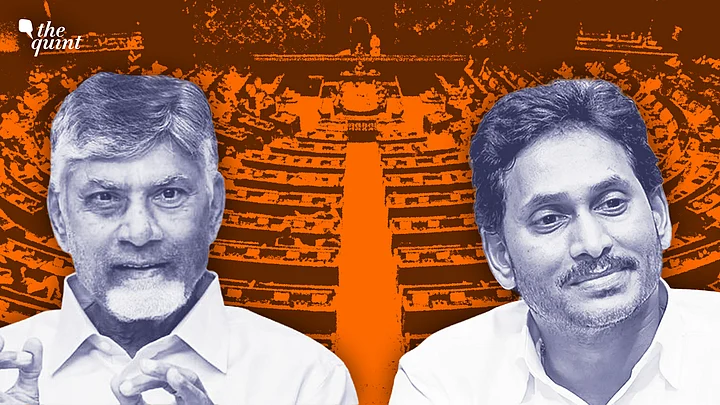
Despite the legitimate concerns from South Indian states, both Chandrababu Naidu and Jagan Mohan Reddy not only ordered their MPs to vote in favour of aborted 131st Constitutional Amendment Bill, but came out brazenly in defence of the Bharatiya Janata Party's (BJP) political and ideological project.
Chandrababu Naidu, in an exclusive interview to The Economic Times even before the Bill came to the Parliament, stated in unequivocal terms that the number of seats should be delinked from the Census. His tweet after the defeat of the 131st Constitution Amendment too, acknowledged the possible injustice to southern states if the number of Lok Sabha seats were linked to the Census.
Yet, the Telugu Desam Party (TDP)—an ally of the BJP-led ruling National Democratic Alliance (NDA)—extended its uncritical support to the 131st Constitution Amendment, despite it explicitly linking delimitation with the Census.
The Missing Safeguards in the Draft Law
The pretext is that the NDA government came out with the formula to assuage the feelings of southern state by offering 50 percent increase in seats for each state, though not mentioned in the proposed enactment.
But the NDA’s proposal, which Chandrababu Naidu mentioned, was missing in the draft of the proposed Bills. Why did Naidu not insist on the idea which he himself is advocating to be included in the text of the legislation itself? In the constitutional jurisprudence, oral assurances of ministers do not prevail over the text of the legislation.
Andhra Pradesh’s Own Precedent
Andhra Pradesh has experience in this regard. When the undivided state was bifurcated, genuine concerns were expressed by the Andhra and Rayalaseema regions—now constituting the residuary state of Andhra Pradesh—that they would be at a serious disadvantage, having lost their economic growth engine in the form of Hyderabad.
The then Prime Minister Manmohan Singh promised Special Category Status to the residuary state of Andhra Pradesh. This assurance was made in Parliament. Thus, the very bifurcation of Andhra Pradesh was predicated upon this promise.
Yet, the government led by Narendra Modi refused to accord Special Category Status to the state, arguing that there was no such provision in the Act and that the Finance Commission had recommended against it.
The Limits of Political Promises
In fact, the Finance Commission has never recommended against granting Special Category Status to Andhra Pradesh. It only stated that the concept had become redundant in the wake of the new devolution formula introduced after the 14th Finance Commission’s recommendations. In fact, the BJP was itself an advocate of Special Category Status, and the NDA benefitted from this promise in the 2014 elections.
How, then, can Naidu now be satisfied with an oral assurance from the Home Minister, without any legislative backing? He has accused Opposition parties of ensuring the defeat of the Constitution Amendment. His tweet reads:
“It is unfortunate that political agendas have prevailed over long term national interest. Those celebrating this outcome must introspect, we have lost an opportunity to secure a fair and constitutional safeguard for rightful representation.”
Contradictions in the Delimitation Argument
On the contrary, Naidu uncritically endorsed the Modi government’s proposed delimitation, which scuttles the "fair and constitutional safeguards for rightful representation" that he is talking about. It may be noted here that Naidu extended his 100 percent support for the Bills even before the Home Minister assured that official amendments would be introduced to assuage the Opposition on the eve of voting in the Lok Sabha.
Thus, Naidu was advocating for no link between population and number of seats, as such a measure would hurt the states, especially in South India that assiduously implemented the national objective of limiting the population and fostering economic growth.
But the Bill does exactly the contrary. It linked delimitation with population census and removed the freeze on increase of seats brought about by the Vajpayee government in 2001 precisely to address the concerns which now the South Indian states are voicing. In fact, Naidu, in his capacity as the convenor of the then NDA, was instrumental in influencing the Vajpayee government to institute such a constitutional safeguard. How can an oral assurance by the Home Minister replace a constitutional safeguard?
One Person, One Vote vs Federal Balance
Defending the delimitation proposal in Parliament, Amit Shah said that the existing freeze on the number of seats since 1976 violated the Constitutional principle of one person, one vote, and one value. Thus, Amit Shah’s argument contradicts Chandrababu Naidu’s demand not to link population with number of seats.
Section 8 of the Delimitation Bill mandates that the Commission allocate seats on the basis of the latest Census figures. The Home Minister’s assurance runs contrary to the provisions of the constitutional amendment and the Delimitation Bill. The Bills contain no mechanism to guarantee the existing proportion of seats, which N. Chandrababu Naidu is advocating.
Further, Article 81(2)(a) of the Constitution—retained unchanged—mandates population-based allocation of seats. How, then, can a uniform proportional increase be incorporated into the Bill in a manner that departs from this constitutional requirement? Even if attempted as a matter of political expediency, such a measure is unlikely to withstand judicial scrutiny.
The Politics Behind the Convergence
N. Chandrababu Naidu appears oblivious to the blatant mischief at play, given his political proximity to the Bharatiya Janata Party. Meanwhile, Naidu joined a protest organised by the National Democratic Alliance against the alleged betrayal of women by the Opposition.
On the contrary, Naidu has failed to question the necessity of linking women’s reservation with delimitation. He can even now impress upon Narendra Modi to bring in a simple amendment to the 106th Constitutional Amendment enacted in 2023. This law was notified on the eve of Parliament taking up the Constitution (131st Amendment) Bill and related legislation.
Such an amendment should drop the clause stating that one-third reservation for women will commence only after delimitation is undertaken on the basis of the first Census conducted after the commencement of the Constitution (106th Amendment) Act, 2023. This would enable one-third reservation for women to be implemented in the present 543-member Lok Sabha.
A Shared Political Calculation
Not surprisingly, given the past record, Y. S. Jagan Mohan Reddy joined his arch-rival N. Chandrababu Naidu in supporting the National Democratic Alliance’s political subterfuge.
The YSR Congress Party leader in the Lok Sabha, Midhun Reddy, sought a 50 percent increase in seats for every state within the Bill itself. Yet, Jagan’s party voted in favour of the Bill even though no such provision was incorporated. Midhun Reddy also pointed to the futility of oral assurances, citing the injustice done to Andhra Pradesh on Special Category Status. Sources close to Jagan say he cannot afford to be openly hostile to the Narendra Modi government, given the cases pending against him with central agencies.
Thus, both the TDP and the YSRCP refused to stand with the people of South India at a time when its political relevance in India’s electoral map is rudely under question.
(Prof K Nageshwar is a senior political analyst, faculty member of Osmania University, and a former MLC. This is an opinion piece and the views expressed are the author’s own. The Quint neither endorses nor is responsible for them.)
