
ADVERTISEMENTREMOVE AD

Monsoon Session—Delimitation Debate Must Move Past Reservation to Representation

The design of the delimitation process is as important as its outcome.

Published
story-hero-img
i
Aa
Aa
Small
Aa
Medium
Aa
Large

Earlier this year, the Constitution (131st Amendment) Bill, 2026, introduced during a special session of Parliament, fell short of the requisite two-thirds majority and was not passed. The Bill proposed to increase the size of the Lok Sabha, remove the freeze on the allocation of seats to states, and advance the implementation of women's reservation. It also formed part of a legislative package comprising the Delimitation Bill, 2026, and the Union Territories Laws (Amendment) Bill, 2026. 

However, these allied Bills escaped scrutiny and were barely discussed in Parliament or elsewhere, with the focus largely remaining on women’s reservation and the population-based allocation of seats. This amounted to missing the woods for the trees.

Despite the political messaging, the legislative package was largely about delimitation—an exercise that would be undertaken within states after two decades and nationwide after nearly 50 years. The framework for this exercise is provided in the Delimitation Bill. With reports suggesting the government may reintroduce the legislative package during the Monsoon Session, it is vital that the Delimitation Bill receives serious discussion. 

ADVERTISEMENTREMOVE AD

What is Delimitation?

Articles 81 and 82 of the Constitution envisage that the representation of states in the Lok Sabha must be in proportion to their respective populations and that such representation is to be readjusted after each census. Further, within each state, every constituency must, “as far as practicable”, comprise an equal population. The process of drawing these constituency boundaries is known as delimitation.

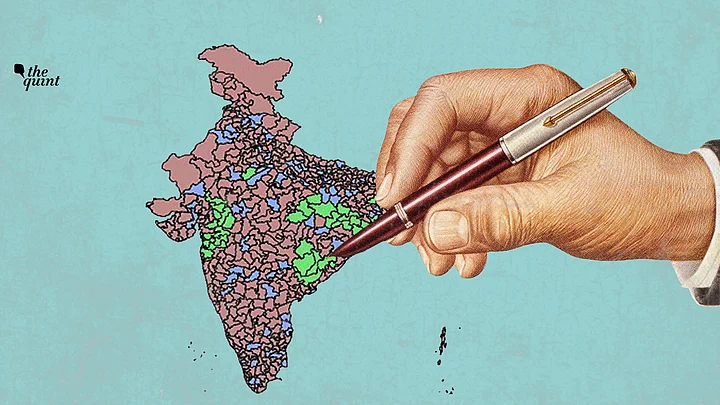
However, across the world, delimitation has often proved contentious, with governments accused of redrawing electoral boundaries to suit political interests and influence electoral outcomes—a phenomenon known as gerrymandering. A stroke of the pen can concentrate opposition voters in few constituencies or split them across several constituencies, thereby diluting their electoral influence.

An often-cited example is Chicago’s “Earmuffs” district in Illinois, where two geographically separate clusters of territory were connected by a narrow strip to create a majority Hispanic constituency. The resulting constituency resembled a pair of earmuffs connected by a headband.

In India, the courts have emphasised that delimitation must be transparent and equitable, terming it an essential component of free and fair elections. This is especially significant because the process is largely insulated from judicial review by virtue of Article 329(a), which bars challenges to delimitation orders before the courts. The design of the delimitation process is therefore as important as its outcome.

However, historically, the process has remained opaque and Executive-led. The 2026 Bill followed the same footsteps and largely adopted the framework of the Delimitation Acts of 1952, 1962, 1972, and 2002, all of which had significant concerns of opacity and Executive influence. 

An Executive-led Process

First, the Bill creates a three-member Commission, that shall determine how both parliamentary and legislative constituencies will be redrawn. However, the Commission is  largely executive appointed. The Chairperson is appointed by the Union Government, while the second member is the Chief Election Commissioner, another office in whose appointment the Union Government enjoys primacy. Since decisions of the Commission are taken by majority vote, the union government effectively enjoys a majority in the decision-making process. 

The Commission is further assisted by ten Associate Members drawn from the Lok Sabha and the concerned Legislative Assembly, nominated by the Speaker of the respective House. However, the Bill prescribes no criteria for these appointments. Historically, the ruling party has tended to secure a disproportionate share of nominations. For instance, in the 1972 Delimitation Commission, Congress nominees constituted over 55 percent of the Associate Members.

Second, the Commission is required to publish its proposals for the delimitation of constituencies and thereafter invite and consider objections and suggestions before issuing its final order. However, in the past, these proposals have not been accompanied by “working papers” which contain the methodology adopted by the Commission and the reasons for its key decisions, instead only the final proposals have been published.

These papers have not been made public even in response to applications under the Right to Information Act. To be fair, during the recent delimitation exercises in Jammu and Kashmir and Assam, the Commission did publish working papers which enabled civil society to analyse and critique the redrawing in some constituencies. However, this remained a matter of discretion, as the Bill imposes no statutory obligation to do so.

Making Delimitation More Transparent

The possible reintroduction of the Delimitation Bill presents an opportunity to reform India’s existing approach to delimitation. First, the process for appointing the Chairperson should be revised to make it less Executive-driven. A model similar to that endorsed by the Supreme Court for the appointment of the Chief Election Commissioner could be adopted, whereby a selection committee comprising the Chief Justice of India, the Prime Minister, and the Leader of the Opposition selects the Chairperson.

This would ensure that the Chairperson commands bipartisan support and dispel allegations of Executive dominance. It must be noted however, that for the CEC, the Parliament subsequently replaced this model with a committee dominated by the Executive. 

Similarly, to make the Commission more representative, the Bill must provide that Associate Members are drawn from different political parties, geographical regions, and population groups within the State. Such a requirement would make the Commission more inclusive and representative of different political parties, encourage bipartisan confidence in the delimitation process, and reduce the scope for political contestation.

Further, the Bill should make it mandatory for the Commission to publish working papers alongside its proposals. These papers would set out the methodology adopted by the Commission and explain the reasons for its key decisions. This would not only enhance transparency and help dispel allegations of political misuse, but also facilitate the limited judicial scrutiny that remains available.

The Courts have held that, notwithstanding the bar under Article 329, delimitation orders may be challenged in exceptional cases where they are found to be “manifestly arbitrary and irreconcilable with constitutional values”. Requiring the publication of working papers would make that limited judicial review more meaningful.

Delimitation will reshape India’s political map. Alongside changes to the delimitation procedure, the government has also proposed amendments to the Constitution that remove the freeze on the population-based allocation of seats, as well as the requirement of conducting delimitation after every census based on updated population data, leaving both the timing of the exercise and the choice of census data to be used to the discretion of the Delimitation Commission.

The latter is particularly crucial, as the Commission would function in accordance with a law enacted by Parliament, and resultantly, questions relating to the timing of delimitation and the census data to be used would be governed by ordinary legislation amendable by a simple majority, rather than by constitutional provisions that can be altered only through the special majority required under Article 368.

It is, therefore, imperative that the Parliament looks beyond the largely uncontested issue of women’s reservation and debates the process of delimitation itself, with a view to making it more transparent and inclusive.

(Swapnil Tripathi leads Charkha, the Constitutional Law Centre at the Vidhi Centre for Legal Policy. He specialises in constitutional law and administrative law, with a particular focus on constitutional interpretation and judicial review. This is an opinion piece and the views expressed are the author’s own. The Quint neither endorses nor is responsible for them.)

Speaking truth to power requires allies like you.
Become a Member
Monthly
6-Monthly
Annual
Check Member Benefits
×
×