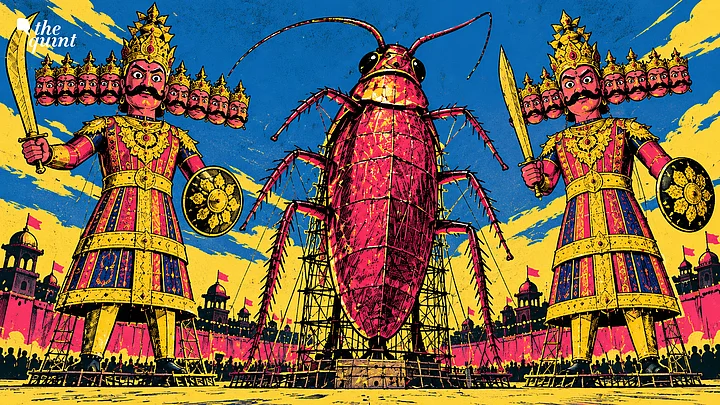
The cockroach effigy at a Ramlila in Delhi offers an ideologically pure moment to unpack Brahmanism: the ideology of India’s enmeshed economic and political elites. The cockroach effigy should be seen in a long line of spectacles that elites have historically invested in to speak to a wider audience. In the past, there have been effigies of naxalism and terrorism.
Starting from the late 20th century, Ramlila festivals have drawn heavy crowds in parts of north-India. Historian Sandra Freitag, who studied prominent urban centres in north India, argued that in 1911 the British administrators were alarmed by the numerous innovations that were introduced in the staging of Ramlila. Freitag, notes that from the organisation to its reception Ramlila festivals drew a wide-based support, making it hard to find ― any activity which expressed more directly the ideals and tastes of the entire Hindu public of a North Indian town. The cockroach effigy showcases elite Brahmanical anxieties that which are being universalised through the Ramlila festival.
Who Funds Ramlila festivals?
A look at the surnames of those who head Ramlila committees shows that it is mostly headed and funded by Baniya and Brahmin men. For example, the current president is Ashok Goel, an Agarwal Chartered Accountant, a millionaire, and a BJP MLA. He was preceded by Akhilesh Pati Tripathi, an aspiring Brahmin civil services aspirant and an AAP MLA. Amongst the baniyas in Delhi, the funding comes from businessmen who own family-owned, local, and small and medium enterprises (SMEs). These are India’s vernacular or provincial capitalists.
Funding Ramlila is part of an eco-system of extra-curricular activities that noted businessmen/business turned politicians undertake, often in the name of philanthropy or social work to differentiate themselves in a close-knit informalised economic eco-system and establish credibility in their caste kinship networks. It is also a creative space that allows internal disputes in business to spill over into the extracurricular and be resolved peacefully. Members of the Shri Keshav Ramlila Committee from Pitampura (North-West Delhi) have decided to show their competition that they are the most politically astute Ramlila actors by funding a 30-foot-tall cockroach effigy.
Elite Political Imagination
When Goel was asked the reason behind having an effigy of a cockroach, he replied, “the insect represented filth and dirt”. Furthermore, he said that “burning the cockroach effigy is meant to reinforce the message of the victory of good over evil and cleanliness”. Why is there such an obsession with hygiene? In the political imagination of elites, they are not just crushing the lower class of this country; they specifically want to disenfranchise 13.3 crore Dalit, Bahujan, Muslim, and woman voters from the electoral rolls nationwide. Using the Brahmanical principle of purity and pollution, the elites think, that just because the marginalised clean their filth, they are also filthy. In the Brahmanical logic, the body of the marginalised is intrinsically polluting. Erasing them from the voters list and dismantling public infrastructure of education, mobility and clean fuel in the elite mind is an act of cleaning the democratic body politic of filth. Sahil Wakhode’s institutional murder by IIT Mumbai, is within this Brahmanical logic of ensuring that the very few who gain mobility will be shown their place. The Cockroach Janata Party (CJP) protests and the growing movement demanding accountability for Sahil are joined on the hip and should be combined for the fight is against the country’s elites and their narrow political imagination.
The CJP 2.0 protests have demanded the resignation of baniya civil servant Gyanesh Kumar, a Chief Election Commissioner (CEC) who has an entire family, including a son-in-law who is a civil servant. Gyanesh is part of the inner circle of the political elites who played a central hand in everything from the abrogation of Article 370 to the Ram Janmbhoomi trust. I write from South Africa, where land dispossession was followed by political disenfranchisement completing the colonial and apartheid projects of elite domination legalistically. CJP 2.0s call to protect the marginalised citizen’s right to vote has an epic significance. Economists estimate that 60% of India’s total wealth is held by “upper” or Hindu high Castes. The economic dispossession of the marginalised in India has historically continued, but this is the second time in India’s independent history, that their political dispossession is underway. As a poster on social media says, “At least Indira Gandhi had the uterus to declare an emergency an emergency!”. The Special Intensive Revision (SIR) is India’s version of South Africa’s legalised exclusion —effectively apartheid — and needs to be stopped by all accounts.
From the images online, the cockroach effigy is as big as that of Raavan, Meghnad and Kumbhkaran. Imagine, the elites are so scared, that the humble young cockroach has reached such epic dark proportions. Historian and cultural theorist, Kajri Jain, argues that the forms of violence towards images are a continuum of the violence against humans. History is testament, that the dehumanisation of sections of the population, is the first step in legitimating violence against them. Just in case you saw Ramlila as a harmless cultural festival, the sarkari (government) footprint has been added by linking sanitation schemes like Swachh Bharat and Swachh Delhi with the effigy. The cockroach effigy showcases Indian elite deepening anxieties.
(Dr Ujithra Ponniah is a senior researcher at the Southern Centre for Inequality Studies (SCIS), University of Witwatersrand, Johannesburg. She is the author of Becoming Agarwal: The Manufacture of a Close-Knit Mercantile Caste, Cambridge University Press (CUP), 2026.)