
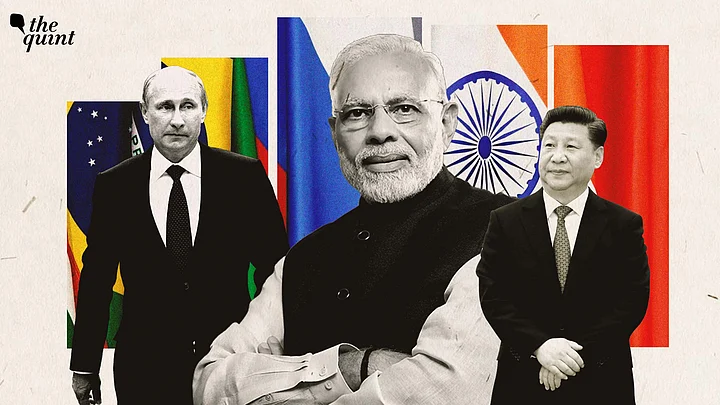
Set to occur amid a burgeoning new world order, the 18th BRICS Summit is scheduled for 12-13 September.
Crises in the West and Ukraine highlight the inadequacies of multilateral institutions. The dollar's role in economic interdependence, weaponised through statecraft, has sparked sanctions, tariffs, and technology limits to serve different ends. Middle-tier nations do not so much enter into new geopolitical alignments as pursue adaptive partnerships.
Although BRICS is now much larger, its increased diversity has been both a blessing and a curse for the bloc, as power and influence shift with every new member. India will be an exemplar of how states can avoid bloc politics by continuing their mutually beneficial engagement with both Russia and the Quad.
This is clearest in New Delhi’s decision to resume high-level boundary talks with China.
The China Matter
When National Security Adviser Ajit Doval sat down with Chinese Foreign Minister Wang Yi in Beijing on 25 August for the 25th round of Special Representatives’ discussions, it was a sign that both parties understand the price of letting a border dispute dictate the whole of their relationship. However, geography does not allow for a permanent standoff. An extensive border, shared membership in multilateral organisations, and substantial economic interdependence connect India and China.
They have agreed to keep the peace on the border, open two more military hotlines, set up new venues for senior commanders to meet and, not least, push forward with boundary delimitation—one achieved through years of struggle to follow the four-year standstill and the deadly incident in 2020 along a frontier over 3,800 km (2,300 miles) long that remains contested.
However, despite strategic mistrust, India and China are politically and economically interconnected and remain each other's largest trade deficit. Confrontation will not counter this challenge, nor will accommodation. India must balance deterrence, negotiation, and trade in its strategy, giving each equal weight.
Border stability will provide political space for India to manage competition and the incessant risk of escalation. Chinese President Xi Jinping’s frustration with New Delhi is significant, though not a radical reconfiguration. Instead, it is a more sustainable and stable form of cohabitation in which competition exists, but without spiralling out of control.
The BRICS Summit is likely to repeat this trend, unless India presents an unconventional solution.
The Russian Concern
India’s long-standing relationship with Russia is also experiencing difficulties. However, after October 2023, the US's influence might extend further. India's External Affairs Minister S Jaishankar's talks with Russia officials on 23-24 August on trade, energy, and technology helped maintain continuity, given Russia’s established role as a defence ally and diplomatic supporter of China.
However, that link is not as persuasive. The escalating partnership between Russia and China poses considerable challenges for India regarding the Eurasian balance of power. Despite a quadrupling of India-Russia trade to $13 billion in 2021-22, with projections of nearly $60 billion by 2025-26, the trade deficit has also surged, increasing from $6.6 billion to over $50 billion. India aims to stay close to Russia as China-Russia ties grow.
Despite this, New Delhi’s goal is to develop a pluriversal Eurasia, unburdened by past regrets. This explains, in part, why India will keep pushing back against a simplistic Western versus anti-Western framing of its foreign policy.
It can work with the US, Japan, and Europe while maintaining a strategic partnership with Russia and managing relations with China. These seemingly opposite pursuits have been pursued deliberately to maintain balance and avoid relying too heavily on one pole of power. However, these actions on both sides are only a part of the larger problem India faces as BRICS leader.
What's on the BRICS Menu?
The BRICS Summit in New Delhi will face a critical question: can the expanded and more diverse group effectively wield its political influence? The answer will be showcased at an event themed “Building for Resilience, Innovation, Cooperation and Sustainability.”
Global governance will top the agenda. BRICS nations generally concur that current global institutions, such as the UN Security Council, the International Monetary Fund, World Bank, and World Trade Organisation, fail to reflect the Global South’s population and economic strength. We still need to see if they can do more than just broadly advocate for representation and draft joint proposals for institutional reform.
Economic resilience is another matter of concern, given the headwinds of tariffs, sanctions, sovereign debt, and supply-chain issues. Expect talks on how to integrate payment systems more closely, foster central bank cooperation, and perhaps make their digital currencies interoperable. The aim is not so much to put forward a common BRICS currency overnight as to cut transaction costs and insulate themselves from the vagaries of dollar-centred finance.
In that vein, the New Development Bank will be in the spotlight. members will want to see it expand lending in local currencies and fund infrastructure without the kind of conditionality one finds at more established institutions.
The cluster of climate and sustainable development poses a grave challenge to the organisation. Here, members have to find a way to square their reliance on fossil fuels with the need for energy security and a just transition that does not penalise developing economies. A united front on emissions may be elusive, but there is more promise in working together on critical minerals, public health, or climate-resilient agriculture. Technological sovereignty will also be a prominent feature.
BRICS is sure to push for inclusive rules on artificial intelligence and better access to the computational resources needed for development, as a counter to a digital order run by a handful of Western firms.
On the security side, the conversation will range from cyber threats and maritime routes to the conflicts in Ukraine and West Asia and unilateral sanctions. Still, divergences between members could mean any diplomatic initiatives are the product of careful negotiation rather than a collective move.
India's Autonomy in the Global Coalition
The New Delhi summit will also have to discuss the future of BRICS. Its growing portfolio has simultaneously highlighted differences in political systems and regional goals. Leaders will have to uphold the quality of participation and make sure agreement is not confused with inertia. In the end, no single climactic declaration will come out of New Delhi. Whether BRICS is here to stay ultimately depends on its ability to follow through on a few tangible, implementable projects, whether in development finance or climate resilience, that can demonstrate that at least some component of BRICS can deliver public goods for the Global South.
India’s participation in BRICS is crucial for its efforts to form a global coalition focused on power sharing. Acting in such a manner would imply an unwillingness to employ that coalition for China’s purposes or to turn against the West openly. Replacing one hierarchy with another would be counterproductive.
India’s preferred arrangement is both pluralistic and multipolar. Strategic autonomy enables diverse connections, negating the necessity of loyalty to singular alliances. India faces a strategic hurdle with both relationships. India should avoid hierarchies where its strengths are weaker. It needs to hold back only when it has more power.
The current global landscape may push India's strategic autonomy to evolve from a passive stance to a proactive strategy to counter asymmetries. The BRICS summit could be a significant test case in this direction.
(Shibashis Chatterjee is Professor, Department of International Relations, Jadavpur University. This is an opinion piece and the views expressed are the author's own. The Quint does not endorse or is responsible for the same.)
