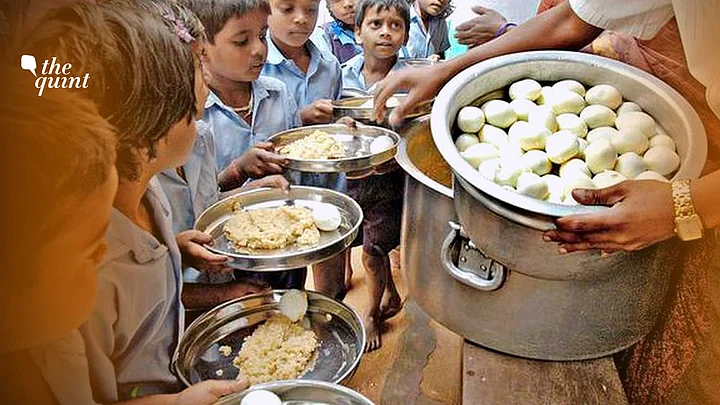
In what is being seen as the first government-sponsored move in West Bengal to promote vegetarianism, eggs are set to go off the mid-day meal platter in schools in Kolkata.
This move comes less than two months after the state witnessed an intense political battle over culinary practices. Mamata Banerjee’s Trinamool Congress (TMC) alleged that the Bharatiya Janata Party (BJP) would ban eggs, fish, and meat should they come to power. The BJP countered the charge uniquely—many of its candidates carried large fish during their campaign.
Nevertheless, the state’s first BJP government’s first budget on Monday proposed handing over the mid-day meal services in areas within the Kolkata Municipal Corporation (KMC) limits to the International Society for Krishna Consciousness (ISKCON). This Hindu religious organisation promotes vegetarianism.
What To Expect From ISKCON's Meal Plan
The government did not say anything about the food items. However, ISKCON is a purely vegetarian organisation. ISKCON Kolkata spokesperson Radharaman Das confirmed to The Quint that they would be serving vegetarian meals. He insisted that the nutritional value of eggs are adequately supplemented by veg items in their meals.
According to him, ISKCON has been serving mid-day meals since 2004, currently operating in 21 cities in eight states where they serve 1 million students daily. Their fully automated kitchens maintain “5-star cleanliness.” They make sure no food is touched by hand. Even chapatis (Indian breads) are machine-made. The cooked food is always carried in sealed stainless steel containers.
“Children love our food. Dietitians prepare our menu. We serve soya chunks, rajma daal, paneer and beans alternately. The protein intake remains the same as meals that include eggs,” said Das. He added that they have only heard of the government announcement and their teams will start interacting with the government soon.
Why Controversy is Inevitable
“ISKCON will serve the mid-day meals. You don’t need to chant Hare Krishna if you don’t want to,” said West Bengal Chief Minister Suvendu Adhikari.
It, however, is less of a question of religion than nutrition and culinary practice. India's mid-day meal scheme, now called PM POSHAN, has been running since 1995. It provides hot cooked meals to children in government schools up to the upper-primary level. Since 2001, children have been legally entitled to a daily hot meal totalling 700 calories and 20 grams of protein, with eggs included on some days.
As of now, West Bengal has been providing two eggs a week per child or mother at anganwadis. A vegetarian mid-day meal in Kolkata is set to trigger controversies. The city and the state are overwhelmingly non-vegetarian.
However, the Rashtriya Swayamsevak Sangh (RSS), the ideological-organisational parent of the BJP, is a vegetarian organisation. People involved with the RSS may consume non-veg food at home or outside, but it is not allowed inside any RSS office. Last year, RSS chief Mohan Bhagwat had said that government policies should promote vegetarianism.
During that event in Bengaluru on 9 November, 2025, he had argued that in Bengal, Assam and Odisha, fish is not considered non-veg but as “fruits of water.” Due to waterlogged soil, there was no production of daals—chana, arhar, artur, urad—leaving no other source of protein except fish. “Now, the situation has changed, but the habit does not go away. So, we have to bring about these changes,” Bhagwat said.
The decision to hand over mid-day meal supply in Kolkata’s schools to a vegetarian organisation might just be the beginning of the changes that Bhagwat apparently desired. Denying eggs in mid-day meals has become quite common in BJP-ruled states–Madhya Pradesh, Maharashtra, Chhattisgarh and Goa, among 12 states. All of them are run by the BJP directly or in coalition.
The Issue Of Malnutrition
The developments are coming even as India has been battling a nutrition problem, especially among children. As much as 12 percent of the country's population suffers from malnutrition. Among children under the age of five, 35.5 percent are stunted, 32.1 percent are underweight, and 19.3 percent are wasted (low weight for height).
Data from 2018 shows India at the very bottom among the world's 25 most populous nations in terms of the consumption of animal-based foods—such as meat, fish, eggs, milk, and cheese—ranking lower than Africa’s Tanzania.
To tackle the issue, the Karnataka government announced in 2024 that it will provide one egg six days a week. Tamil Nadu and Andhra Pradesh serve it five days a week, while in Telangana it’s served thrice a week. All are non-BJP governments.
According to the fifth National Family Health Survey (2019–21) report, 98 percent of people in Bengal consume meat, and 99 percent consume fish. Among the country's major states, Bengal records the highest expenditure on non-vegetarian food, with 20 percent of the total food budget allocated to it. In contrast, non-vegetarian food accounts for only 2 percent, 3 percent, 4 percent, and 5 percent of total food expenditure in Gujarat, Rajasthan, Haryana, and Madhya Pradesh, respectively.
Kolkata-based dietitian Sanchita Sil told The Quint that soya chunks or rajma daal cannot fully supplement egg’s nutritional values, it needs to be paired with milk, chhana (cottage cheese) or curd. Even then, it's difficult to supplement eggs. Besides, eggs make students feel full for a long time.
“Eggs contain all nine essential amino acids, which makes them a complete protein. Besides, eggs contain vitamin B12, vitamin D, healthy fat, and iron, sodium, magnesium, etc. There is no easy supplement for eggs.”Sanchita Sil
A 2024 publication by the Indian Council of Medical Research (ICMR) sttes that 14 percent of total dietary energy intake should come from pulses or animal-based protein sources. However, for the average Indian, this figure stands at only 6 percent to 9 percent. They attribute this to the high cost of pulses, fish, and meat, which prevents most people from consuming them in adequate quantities.
It also said that animal foods like milk, meat, fish, and eggs and plant foods such as pulses are rich sources of proteins, but animal proteins are of high quality. They are bioavailable and provide all the essential amino acids in right proportions. Plant or vegetable proteins are not of the same quality due to their low content of some of the essential amino acids.
What Opposition Parties Have To Say
The decision to hand over Kolkata’s mid-day meal services to ISKCON had also triggered concerns among the mid-day meal cooks. The Paschim Banga Randhan Kormi (mid-day meal) Union protested the move, saying that this could mean loss of jobs for those who were cooking in those schools.
“We, too, are apprehensive that children will be deprived of required nutrition due to this move,” said Jayashree Das, secretary of the organisation.
While this could have been an ideal protest topic for the Trinamool Congress, the party is currently in a mess due to organisational splits. Left parties, however, are keeping a close watch. “Let the information be public and official that ISKCON will not serve eggs. Our student organisations will surely protest it,” said a CPI(M) leader who did not want to be named.
(Snigdhendu Bhattacharya is a journalist who writes on politics, history, culture, environment, and climate change. He has authored books on leftwing insurgency and Hindu nationalism.)