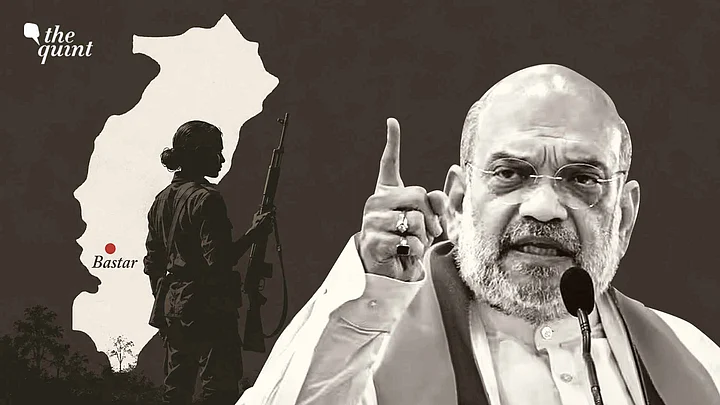
On the morning of 18 May, as I leafed through a local Hindi newspaper in Chhattisgarh, I stumbled upon a full-page advertisement glowing with a never-out-of-fashion catchphrase: 'Bastar Mein Vikas' (Development in Bastar).
The advertisement had photographs of Prime Minister Narendra Modi on the left and Chhattisgarh Chief Minister Vishnu Deo Sai on the right. But the hero of the show was Home Minister Amit Shah, who was seen posing with a group of people, presumably and expectedly from Bastar, as one could guess by looking at the stereotypical representative markers that were all in place: the sikka mala (coin necklace) around the woman’s neck, the headwraps on the men's forehead, and so on.
The text in the advertisement read: "We welcome our honourable Union Home Minister and Minister of Cooperation, Mr Amit Shah, to Bastar for the first time after the end of Naxal terror."
Other details that were hovering over the massive spread of the paper presented the itinerary for his daylong visit, which included inaugurating a Jan Suvidha Kendra (public convenience centre), paying homage to martyred soldiers, and meeting with victims of Naxal violence and their families.
Amit Shah's Consistent Initiatives in Chhattisgarh
Since the Bharatiya Janata Party (BJP) won the state Assembly elections in 2023, Shah has repeatedly visited Chhattisgarh to hold anti-Naxal strategy meetings. In those visits before 31 March 2026, he also often declared that he will bring an end to Naxalism in the country before that date.
Interestingly, his visits were not just limited to strategy meetings with police and paramilitary officials.
Over the last two years, he addressed various gatherings of thousands of people, including the state-sponsored cultural festival Bastar Pandum; sports festival Bastar Olympics; and the popular and iconic 75-day-long public festival of Dussera (not the Hindu Dussehra).
In 2024, during the closing ceremony of the Bastar Olympics, the home minister stated that the sports festival, which saw the participation of lakhs of Adivasi children, will mark a new chapter in the development of Bastar towards the direction of annihilating Naxalism.
He said the sports initiative will prevent youth from "taking the wrong path" (joining the Maoist movement). Emphasising words like 'peace', 'security', and 'development', Shah hoped that, when the same sports festival is held in 2026, Bastar will witness a profound change—as Naxalism would have been eradicated by then.
In the closing ceremony of Bastar Pandum this year, Shah claimed that the participation of more than 50,000 people in the programme meant that Bastar is becoming free from the fear of Naxalism. He reiterated that Bastar will be shaped as the most developed region among all tribal areas in the country.
Regardless of the nature of these events, his speech always promoted the idea of 'Naxal-mukt Bastar' (Naxal-free Bastar), eradicating Left-wing extremism, and asking Naxalites to give up arms, surrender, make use of the rehabilitation programmes, and join the mainstream.
Last year, during Dussera, Shah again highlighted that Bastar is not able to develop because of Naxalism—and assured that Naxalites will be eliminated by 31 March 2026.
These recurrent announcements of eradication, as if referring to some disease or infestation, juxtaposed with imagery of development, were generated on the grounds of a very heavy and elaborate increase of the military force and its operations in the Bastar region.
In 2025, Bastar Police established 52 forward operating bases in Sukma, Narayanpur, and Bijapur.
Execution of 'Operation Black Forest' in the Karreguttali Hills caused the death of 27 Maoists. As many as 54 were arrested, and 84 surrendered across Chhattisgarh, Telangana, and Maharashtra.
Launched in 2024, 'Operation Kagaar' was designed as the final mission to put an end to Maoism by 2026 through aggressive proliferation in military personnel and the deployment ofadvanced surveillance technologies.
Human rights organisations have periodically questioned the use of force in situations of internal armed conflict and raised concerns about the massive number of extra-judicial killings of security personnel, Maoists, and innocent villagers.
Peace Talk Offers By CPI(Maoist) Rebuffed
Following the continuing deaths, when the Communist Party of India (Maoist) [CPI(Maoist)] proposed a ceasefire and requested peace talks, no formal response was given by the government.
The CPI(Maoist)’s proposal also called for temporarily halting the armed struggle and requested a meeting with Shah. However, no discussions ensued.
By December 2025, more than 1,500 Maoists were estimated to have surrendered. As per Bastar Police, 256 Maoists, 23 security personnel, and 46 civilians were killed in 2025. Those killed included Madvi Hidma, a top-ranking Adivasi leader who died allegedly during an encounter.
Frequent news of surrenders marked the whole of last year. A former Politburo member, Mallojula Venugopal (also known as Sonu Dada), along with over 60 associates surrendered on 15 October last year in Maharashtra’s Gadchiroli district.
In February 2026, around 50 Naxalites, including over 30 women, surrendered in two districts under the Bastar division. As the March-end deadline approached, more cadres, along with key leaders, surrendered.
On 30 March, in a rather long reply to the discussion in the Lok Sabha on the efforts to free the country from Left-wing extremism, Shah claimed that a "Naxal-free India" is one of the most historic successes of the Modi government. He gave due credit to the CAPF, the jawans of COBRA and the CRPF, the state police, and District Reserve Guard (DRG). He also reiterated that Bastar had lagged because of the shadow of 'Red Terror'. Now that it has been eradicated, he said, Bastar is developing.
He also furnished the combined figures for 2024, 2025 and 2026, which amounted to a total of 706 Naxalites killed in encounters till March 2026, 2,218 arrested and sent to jails, and 4,839 who surrendered.
What do these numbers really mean to the state, to the people of Bastar?
Is India Really 'Naxal-Free'?
Last month, as the front pages of several Hindi newspapers were filled with the details of the home minister’s visit, the biggest news was India is now ‘Naxal-free’.
Shah said the Modi government had triumphed over the country's three major internal security challenges: Kashmir, the Northeast, and Naxalism. With a developed Bastar, he said, the dream of Viksit Bharat 2047 will come to fruition. He also added that the Maoist revolution in central India has finally been exterminated.
The most audacious and existential of all claims was this: the nation gained independence on 15 August 1947, and it is only after 31 March 2026 that Bastar has finally walked into freedom.
Over the next five years, the home minister said, the government will try to work on the loss and suffering that permeated the lives of the people of Bastar because of Naxalism in the last 50 years.
A big question in this supposedly post-conflict transition (although the state never seems to use the words 'conflict', 'war', or 'genocide') is: What will happen to the military and police camps?
Will the home minister demilitarise Bastar? As one of the most militarised regions in India after Kashmir, will the state withdraw the police forces since the region is deemed liberated from, as erstwhile prime minister Dr Manmohan Singh once called it, the "gravest internal security threat"?
The home minister has masterfully maintained strategic silence about what he plans to do with thousands of soldiers deployed in the region. What will the local forces, such as the Bastar Fighters, which is especially targeted towards hiring young Adivasi boys and girls, do now?
Is It Really So Easy To 'Repurpose' Police Camps?
Well, he did say that these police camps will be repurposed. That around 70 of the 200 existing police camps will be converted into seva camps or public service centres, which may function to provide facilities like groceries/ration, Aadhaar/Ayushman Bharat cards, health check-ups, and may also run Anganwadi centres.
The home minister also innagurated the Jan Suvidha Kendra inside the Bravo company campus of the CRPF’s 80th battalion in Netanar village (the birthplace of legendary freedom fighter Gundadhur).
It is unnerving to imagine all this. How is it possible that the camps, which were once a scary, dreadful place where the local Adivasi people were detained, interrogated, beaten, and abused, can ever become spaces where they can walk in freely? Is it possible to carry out a spatial rearrangement that can erase painful memories of violence from the consciousness of people?
How can one forget the multiple peaceful anti-militarisation protests that happened in the past few years in Bastar when thousands of Adivasi people gathered to oppose the illegal (as per the Panchayat Extension to Scheduled Areas Act 1996) construction of security camps in their villages?
The memorial for those four people were killed by CRPF soldiers in the Silnger village in 2021 during a peaceful march was built near the camp and is an unfailing testimony of the violence that had taken Adivasi lives. Is it that easy to just convert a military camp, which has a horrifying history of being a space from where oppressive forces operate with guns and bombs and drones, into a seva camp where people could just walk like children fearlessly run in and out of a village Anganwaadi centre with plates of food in their hands?
Shouldn’t the first decision about camps be to consider the demilitarisation of the region rather than thinking about providing certain services?
Shouldn’t the state worry about a pathological normalisation of the powerful, and the intimidating presence of camouflaged soldiers with massive weapons on their shoulders, walking, patrolling, opening roads, wandering all across the Bastar?
Shouldn’t the state first consider taking back all the armed power and perhaps return the land to the villagers or let the Gram Panchayat decide what to do with that land and infrastructure? Shouldn’t forests also have the right to grow on these occupied lands?
What's the 'Post-Naxalism' Future of Bastar?
Bastar 2.0, as the chief minister calls it, is a proposition of a new and developing Bastar that aligns with the prime minister’s vision of Viksit Bharat 2047. According to the visionaries who sit on the thrones of the state machinery, it is time to look forward to the next phase of Bastar’s development.
The blueprint that the chief minister provided to PM Modi consists of several projects like new educational cities, super-speciality hospitals, medical colleges, railway networks, airport facilities, generating employment opportunities, improving access to essential services, completion of pending works under the Pradhan Mantri Gram Sadak Yojana by 2027, universal electrification, permanent buildings for 45 Pota cabins schools, 15 stadiums, healthcare infrastructure, irrigation coverage to nearly 31,840 hectares of land, and much more.
The gaze is set in the future. But staring into tomorrow doesn’t mean we can forget the past.
Remember the incident in March 2011 when, in Tadmetla, more than 200 houses in three villages were set on fire? The Central Bureau of Investigation (CBI) investigated and confirmed that the houses were torched by security forces that included 323 police officials and 95 CRPF/COBRA personnel. In the Sarkeguda firing in 2012, 17 innocent people, including seven minors, were killed by a combined team of CRPF and police personnel.
Eight people, including four minors, were killed in May 2013 when the CRPF opened fire on villagers who had gathered to celebrate Beej Pandum in Edesmetta.
A judicial panel report confirmed that those killed were neither Maoists nor armed. As stark as it can get, the Edesmetta firing incident occurred in 2013, and the investigation report was submitted to the Chhattisgarh cabinet after eight years in 2021, tabled in the Chhattisgarh Legislative Assembly in 2022, and yet it does not name any individual for prosecution or punishment. It does not order arrests, convictions, or jail terms for the CRPF and police personnel involved, and just rests the case by suggesting that the incident was an outcome of operational failure and panic firing.
I have only mentioned a few older cases that were taken into judicial enquiries. There are many uncounted and undocumented incidents of alleged killings and of human rights violations that have not been highlighted by the media or taken to the courts.
Will There Be No Accountability for Police Brutality?
You hear them as you talk to the survivors, and I cannot cite the validity of these told truths. But many fact-finders, lawyers, and activists do reveal truths and publish reports that need more attention.
In an independent fact-finding report, it was alleged that six innocent people from the Kummam and Lekavada villages in the Bijapur district were killed and branded as Maoists by police forces in December 2024.
Several minors were also injured, including a young teenage girl who was shot but miraculously survived. Even after the media reports and press conferences by local activists to condemn the killing of ordinary villagers, the state refused to say anything about this.
The killing of a six-month-old baby girl, Mangli, in early 2024, smashed all sorts of pretensions that security forces portray. It exposed the fact that not even children are spared from violence.
Young local human rights defenders like Raghu Midiyami and Suneeta Pottam, who, along with many other young boys and girls, formed Moolwasi Bachao Manch, are still in prison for raising their voices against state violence. What would Bastar 2.0 mean for the Adivasi activists who have spent decades fighting against notorious atrocities and are allegedly accused of being 'anti-national' and 'anti-development' for exercising their right to protest?
Forgotten amidst the frenzy of news about encounters, arrests, surrenders, and killings are the sexual violence cases. In multiple reports and booklets, the Women Against Sexual Violence and State Repression (WSS) have highlighted, in horrifying detail, the testimonies of women who were sexually assaulted, molested, raped, and gang-raped. How is the new Bastar going to bring justice to these women? and respond to the massive level of sexual violence perpetrated by the police personnel in the last decade?
In an analysis piece published in The Wire this year, professor Nandini Sundar, who's a longtime observer of Bastar, highlights the heinous manner in which this government has acted to bring an end to Naxalism and asks if it is now possible to locate accountability for the lives lost, dislocated, and wasted. She noted that the end of Naxalism means the end of accountability for two decades of killings, displacement, and impunity.
Is it possible to take responsibility for all the deaths, rapes, burning of villages, and displacement of people caused by either police forces or the Maoists? As Sundar notes, “... there may be peace now, but it is a peace without justice.”
Here, I will echo her suggestion. Instead of thinking of 101 ways to keep the military intact, camps must be dismantled. The loud noise of dismantling should reach the villages. Lands must go back to the people and their villages, and back to forests. If we agree on the word 'conflict' that marked the last many decades of Bastar, we may as well say that the region is moving into a new post-conflict time (although many don’t agree that it is over yet).
Apart from the loud drumming and dreams of vikas, it is not too much to ask for a post-conflict plan that attends to some critical questions: how to live with dignity in a place that has suffered and witnessed unbearable violence and abuse in the last three decades? How do we imagine healing in Bastar? How to ensure justice that is pending for the innocent people rotting in prisons? And how will justice look in an area infamous for human rights violations? How to really demilitarise Bastar? How do you really bring peace with justice?
Can local people, community leaders, surrendered ex-Maoists, activists, workers, NGOs, state officials, and ministers come together for a much-needed dialogue rather than give a one-sided fantastical speech from one end of a stage?
(Neeraj N is a social anthropologist. He has worked with children and the youth in Chhattisgarh's Bastar for more than a decade as an educator and social worker. This is an opinion piece. The views expressed above are the author’s own. The Quint neither endorses nor is responsible for them.)