
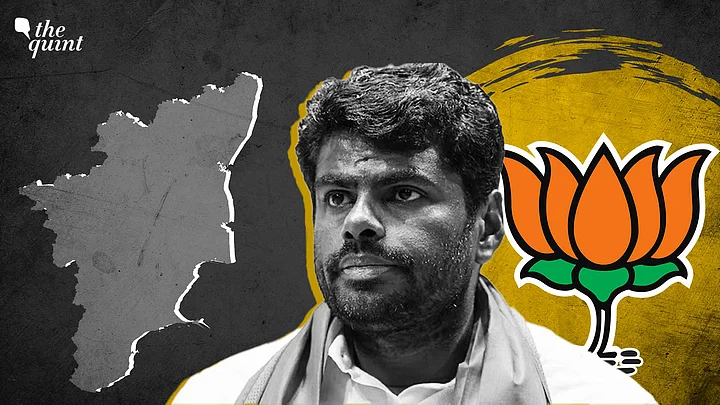
When the Bharatiya Janata Party (BJP) released its list of 27 candidates for the Tamil Nadu Assembly elections last week, the name that many people were looking for was the one that wasn’t there.
K Annamalai, the former IPS officer who spent five years rebuilding the BJP’s Tamil Nadu unit almost from scratch, and who became the most recognisable BJP face in a state that has historically been allergic to saffron politics, was absent. The list had Union Minister L Murugan from Avinashi, Tamilisai Soundararajan from Mylapore, and Vanathi Srinivasan from Coimbatore North.
It did not have the man most voters associate with the BJP in Tamil Nadu today—and that absence is as loud as any name on it.
How does one understand this development? Three explanations are competing for credibility, and each carries some truth.
The Loudest Name Is the Missing One
The first possible explanation is that Annamalai opted out. He had himself said last month, with carefully chosen restraint, “In the 2024 Lok Sabha elections, they asked me to contest. Now, nobody has asked me to contest. I did not seek an opportunity.”
Then, he skipped Prime Minister Narendra Modi’s airport reception in Coimbatore on 29 March, a pointed act of public disengagement that could hardly have been accidental. Sources close to him confirmed he was “extremely upset” with the seat allocation.
The second explanation is that the high command kept him out. “This is a decision from the high command,” said Nainar Nagendran, the current party chief in the state.
The third, and structurally the most consequential, is that the All India Anna Dravida Munnetra Kazhagam (AIADMK) General Secretary Edappadi K Palaniswami engineered the situation through the seat-sharing matrix itself.
The truth, on closer examination, is that all three explanations are facets of the same outcome. In that sense, the more interesting question is not why Annamalai is not contesting this election, but what his absence tells us about the BJP’s future in Tamil Nadu.
Coimbatore: Ground Zero of the Standoff
The Coimbatore flashpoint is where the story crystallises. Annamalai had his sights set on Singanallur or Kavundampalayam, both within the Coimbatore Lok Sabha segment, where he had demonstrated visible electoral traction in 2024, finishing second in Singanallur and pushing the AIADMK candidate to third place. The BJP’s Delhi leadership reportedly pressed EPS to release Singanallur, even after the AIADMK had announced its own candidate there. EPS did not budge.
In the end, the BJP received exactly one Coimbatore constituency, Coimbatore North, and it went to Vanathi, a sitting MLA with an established local base and the goodwill of AIADMK heavyweight SP Velumani.
Annamalai was apparently offered Modakurichi, a seat without his organisational footprint, and later Tiruppur South, a DMK-held constituency. He declined both. Coimbatore is the closest district the BJP has to a political foothold in Tamil Nadu. If even here the party could not secure a seat for its most prominent face, the seat-sharing arrangement, on the surface a numerical concession of 27 seats to a junior ally, was in practice a carefully designed cage.
This brings us to EPS’s strategy, which deserves the sharpest scrutiny. The AIADMK chief, who had been on the receiving end of Annamalai’s public barbs, most memorably the “illiterate” remark during the 2024 campaign, used the seat-matrix negotiations to settle political scores with clinical precision.
At least 13 of the constituencies handed to NDA partners are held by sitting DMK ministers. The BJP, which had sought urban, winnable constituencies, particularly in the Kongu belt, received the most challenging terrain instead.
EPS’s Quiet but Calculated Power Play
EPS retained nine of the 10 Coimbatore district seats for the AIADMK, while conceding one to the BJP. There is also a coalition optics dimension to this.
Annamalai’s growing popularity and assertive style had already positioned him as more than just a state unit head. He was increasingly seen as a possible alternative centre of power within the alliance. For the AIADMK, allowing such a figure to contest prominently could have risked diluting its leadership claim and EPS’s status as the undisputed chief ministerial face.
It is old-school Dravidian coalition management: appear generous in numbers while controlling the geography. The result is that Annamalai’s most credible electoral ground was fenced off before the question of his candidacy was even formally raised.
However, the BJP high command’s own role in this outcome cannot be entirely absolved. The internal churn within the Tamil Nadu BJP unit is real and pre-existing. Annamalai was replaced as state president last year by Nagendran, and his distancing from day-to-day organisational control had begun well before the seat-sharing talks.
The BJP is, after all, a highly centralised party in which major decisions are rarely left to state leaders.
Annamalai’s political style—direct, outspoken, and often confrontational—has helped him gain public attention, but it may also have made him difficult to accommodate within a tightly controlled strategic framework. His exclusion, seen from this angle, is not just an electoral adjustment; it is a reminder of where ultimate authority lies.
The high command had been signalling since at least mid-2025 that Annamalai’s trajectory was national rather than regional, with Amit Shah explicitly stating that the party would leverage Annamalai’s organisational skills within its national framework. Whether that is genuine elevation or a consolation framing depends on what actually materialises after 4 May.
For now, it functions as a face-saving device for all parties involved.
Between Visibility and Vote Conversion
Against this backdrop, what the BJP can realistically win in this election deserves honest assessment, stripped of the optimism that party spokespersons are obliged to maintain. In 2021, the BJP won four of the 20 seats it contested. It now contests 27, but on harder ground.
Pre-poll surveys suggest the DMK alliance is likely to win between 130 and 170 seats, while the AIADMK-led NDA is likely to win between 60 and 100 seats. Within that NDA tally, the BJP’s individual contribution is likely to be modest. Nagercoil, where MR Gandhi has a proven record, and Coimbatore North, where Vanathi has demonstrated resilience, are among the more bankable seats. A tally of six to eight seats would, given the terrain, represent a credible showing.
The party’s ceiling is constrained not by the quality of its candidates but by the structural reality of contesting on the ground that even experienced candidates would find difficult. There is also the separate question of whether Annamalai’s appeal has genuinely penetrated Tamil Nadu’s deeper political layers: the caste networks, local leadership structures, and ideological loyalties that determine outcomes on the ground. His rise has been rapid and highly visible, driven in part by communication skills and media presence.
But visibility and vote conversion are not the same thing, and the party may have quietly factored this in as well.
Given this context, the high command’s decision to position Annamalai as a statewide campaigner rather than a constituency candidate has a logic to it, even if that logic was arrived at as much by compulsion as by strategy. The argument is that tying a statewide asset to a single seat is a poor use of political capital. There is some merit in that, provided the campaigning actually moves votes.
The risk, however, is that a leader without a personal electoral stake has a fundamentally different quality of engagement than one fighting for his own seat.
By not contesting, Annamalai avoids the possibility of defeat, but he also misses the opportunity to convert his visibility into tangible political capital. Over time, this could create a gap between perception and performance, and his opponents will be quick to exploit that.
A Party Between Expansion and Accommodation
The deeper and more uncomfortable question for the BJP is also whether it has allowed a rare political asset to be strategically neutralised by an alliance partner without adequate resistance.
Under Annamalai, the party had begun to project a more independent and assertive identity, seeking to position itself as a distinct alternative to Tamil Nadu’s entrenched Dravidian parties. That was a slow and uncertain process, but it carried the promise of long-term growth. The current alliance strategy points in a different direction; it prioritises immediate electoral relevance through partnership with the AIADMK.
These two approaches are not easily compatible. One seeks expansion; the other demands adjustment. The decision to keep Annamalai off the ballot suggests that, at least for now, the BJP has chosen coalition pragmatism over organisational experimentation. A party that benches its most compelling face while insisting he is more valuable on the bench must, at minimum, be honest with itself about the circumstances that led to that decision.
4 May, for sure, will deliver the first verdict. The more consequential one, on whether Annamalai’s promised national role is real or merely rhetorical, will follow. His absence from the ballot is ultimately about a party still caught between aspiration and accommodation.
Whether the BJP’s future in Tamil Nadu is built with leaders like him or around them is the question that outlasts this election.
(The author is an education consultant and political analyst based in Bengaluru. This is an opinion piece. The views expressed above are the author’s own. The Quint neither endorses nor is responsible for them.)
