
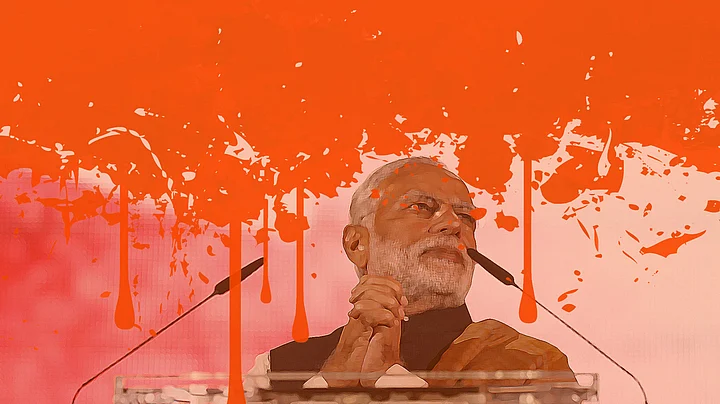
To most supporters of Narendra Modi, including those outside the saffron fold who welcomed his economic agenda, the Prime Minister’s tenure so far has been disappointing. That he has sensed the uneasy public mood is evident from his directive for action against non-performing bureaucrats.
But, apart from disciplining the officials, what is expected of him is the kind of sternness which he showed as the Gujarat Chief Minister. As a result, he was able to marginalize his predecessors like Keshubhai Patel and silence rabble-rousers like the Vishwa Hindu Parishad’s Pravin Togadiya.
In Delhi, he has taken similar effective action against incorrigible trouble-makers like Yogi Adityanath and seems to have persuaded Rashtriya Swayamsevak Sangh (RSS) chief Mohan Bhagwat to refrain from saying that all Indians are Hindus.
But his task remains incomplete as the hooliganism of the Akhil Bharatiya Vidyarthi Parishad (ABVP) activists recently showed in Allahabad University where they held a senior journalist hostage in the vice chancellor’s office to prevent him from speaking at a seminar. Their charge against the journalist was that he was “anti-national”, a label which they also used to defame the Dalit student, Rohith Vemula, who recently committed suicide in the Hyderabad Central University.
Modi’s Dangerous Silence Hurting Party?
But perhaps because he feels that it is below his dignity to react to the various incidents which can appear to be minor in the larger perspective, he prefers either to say nothing or leave it to party president Amit Shah and others to speak to those who step out of line.
However, his “dangerous silence”, as the New York Times once called it, has begun to hurt the party as mavericks like Subramanian Swamy continue their campaign for building the Ram temple and suggestions are made by the RSS chief to regulate the media “to ensure that no ill-effects prevails in society” as a result of their writings.