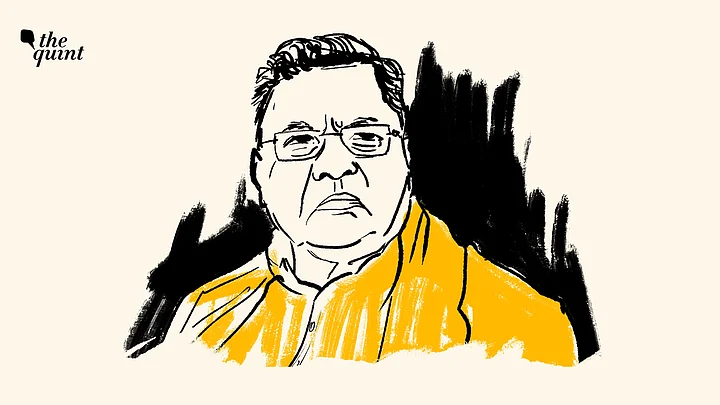
Karnataka's political transition is now underway. Siddaramaiah has tendered his resignation and paved the way for DK Shivakumar to be sworn in as Chief Minister. The transition closes a chapter in the state's social justice politics that has no obvious successor.
Siddaramaiah is the only Chief Minister after Devaraj Urs to complete a full term in more than 35 years, and he surpassed Urs' record of 2,792 days as Chief Minister in January 2026. Both leaders disrupted the Vokkaliga-Lingayat binary that had long defined Karnataka's political arithmetic.
Yet Siddaramaiah himself once drew an important distinction between the two: Urs belonged to the less-populated Ursu community, which Siddaramaiah described as part of the ruling class, while he emerged from the socially backward Kuruba community. In that specific sense, Siddaramaiah may well be the last of a particular political tradition in Karnataka.
Can Congress Hold Siddaramaiah's Coalition Together?
The Congress victory in 2023 was built on the AHINDA (a socio-political coalition in Karnataka, representing Alpasankhyataru (Minorities), HINDulidavaru (Backward Classes), and Dalitaru (Dalits) coalition of minorities, backward classes, and Dalits, combined with the party's welfare guarantees. Congress had deployed guarantee-based campaigns in Rajasthan, Madhya Pradesh, Chhattisgarh, and Telangana as well during the same year, but won only in Telangana.
In Karnataka, the guarantees carried credibility because they were associated with a Chief Minister whose administrative record and social coalition gave them political legitimacy among AHINDA voters.
The India Today-Axis My India Exit Poll showed Scheduled Caste (SC) votes for Congress rising by fourteen percent, Muslim votes by ten percent, OBC votes by five percent, Scheduled Tribes and Kuruba votes by four percent each compared to the previous election. That credibility does not automatically transfer with the office.
The most immediate political question now concerns the Kuruba vote, a community that constitutes nearly eight percent of Karnataka's population. Siddaramaiah remains its most prominent political figure in the post-Urs era, and Congress has no leader of comparable stature waiting to inherit that role.
Whether Kuruba voters remain firmly with Congress under a Vokkaliga Chief Minister, or whether gradual attrition begins to affect close contests across north Karnataka and parts of the Old Mysore region, remains uncertain.
The Shivakumar Test Begins
It falls to DK Shivakumar to manage this inheritance.
His contribution to Congress in Karnataka has often been understated in public commentary. His ability to manage his rivalry with Siddaramaiah and unify both factions behind the 2023 campaign was itself a structural contribution to the Congress victory. Nationally too, he has repeatedly been deployed by the Congress high command as a ‘troubleshooter’ tasked with stabilising party governments and resolving organisational disputes.
Yet his elevation rests on an electoral assumption that the 2024 Lok Sabha results complicated considerably. The expectation within Congress has long been that a Vokkaliga Chief Minister could consolidate Vokkaliga support in the Old Mysore region and offset any AHINDA attrition following Siddaramaiah's exit. But after the Lok Sabha elections, Congress leaders themselves privately acknowledged that sections of Vokkaliga voters who had supported the party in the 2023 Assembly election appeared to have shifted back towards the JD(S).
The results in Bangalore Rural became particularly difficult to ignore. DK Shivakumar's brother, DK Suresh, lost by 2.69 lakh votes to the BJP-JD(S) alliance candidate, while Shivakumar's own Kanakapura constituency delivered a lead of only 25,677 votes against his own projection of 50,000 to 70,000. As long as HD Kumaraswamy and the JD(S) remain politically relevant in the Old Mysore belt, the electoral dividend of a Shivakumar-led government cannot simply be assumed.
Legal Troubles Could Shadow the New Government
Electoral arithmetic, however, is only one part of the challenge. Shivakumar also enters office carrying unresolved legal vulnerabilities, including income tax cases that have shadowed him for years. The political consequences of such cases, irrespective of their eventual legal outcome, are not difficult to understand.
The experience of the Aam Aadmi Party government in Delhi demonstrated how corruption allegations against a sitting Chief Minister can gradually erode a party's governance narrative and hand the opposition a sustained political campaign. Siddaramaiah himself was not immune from this dynamic, with the MUDA case consuming significant political capital during his tenure.
A Congress government navigating legal pressure on its incoming Chief Minister, while simultaneously managing AHINDA anxieties and factional negotiations within the party, may find itself firefighting on several fronts at once.
Beyond the electoral and legal terrain, the transition also unsettles a quieter question about who shapes Congress strategy in Karnataka going forward. Siddaramaiah appointed Sunil Kanugolu as his Chief Political Adviser with cabinet rank, giving him direct access to the Chief Minister's Office. Kanugolu was central to the PayCM campaign and the 2023 candidate selection strategy, relying heavily on field surveys and data analytics to identify political trends.
Shivakumar has often been described as more receptive to coordinated political strategy and organisational management than Siddaramaiah's movement-oriented style of politics. Whether Kanugolu's operational role expands under the new dispensation, and how that shapes Congress's 2028 campaign architecture, could carry significant electoral consequences.
A Transition, Not a Departure
Much will also depend on the terms under which this transition has been negotiated. Siddaramaiah has reportedly declined the Rajya Sabha berth offered by the Congress high command and chosen to remain MLA from Varuna. That decision ensures he remains not merely politically relevant, but physically and institutionally proximate to the state government.
His camp is already pushing for deputy chief minister berths for loyalists and a decisive say in the appointment of the next KPCC president. If those demands are accommodated, Shivakumar may enter office as Chief Minister in title but governing within a negotiated settlement that limits his organisational autonomy from the outset. If they are not, the factional tensions temporarily subdued during the 2023 campaign could resurface quickly.
What Congress confronts today, therefore, is larger than a routine leadership transition. Siddaramaiah was not merely a successful Chief Minister or an electoral tactician. For large sections of backward classes, minorities, Dalits, and voters from historically neglected regions, he represented the political arrival of communities that had long remained peripheral to Karnataka's centres of power. That emotional identification cannot be transferred administratively through a swearing-in ceremony.
DK Shivakumar may yet emerge as an electorally successful and administratively capable Chief Minister in his own right. But the Congress transition still marks the closing of a distinct ideological chapter in Karnataka politics: one shaped by welfare expansion, backward caste assertion, secular political language, and the AHINDA imagination that Siddaramaiah spent decades constructing. Whether the Congress can preserve that coalition without the leader who embodied it at the helm remains the central political question Karnataka now enters.
(Jehosh Paul is a lawyer and former political consultant. This is an opinion piece and the views expressed are the author's own. The Quint does not endorse or is responsible for them.)