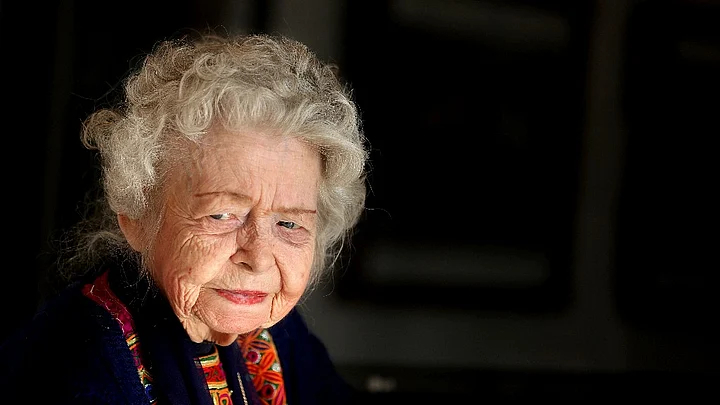
An American historian who spent decades in Afghanistan working to preserve the heritage of the war-torn country died Sunday.
An Afghan government statement said Nancy Hatch Dupree, who first came to Afghanistan in 1962 and spent much of her life collecting and documenting historical artifacts, passed away at a Kabul hospital at the age of 90. She was born in Kerala (then Travancore).
She amassed a vast collection of books, maps, photographs and even rare recordings of folk music, all now housed at a centre she founded at Kabul University. She also wrote five guidebooks.
Dupree came to Afghanistan as the wife of a diplomat, but later fell in love with Louis Dupree, an archaeologist and anthropologist. They married and lived for decades in Afghanistan, visiting historical sites across the country, retracing the footsteps of ancient explorers and documenting it all.
Together they wrote the definitive book on Afghanistan, an encyclopedic look at the country they had adopted as their own.
Dupree lamented the fact that young people in Afghanistan, many of whom had grown up as refugees in neighboring countries, knew little if anything about their history.
“So many young Afghans know more about the histories of the countries where they lived as refugees than their own country’s history,” she said. “It makes me sad because their own history is so rich.”
She founded the Afghan Center at Kabul University in 2006, where she worked to create an extensive library that could be accessed electronically from universities in Herat, Kandahar, Jalalabad and Mazar-e-Sharif.
“She called herself an old monument and a lot of Afghans called her the ‘Grandmother of Afghanistan,’” said Wahid Wafa, Executive Director of the Afghanistan Centre. “She understood and knew Afghanistan much better than anybody else.”
A fixture in the social scene of Kabul during the 1970s, a now-vanished world of smart cocktail parties and mini-dresses, they were forced to leave in 1978 after the Soviet-backed government accused Louis Dupree of being a spy.
Her husband died in 1989 and much of the time before her return to Afghanistan in 2005 was spent in Pakistan, where as well as briefly meeting Osama Bin Laden and working with the growing number of war refugees, she assiduously gathered as much documentation on Afghanistan as she could.
In 2005, after the fall of the Taliban and the installation of a new Western-backed government in Kabul, she returned with some 35,000 documents wrapped up in fertiliser bags, which became the basis for the Afghanistan Centre archive.
A prolific writer, she was director of the Centre between 2006 and 2011 and continued to go into her office after she stepped down, remaining an institution in the cultural life of Kabul and receiving a stream of visitors.
(With inputs from Reuters and AP.)
(#TalkingStalking: Have you ever been stalked? Share your experience with The Quint and inspire others to shatter the silence surrounding stalking. Send your stories to editor@thequint.com or WhatsApp @ +919999008335)