
ADVERTISEMENTREMOVE AD

'We Call Dubai Home': War or Not, Indian Expats Share Why They're Staying

'If I had to face a war-like situation in any country, I would choose to face it in the UAE,' one expat said.

Published
story-hero-img
i
Aa
Aa
Small
Aa
Medium
Aa
Large

When Humaira Ayaz (name changed) woke up on the morning of Eid on Friday, 20 March in her downtown Dubai home, she received messages of greetings not only from her family and friends, but also from a VIP: the President of the United Arab Emirates (UAE) himself.

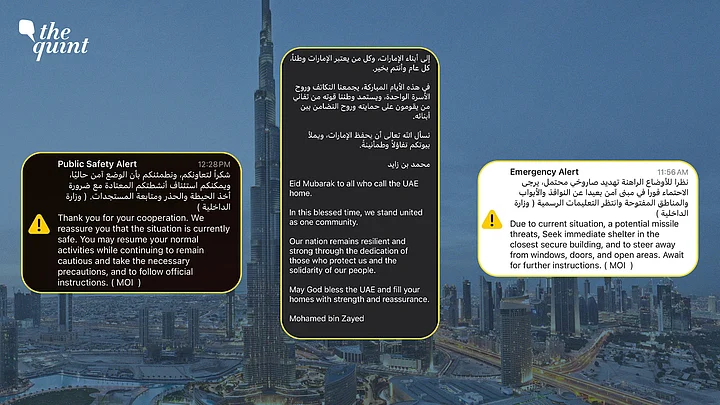
"Eid Mubarak to all who call the UAE home," the message, attributed to 'MBZ' (Mohammed bin Zayed Al Nahyan), read. "Our nation remains resilient and strong through the dedication of those who protect us and the solidarity of our people."

The message, carrying undertones of strength, resilience, and hope, is part of a broader set of initiatives by the UAE government to reassure its citizens as Iranian strikes on Dubai and other Gulf cities continue into the fourth week of war.
ADVERTISEMENTREMOVE AD

'Saw Drones & Smoke in the Air...'

Ayaz, who hails from Kashmir and has been working as an architect in Dubai for the last four years, says that anxiety hit her like a bolt on 28 February when Iran launched strikes against prominent sites in the city, including the Dubai International Airport, Dubai Marina, and the Fairmont Palm Hotel, among others.

"I was at Palm Jumeirah when a drone struck the Fairmont Hotel," the 31-year-old recalls while speaking to The Quint. "While I was quite far from the site, I could see smoke and drones in the air. That's when anxiety hit me... I just wanted to go home."

Ayaz reached home as quickly as she could and went to bed, but wasn't able to sleep that night. She spent the first few days of the conflict in complete uncertainty, like most others, wondering what was going to happen next.

However, with time, things started settling into their own rhythm, she says, despite there being no let-up in Iran's strikes.

"While the government had extended the 'work from home' facility to all Dubai locals, I started going to the office shortly after the conflict began," she says.

The reason she felt confident doing so, Ayaz adds, is because of the considerable trust she had in the government after witnessing the various steps they were taking for the welfare of citizens.

"If I had to face a war-like situation in any country in the world, I would choose to face it in the UAE," she says. "The government has made us feel completely safe amid the conflict. The few missiles that hit Dubai are just a fraction of the huge number of missiles that were intercepted by the military."

She further adds that while there were fewer people on the streets in the initial days of the conflict, including faithfuls going for prayers, preparations for Eid soon resumed with the same vigour as before the conflict.

"There hasn't been any kind of shutdown. Whether it's gathering for Iftar or going to the mosque, we went ahead with our plans without any hesitation. Even if you go out for a meal or order food in the middle of the night, services are available 24/7."
Humaira Ayaz

A 'New Normal' 

Ayaz's views were seconded by several other Indians living in Dubai whom The Quint spoke to.

"I've been experiencing a mix of emotions, to be honest. Hearing and seeing missiles is something no one should get used to, but it's become a strange new normal," says 29-year-old Sanjana Santoshi, a content executive working at a Dubai-based logistics company.

Santoshi, who moved to Dubai from Kerala around a year ago, says that it took some time for her to adjust to the current situation.

"The initial days were incredibly stressful. I worked from home for a couple of days and then got back to the office," she tells The Quint.

"I'm here to build my career, and it's been unnerving to navigate the war-like situation. There were times I worried about my job and other things, but the government's support, along with support from my office, has been really helpful," she adds.

Speaking about support being extended by local authorities, Santoshi says that the UAE government heeded concerns raised by several residents who were facing disruptions in their normal routines.

"When the airport was hit last week, there was no metro service from Centerpoint to Garhoud Metro Station. But the authorities quickly arranged free buses to Garhoud. So it was reassuring to see things getting back on track."
Sanjana Santoshi
ADVERTISEMENTREMOVE AD

Timely Alerts By UAE Government

Dubai residents have welcomed another government initiative: timely alerts issued during strikes.

"Due to (the) current situation (and) a potential missile threats, seek immediate shelter in the closest secure building, and steer away from windows, doors, and open areas," stated one such 'emergency alert' received by 41-year-old Pratiba Raman, a business development associate at a waste management solutions company.

Once the threat subsided, authorities sent another message to residents thanking them for their cooperation: "We reassure you that the situation is currently safe. You may resume your normal activities while continuing to remain cautious and taking necessary precautions..."

Raman, who hails from Karnataka and moved to Dubai in 2024, lives in the Business Bay area of Dubai, where, she says, there haven't been any strikes so far.

"I was tucked indoors in the first few days of the conflict. But I'm fortunate to be living in an area which is largely safe. None of the residential buildings in my area has been hit," she tells The Quint, adding that she and several other Indian associates of hers have been waiting desperately for the danger to subside.

"For now, I trust the UAE government and the Indian Embassy to do their part and keep us safe. I also hope that the government does everything in its capacity to uphold the safety net it has so carefully built over the years."
Pratiba Raman
ADVERTISEMENTREMOVE AD

Are Indians Planning To Move Back Temporarily? 

India's Ministry of External Affairs (MEA) stated on 9 March that as many as 67,000 Indians had returned from the Gulf amid the Iran-Israel-US conflict. While no specific figures for the UAE are available, several hundreds are believed to have moved back from Dubai and other cities in the country.

This also comes amid speculation that the UAE is considering more active involvement in the war to retaliate against Iran's strikes on the country's civilian infrastructure.

However, Indians who have decided to stay put are divided over whether they will contemplate moving back for their safety, even if for a temporary period.

"Of course I won’t be foolhardy. If the war intensifies, I will consider heading back until things get back to normal," says Pratiba Raman, adding, "I love my life in Dubai and would love to pick up from where I left."

Others, however, stated that there was no question of them moving back, even if for a few weeks.

"From my perspective, things have remained stable, and we’ve continued with our routines and work more or less. At this stage, there’s been no reason to consider relocating," says Priyanka Rao while speaking to The Quint.

Rao, a businesswoman who moved to Dubai from Mumbai in May 2025, says that her friends and family have been checking in with her regularly, including urging her to come back for the time being. However, Rao says she doesn't want to take any "hasty" calls.

"Relocating is a significant decision and typically takes months of planning. In my immediate circle, I haven’t heard of anyone relocating. Some people had pre-planned travel and went ahead with that, but otherwise most are continuing with their routines as usual."
Priyanka Rao

Her views were seconded by several others.

"I haven't even thought of going back to India. I feel safe here. My whole life is here," says Humaira Ayaz.

"You never know when the situation may take a turn for the worse. I don't want to head back and then get stuck if flights get cancelled," she says, adding, "Even if the UAE does get involved in the conflict, I still won't go back."

On 23 March, US President Donald Trump said the US and Iran held talks on ending the war—and could reach a "very good deal". Iran, however, denied any such talks had taken place, saying "fake news" was being used to "manipulate" the oil markets.

Speaking truth to power requires allies like you.
Become a Member
Monthly
6-Monthly
Annual
Check Member Benefits
×
×