
(Publishing politically suppressed voices requires editorial independence and often comes at great personal risk to us. We need your support as we continue to bring out more such voices. Please BECOME A MEMBER and support us.)
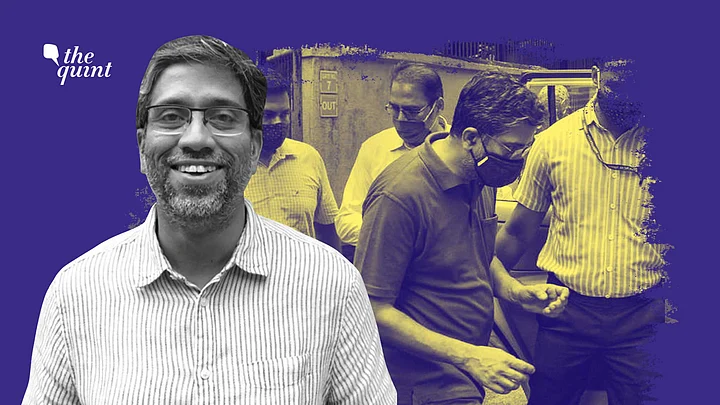
Professor Hany Babu has for years been a fount of a certain pedagogy of hope within the Indian academia, especially for students from the Dalit-Bahujan communities. An Associate Professor teaching in the English Department at University of Delhi from 2008 until his arrest by the National Investigation Agency (NIA) in July 2020 in connection with the Elgar Parishad case, Babu uses a distinct methodology of teaching to question the dominant ways of knowledge-building.
Far from being just an academician, he is also an activist whose scholarship on the relationship between caste and linguistics critically analyses the systemic flaws within India’s national language policies.
After five years of incarceration, Babu was released on 4 December 2025 on the grounds of “prolonged incarceration”. In an exclusive interview with The Quint, he speaks candidly on the need for egalitarian classrooms, the politics of language, and English as a skill for opportunities.
He also recounts the solidarities he built with his fellow inmates in prison through acts of conscious and intentional use of his knowledge.
What did your classrooms feel and look like at the university where you taught before your five-year-long incarceration?
I was teaching a much smaller group in Hyderabad before I came to Delhi in 2008. DU was a lot more diverse in comparison. However, I could immediately discern a big divide among students.
Some students easily felt at home in the university space, taking to it like a fish to water. These students had someone at home speaking the same language as that of the academic spaces. On the other hand, there were students from marginalised groups, mostly first-generation, who struggled to cope with the world around them.
One of the first things I had to do as a teacher, therefore, was to formulate ways to bridge this gap.
There are two aspects to doing this: First, make these spaces accessible to the students from marginalised groups. Second, question the accepted notions of wisdom and knowledge in academic spaces, and make room for alternate knowledge and wisdom. I think the second part is more important.
With just accessibility, students from the marginalised groups may feel they are allowed to be in the university space. But if you change the whole discourse of knowledge and make alternate knowledge system(s) available within the institutional spaces, they would feel more a part of the institution, rather than just being allowed to enter it.
At the university level, this can be done to some extent by designing more inclusive courses.
The building of alternate knowledge and making the spaces accessible should happen simultaneously because just establishing alternate knowledge systems by itself isn't enough. We have seen that such knowledge can easily be appropriated by the dominant groups who make it their own discourse. These patterns are quite often seen in areas like Dalit studies.
I recall this particular classroom debate where a student impressed everyone by speaking passionately about caste, but he wasn't a Dalit student. He had just appropriated this discourse. While grading him, I thought my ranking should also reflect that. When we are talking about experiences, and if somebody has appropriated that, they are in essence hijacking that discourse. It is an intellectually dishonest enterprise. Thus, apart from making the university accessible and building alternate knowledge, one needs to be sensitive to think about appropriation.
This reminds me of an essay, 'Crying Time', by black scholar bell hooks, in which she points out that many times in her own mixed classroom, during the discussion about racism, accounts of discrimination faced by black students would often evoke some kind of emotion in the white students. Were there any similar events in your classrooms? As a teacher how did you approach it?
Because of the subject I teach, which is mostly linguistics, my classrooms don't directly become a place for exchange of personal experiences.
There are different scenarios in the context of my teaching. I have students in my classroom who come from families where the so-called standard languages are spoken. When I talk about the issues of standard language and dialect, I talk about this division between the two which actually is completely an artificial one. It is a politically driven divide rather than in terms of linguistic merits or aesthetics.
I find that the marginalised students coming from such linguistic contexts of lived reality feel empowered by this kind of knowledge.
Language gives us the notions of inferiority and superiority. This has been one of the ways by which I could feel that the equation of the existing power dynamics balance gets disturbed inside the classroom.
I've noticed it when we talk about issues like reservation, for example, which within some context, would come up. And I would be going out of my curriculum when doing so, but even then I do make it a point to talk about it.
You have said that much of your ongoing research materials simply vanished. When the police came to your home five years ago, they seized your computer devices as well as your academic work. Were you able to get back research materials that you lost in that process?
I have not been able to get them back, but I plan to revive them.
One particular project I want to look at is the National Education Policy (NEP) language policy and the constitutional framework. It's not as simple as promoting Hindi and other regional languages instead of English. That's actually easier.
The biggest challenge would be institutionalisation. Throughout history, there has always been a particular discourse on knowledge carried out in a particular way. You need to have some kind of institutionalisation. Even if it is Hindi, it is ony the standardised, urban Hindi that gets a kind of prestige.
I think coming from Bihar, you would easily understand what I mean. I always use this example in my classroom. When you speak in Bhojpuri, you are marked as a Bihari; once you move to standard Hindi, you become an Indian. There is always this divide.
English that way has a particular power. It is the most useful tool that one can have because language, ultimately, is also a skill.
So, if you talk about it in terms of skill, this is one thing I also realised while teaching my fellow prisoners in (Taloja Central) jail. A language teacher needs the ability to teach that skill, but, at the university level, when we teach in the English Department, we don't teach the skill because we deal with students who already have that skill.
This is something an English language teacher will also tell you: the difference between teaching English as a subject and teaching English as a language.
If you are talking about giving that skill, it's as important as having access to standard Hindi. So, it's not about replacing English with Hindi, and I think that is where one would have issues with programmes like the NEP which brings regional languages instead of English.
English here is a tool that opens many kinds of avenues, especially for the students from the marginalised communities.
Definitely. Annadurai, the Tamil Dravidian politician, once said, "If you have two dogs, you don't need to build a bigger door and a smaller door for both of them to come out. If you have a bigger door, then both the big dog and the small dog can come out." Any standard regional language will be like a small door, and English is the bigger door.
You need your own language, and you need another tool to access wider systems of knowledge. English will be only an add-on thing. I'm not talking about replacing your own language with English. Your primary strength could be in your own language, and then you should have access to another system which in the current world opens more doors for you.
You have spoken about your experience of teaching English to fellow prisoners, and learning about your "inadequacy as an adult educator." What was your learning?
I was talking about a personal kind of handicap. As a teacher, when you teach at the university level, you have a particular mode of teaching, right? You are talking to adults already quipped with the ability to receive learning.
Inside the prison, I found that actually the receptivity was... I can't even call it low. In some cases, the adult inmates had no experience of any proper learning. They had maybe been to a classroom for a year or two of their life. After that, they probably worked as manual labourers or did odd jobs before they landed here. Many said that despite being poor, they wanted their children to learn English.
Now that they were in prison with someone who could teach them English, they were enthusiastic to learn, but had no learning experience. So, that is where I found my handicap.
I would tell them one thing one day, then again the second day, then again the third day, but on the fourth day, my patience started running out. I'd think, "What is wrong?"
Then I realised that it's not their fault but mine becuse they don't have the skill needed to learn what I was teaching. I felt that it is a teaching technique an adult educator should be equipped with. They should have the skill to impart this knowledge or the skills to people who have no learning skills. I found that I was totally incompetent because I could only teach people who know how to learn.
How can prisons bring education to those deprived of it in their lives?
If conducted in an organised manner, it's not difficult for the prison administration to find teachers or educators who will do this. If you talk about Maharashtra prisons, they are reform or correctional homes now. I think the onus is on the state to have these kind of programmes.
In the prison where I was, in the last one year especially, there have been some initiatives. They are teaching inmates auto-mechanics, gardening, digital photography, and other skill-based courses which are organised by NGOs or by an open university.
They have been promising language courses too, but till I came out of the prison, we did not have language courses.
The prison administration should focus on teaching basic English to prisoners, especially in metropolitan areas like Mumbai or Delhi. There are a lot of prisoners who can benefit from it.
You talk about the access of prison library itself viewed as scrutiny in some sense. Were you able to continue your own personal exercise of reading and writing in prison? Has it changed or transformed in any way since?
Initially, books that my co-accused or fellow prisoners brought helped sustain my reading because the library in the prison was quite ill-equipped. Obviously, I don't expect a prison library to be well-stocked in that sense, but I'm talking about even English books, for instance. There were Marathi books, a few in Hindi, and no books at all in English.
On top of the limited stock, the prison administration had a very uncooperative attitude towards inmates using the library. I'm talking not just about myself here, but about other inmates, too. There were a few who would want to read and would want to go to the library, but it was discouraged. No one was allowed to go.
Later, when there was a lot of struggle and people started demanding that they should be allowed, they would let one person to go and collect whatever books were available, maybe 20-25 books, and bring those back for all to read.
According to the prison manual, we should also get newspapers but they were not made available, so people would purchase, whoever could afford to.
Prison as a space, I would say, should encourage reading and some kind of physical activity. We were confined within a circle inside the prison. There was one volleyball court for some 300 to 400 people of one circle. The prison average age must be around 25 or below 30, an age group that needs both physical and mental activities.
The only thing that the administration seemed to care about was putting people inside the prison, inside the barracks, inside the circles, and just cooping them inside like chickens.
Another aspect to this is that 80-90 percent of people are under-trial prisoners whose tenure inside the prison is uncertain because they may get bail and move out anytime, even though it sometimes takes years. So that kind of uncertainty remained.
Were you allowed to get any books from those who would visit you?
The material I had was given by friends and relatives from outside, not just for myself but my then co-accused too. Without that, the prison would have been like a really dreadful place. The only thing that kept us afloat was being able to read, and I read quite a lot. Whoever got bail in our case, like, those who left two years ago, once said, "We don't get that much time to read and things like that" (laughs).
I always used to think that at least one positive aspect of my prison life was that I got more time. One is confined in terms of space but then time is unlimited.
Even before my arrest, I always had an interest in law. This was something which I was able to develop much more during my life inside. I was able to read quite a lot, and not just read in a theoretical sense, but there was a practical need as well because one thing which all prisoners are deprived of is some kind of legal help. Of course, you find all kinds of legal experts inside the prison because after spending two years inside the prison, most people get to know about the procedures.
I was already equipped with a degree in law, and then I had interest in constitutional law. However, once inside the prison, I had to really engage with criminal law, and even the procedural aspect.
I read a lot... judgments, people's charge sheets... I'd advise them on draft applications, bail applications, routine applications... One of the most common things that we used to do is drafting applications for pleading guilty or for relaxation of bail conditions.
When I drafted an application for an inmate to take it to court, it would be handwritten. When the judge realised this is coming from inside the prison, quite often they would ask, "Who wrote this?". They would be quite impressed that people inside the prison can write these kinds of applications.
I am thinking of making use of that knowledge and skill. Apart from teaching, if I could do something in law, in the legal field, I could perhaps contribute much more meaningfully. I feel that there are more people who are in need of this kind of assistance there. If not for my life inside the prison, I would not have been able to develop this much understanding in this area.
When can your students at DU expect you back in the classroom? What would that process be like for you?
I see that as a long struggle, although, technically, there shouldn't be any. First, the university has to revoke the suspension. Second, the court has to allow me to go out of Maharashtra. Even with that restriction, the university could allow me to teach virtually. That's also possible.
I don't know, I haven't made up my mind as to how I should go about this. I would definitely want to do something so that I can get back to my life as a teacher. The territorial restriction that I have right now makes it all the more complicated. Even if the university says, "Okay, come and join," without the court's permission, I can't go. I have to maybe consult my lawyer and the university to find out how one should best move.
How have these years of incarceration impacted your perspective of things of the world, the state, about oneself, and about education or academia?
It has made me more sensitive to the kind of inequalities and injustice around us. I think I should perhaps be more sensitive and more proactive, and try to not just understand the problems, but try to intervene in a more proactive manner. That is the only way one can combat injustice. If one leads a comfortable life within academia, one tends to get insulated from the world.
I have sort of now been exposed to the raw world, and I don't think I want to get back into an insulated kind of surrounding. Even as a teacher, I would try not to do that.
(Aishwarya AVRaj is an independent journalist, writer and culture critic.)
