
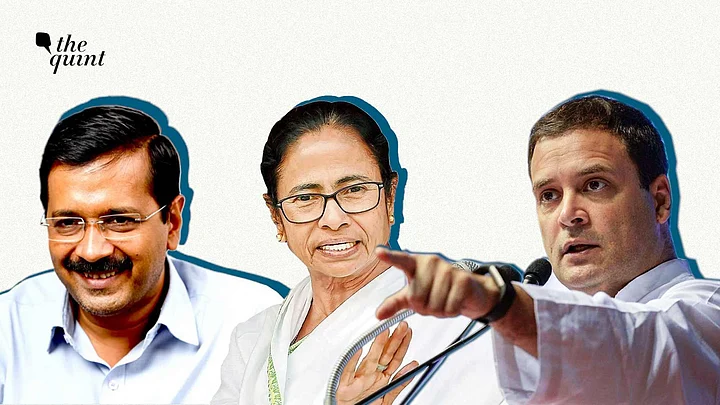
The Opposition scored a rare win in Parliament by managing to defeat the Modi government's Constitutional Amendment seeking to expedite the delimitation exercise on the pretext of the Women's Reservation Bill. The government managed the support of 298 MPs for the Bill against 230 for the Opposition, falling well short of the two thirds majority required.
Women's Reservation will still be taking place as the Bill was passed by a near unanimous vote in 2023.
While the government is planning to go on the offensive by calling the Opposition "anti-women", it was left a bit surprised by the unity in the latter's ranks.
Almost all the Opposition parties and MPs were present and voted decisively against the government's proposed legislations.
How did the Opposition manage this?
Why did the government underestimate them?
What happens next?
We'll discuss these questions in this piece.
Opposition Unity
None of the major Opposition parties are, in principle, opposed to women's reservation. They had all supported the 2023 Bill, which lays down implementation of reservation after the next delimitation exercise, which in turn is to take place after the next census.
The timeline for this is such that it was unlikely to be implemented before the 2029 Lok Sabha elections.
As the bill had already become law and the timeline for its implementation was clear, the government's move to bring another Constitutional Amendment for women's reservation was seen as suspicious by the Opposition.
The Opposition parties, perhaps rightly, concluded that the real aim isn't women's reservation, but carrying out delimitation and increasing the number of seats in Parliament ahead of schedule. Two bills for this purposed were tabled and linked to women's reservation.
There were also accusations from the Opposition that the government is trying to change India's electoral architecture without following due process.
Every major Opposition party - be it the Congress, the Samajwadi Party, Trinamool Congress and DMK - felt that delimitation would go against their interests.
For the DMK and Congress, opposition to the Bill was also due to fears that the proportion of seats in southern states would get reduced.
Due to the Special Intensive Revision exercise, trust towards the government was at a low and the Bills further fed into fears that the BJP is trying to manipulate the electoral process to its benefit.
The TMC's Dilemma
The BJP's floor managers knew that the numbers are not in its favour. However, it hoped that the Trinamool Congress would break ranks. Women are a key votebank for Mamata Banerjee and the BJP thought it may be tricky for her to go against its amendment in the middle of the Assembly elections.
However, the TMC has taken a gamble. Opposing the amendment meant inviting an "anti-women" charge from the BJP in the Bengal campaign. But supporting it or abstaining would have meant inviting "fixed match" allegations from the Left, Congress and AIMIM.
In the end, the party took a calculated risk. Being seen as helping the BJP would have been a bigger risk, especially with many voters suffering due to the SIR process.
On the other hand, as far as the women's vote is concerned, the TMC felt that its welfare schemes for women and Mamata Banerjee's own appeal may help it prevent any major leakage.
"Women's reservation isn't really a vote gaining issue. TMC reserved 30 percent tickets for women in 2024, we underperformed. The women's reservation bill was passed in 2023. It didn't have any impact in the elections," a TMC leader told The Quint on the condition of anonymity.
However, the leader alleged that 'women's vote' could become a post-facto explanation for the TMC's vote losses caused due to the deletion of voters.
Opposition in the South
Despite fears that the increase in number of seats based in the 2011 Census would lead to a reduction in the proportion of seats in the South, the BJP found support from its southern allies like Telugu Desam Party, Jana Sena and Janata Dal (Secular). From non-NDA parties, it got support from the YSCRP.
The AIADMK is said to have privately raised concerns with the BJP on the reduction of the proportion of seats for Southern states. The party was a bit taken aback by the timing of the Bills as it played into the hands of the DMK, which made it a big issue.
Tamil Nadu CM MK Stalin even publicly burnt copies of the Bill. AIADMK leaders felt that on the eve of elections, it gave Stalin an opportunity to change the narrative to an "ideological issue" diverting attention from governance related issues.
To appease the Southern parties, Union Home Minister Amit Shah said in Parliament that there will be "50 percent increase in number of seats for each state" and sought the Lok Sabha to be adjourned for an hour to get this included in the Bill.
However, this wasn't enough and no change took place in the DMK's stand.
YSRCP chief and former Andhra Pradesh CM YS Jaganmohan Reddy criticised the Opposition and said that if change in number of seats takes place based in the 2026 census instead of the 2011 one, the South may end up losing even more.
What Happens Next?
It will now be a battle of narratives between the BJP and the Opposition.
The party is likely to target most of its efforts in Bengal, attacking the TMC on its opposition to the Bill.
The TMC, on the other, hand will have to ensure that Mamata Banerjee's women vote bank stays intact.
In Tamil Nadu, the issue will be a double edged sword. If the BJP makes it a big issue against the DMK, it may lead to attacks on the AIADMK for supporting an "anti-South" move.
Another party that is likely to be targeted by the BJP in the months to come is the SP, with less than two years to go for the Assembly elections in UP.
For the Opposition, this is a morale booster. It is the first time they managed to defeat the BJP in a vote in Parliament. This was a break from the past when the government managed to divide the Opposition and gets its way in the House.
It is a lesson for the Opposition that uniting in numbers and narrative is essential for taking on the BJP.
The threat of delimitation, however, remains. The delimitation process in Assam and Jammu and Kashmir showed how constituency boundaries were redrawn in a way that helps the BJP and marginalises certain communities.
The Opposition may have managed to delay this for now but once the Census data is released, delimitation will be a matter of time.
