
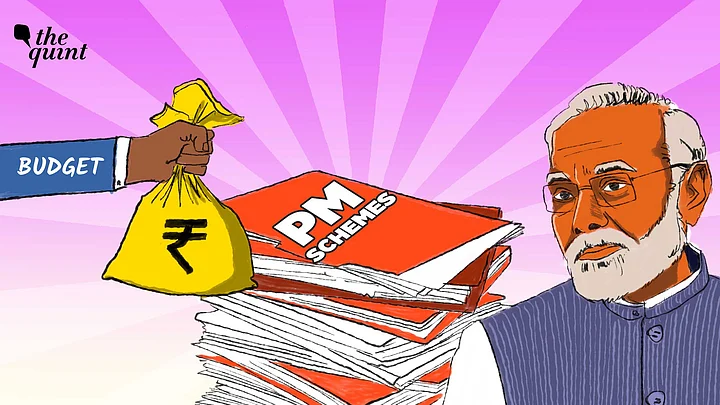
In the Budget speech, the government often announces allocations worth crores of rupees for flagship schemes, which grab headlines at the time. However, the actual spending on these schemes is reflected only in the next year’s budget documents, through the Budget Estimates (BE) and Revised Estimates (RE).
The latest budget document lists 191 schemes as major schemes, out of which 25 carry the Prime Minister’s name. These schemes named on “Prime Minister” are considered priority areas for the government. Out of 25 Prime Minister schemes, 23 have faced cuts, 2 retained their original allocations, and none received an increase. Overall, allocations have dropped from ₹2,63,998 crore in the BE to ₹1,85,597 crore in the RE, marking a nearly 30% reduction.
Youth-Focused Budget Faces Sharp Cuts in Key Schemes
In her 2025-26 Budget speech, the Finance Minister highlighted that the budget is inspired by the Yuva Shakti-driven vision. However, a closer look at the Revised Estimates (RE) for 2025-26 reveals that some of the most ambitious youth-focused initiatives have faced drastic reductions in funding in the current fiscal year.
The Prime Minister’s Internship Scheme, launched by the Ministry of Corporate Affairs, has faced the steepest cut in the revised estimates—95%. While the Budget Estimate (BE) 2025-26 allocated ₹10,831 crore, the Revised Estimate (RE) has reduced it to just ₹526 crore. The scheme is designed to provide internship opportunities to one crore youth in the top 500 companies over five years, giving participants exposure to real-world business environments across a variety of professions.
Education-related initiatives have also faced significant cuts in the revised estimates. The PM Schools for Rising India (PM SHRI), a scheme aimed at developing over 14,500 schools nationwide by strengthening select existing schools managed by the Central Government, state governments, UTs, and local bodies, has been reduced by 40%, from ₹7,500 crore in the Budget Estimates (BE) 2025-26 to ₹4,500 crore in the Revised Estimates (RE) 2025-26.
Similarly, the Pradhan Mantri Uchchatar Shiksha Abhiyan (PM-USHA), designed to expand higher education opportunities for students, has seen a 56% reduction, dropping from BE ₹1,815 crore to RE ₹800 crore. Other education-focused schemes have also been trimmed. The PM Young Achievers Scholarship Award Scheme for Vibrant India (PM-YASASVI), which supports students from Other Backward Classes (OBC), Economically Backward Classes (EBC), and Denotified Tribes (DNT), has been reduced by 32%, from ₹2,190 crore to ₹1,500 crore.
Healthcare and Nutrition Schemes Face Sharp Cuts in Revised Estimates
Healthcare and nutrition initiatives have faced significant reductions in the 2025-26 Revised Estimates (RE). The Pradhan Mantri Poshan Shakti Nirman (PM POHSAN), which provides a hot cooked meal in government and government-aided schools to improve nutritional outcomes, was reduced by 15%, from ₹12,500 crore in the Budget Estimates (BE) 2025-26 to ₹10,600 crore in the RE.
The Pradhan Mantri Ayushman Bharat Health Infrastructure Mission, Aimed at strengthening healthcare infrastructure across the country, experienced a 42% cut in spending, with allocations of ₹4,200 crore in the BE 2025-26 to expenditure of ₹2,443 crore in the RE 2025-26.
Similarly, the Pradhan Mantri Swasthya Suraksha Yojana (PMSSY), which seeks to correct imbalances in the availability of affordable healthcare facilities and augment medical education in underserved states, saw its funding drop by 32%, from ₹2,200 crore of BE 2025-26 to RE 2025-26 ₹1,500 crore.
Housing Schemes Face Steep Cuts in Revised Estimates
Housing initiatives bore some of the deepest cuts in the 2025-26 Revised Estimates (RE). The Pradhan Mantri Awas Yojana (PMAY) – Urban 2.0, an ambitious scheme aiming to construct one crore houses for urban poor and middle-class families, saw its allocation slashed by 91%, from ₹3,500 crore in the Budget Estimates (BE) to just ₹300 crore in the RE.
Similarly, PMAY Urban 1.0 experienced a 62% reduction, dropping from ₹19,794 crore to ₹7,500 crore. Rural housing under PMAY Rural also faced a significant cut of 41%, with allocations falling from ₹54,832 crore to ₹32,500 crore in the RE 2025-26.
These steep reductions raise questions about the government’s ability to achieve its target of “Housing for All”, potentially leaving millions of urban and rural families waiting longer for safe and affordable homes. The revised allocations underscore a growing gap between budget announcements and actual spending on key flagship schemes.
Agriculture and Rural Development
Agricultural initiatives, a cornerstone of government policy, were also affected in the 2025-26 Revised Estimates (RE). The Pradhan Mantri Krishi Sinchai Yojna (PMKSY), which aims to ensure access to protective irrigation for all farms and promote the “per drop, more crop” approach to boost rural prosperity, saw significant reductions in funding.
One component of the scheme experienced a 23% cut, with the Budget Estimate (BE), the planned allocation set at ₹8,260 crore, while the Revised Estimate (RE)—the actual spending fell to ₹6,372 crore. Meanwhile, the Watershed Development Component under the same scheme was reduced by 40%, dropping from a BE of ₹2,505 crore to an RE of ₹1,500 crore.
Rural development initiatives also faced significant cuts in the 2025-26 Revised Estimates (RE). The Pradhan Mantri Gram Sadak Yojna, which focuses on improving rural road connectivity, saw its spending reduced by 42% from its planned allocation, falling from ₹19,000 crore in the Budget Estimates (BE) 2025-26 to ₹11,000 crore in the RE.
However, farmer income support programs remained untouched. The Pradhan Mantri Kisan Samman Nidhi spends its full allocation of ₹63,500 crore, reflecting the government’s continued commitment to direct income support for farmers.
Sharp Cuts in Flagship Schemes Revealed in Revised Estimates
Several other flagship schemes also saw sharp reductions in spending in the 2025–26 Revised Estimates (RE), underscoring a widening gap between budgeted allocations and actual spending.
The PM Electric Drive Revolution in Innovative Vehicle Enhancement , aimed at accelerating the adoption of electric mobility, recorded the steepest cut, with spending plunging by 67.5%, from a Budget Estimate (BE) of ₹4,000 crore to just ₹1,300 crore in the RE.
Social welfare schemes were also affected. The Pradhan Mantri Anusuchit Jaati Abhyuday Yojana, meant to support the socio-economic development of Scheduled Castes, saw its spending reduced by 41.6%, from ₹2,140 crore in the BE to ₹1,250 crore in the RE.
Similarly, the Pradhan Mantri Matsya Sampada Yojana, a key initiative for strengthening fisheries and boosting fishermen’s incomes, faced a 39% cut, with spending falling from ₹2,465 crore in the BE 2025–26 to ₹1,500 crore in the RE.
Support for small enterprises was pared back as well. The Prime Minister’s Formalisation of Micro Food Processing Enterprises (PMFME) Scheme saw a 25% reduction, with spending down from ₹2,000 crore in the BE to ₹1,500 crore in the RE.
Even the high-profile PM Surya Ghar Muft Bijli Yojana, aimed at promoting rooftop solar and reducing household electricity bills, saw a 15% cut, with spending revised down from ₹20,000 crore in the BE to ₹17,000 crore in the RE.
Collectively, these reductions raise concerns about the pace of implementation of key welfare, livelihood, and clean energy initiatives despite ambitious budget announcements.
