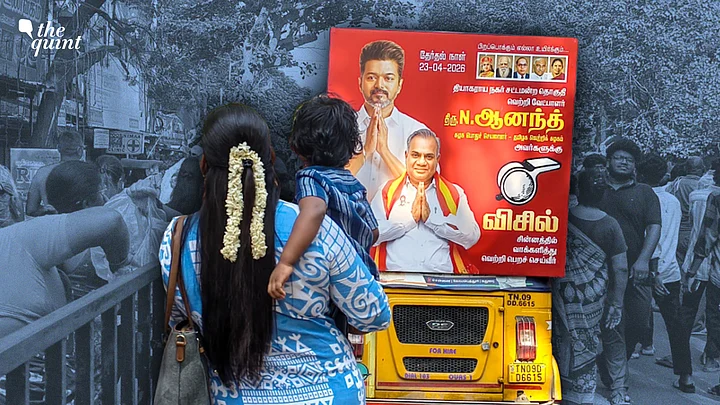
It is 1:30 pm on a Wednesday, and the Chennai sun is directly overhead, draining the street of shade. At first, it looks like any other political meeting. But the crowd building here moves differently – there are no large groups arriving in mini-trucks, and no packets of biryani being handed out.
People come in twos, some alone. Most are wearing red and yellow mufflers, holding flags and blowing whistles. Some climb onto bus stops and trees, lean over terraces, before being asked to step down by the police. Then, from the far end, a ripple. Flags wave, voices yell, “Anna!” “Thalapathy!” Phones go up as the convoy appears. For a few minutes, actor-turned-politician Vijay is visible through the sunroof with a raised hand and a wide smile.
Even in that moment, what stands out is who fills the street: mostly women. This is unlike any rally in Tamil Nadu at the moment. Many are women dressed in coloured sarees, in office clothes with ID cards still clipped on, some in burqas. Some have come straight from picking up their children from school, others carry infants.
Women here do not form a single, easily definable group. Some are long-time fans, after years of watching him on screen. Others come out of curiosity, fatigued by the existing political choices and wanting change – a younger leader who appears, at least for now, more accessible than those in power.
This is why Tamilaga Vettri Kazhagam (TVK) is signalling a shift in state politics as the state is set for elections on 23 April.
The 2026 Assembly election is expected to test the durability of Tamil Nadu’s long-standing political order. The Dravida Munnetra Kazhagam (DMK) remains organisationally strong, while the All India Anna Dravida Munnetra Kazhagam (AIADMK), its principal rival for decades, is still navigating the death of J Jayalalithaa and the ensuing leadership vacuum and messy internal tussle.
It is at this moment that TVK has stepped in. And his cinematic persona feeds into it. Across films, Vijay has played a range of roles but in many of them the story follows one arc – of an individual who confronts corruption and steps in when systems fail.
“TVK operates less like a conventional political party and more like an extension of an already familiar narrative,” said D Suresh Kumar, deputy resident editor of The Hindu newspaper.
Fandom and the Collapse of Distance
For many women gathered at these rallies, the relationship with Vijay does not begin with politics. It begins much earlier, with cinema.
“When I’ve already idolised him for his dialogues and action on screen, it’s easier to accept him as my leader,” said Rajathi, 43, who has been canvassing in Perambur. “He is like my brother. How can I not support him? You don’t question your family.”
Unlike other superstars such as Rajinikanth and Kamal Haasan, for much of his career, Vijay remained mostly aloof. But that distance has now narrowed. And though he still does not engage with the press, he addresses people directly. For many supporters, this creates a sense that access, once improbable, now possible.
“I’ve grown up loving him. My whole family feels that way. He is like family. My annan (brother). From our house, all four votes are for him. We’ve told our relatives too, so we can guarantee at least 100 votes from our extended family. It doesn’t even matter who the candidate is.”Said 19-year-old Amudha, who had come with her mother, four aunts, and two grandmothers to a rally in T Nagar, Chennai.
In these moments, the distinction between a cine-star and politician is blurred.
Maheshwari, 24, has been canvassing door-to-door in Saidapet with her husband, and she is optimistic he will ultimately become a good leader. “Everyone who became Chief Minister didn’t come with experience. He will also learn on the job,” she says.
Mobilising Fandom into Organisation: Trust without Policy
This dynamic of fandom becoming political loyalty is reinforced by how the party operates on the ground. TVK draws heavily from existing fan‑club networks. People who once distributed posters and snacks for film premieres now organise meetings, build social media reach, and canvass door‑to‑door. They do not always describe themselves as political workers, but they are doing the work of political workers.
“I’ve never been interested in politics before,” said Rasathi, 63. “But now I’m going door‑to‑door asking people to vote for Vijay.”
What draws many political newbies into Vijay’s ambit now is not ideology, but the possibility of access and the sense of belonging that comes with being part of a larger ‘family’ project.
“I don’t talk about the manifesto. I’ve never really read it, I just ask people to vote for Vijay because I believe in him. What good has come from these two Dravidian parties in the last few years. When will young people get a chance? This is the perfect timing for our Anna to decide to enter politics.”said Ramya K., who is part of the women’s wing in TVK in central Chennai.
In neighbourhoods like Saligramam, where much of the city’s film life has historically been concentrated, this familiarity takes on a more lived, almost domestic dimension.
“He would come out and wave at people,” recalled Kiran Keshav, an actor who grew up in the area. “For us, he was always like the boy‑next‑door.”
His social‑welfare network, Vijay Makkal Iyakkam (VMI), is also based there and holds blood‑donation drives, food‑distribution camps, and awareness programmes. In October 2021, VMI made its debut in Tamil Nadu’s rural local body elections, winning 115 of the 169 seats it contested. The candidates ran as independents using Vijay’s photo. After the win, Vijay urged them to focus on local civic issues.
And since Vijay doesn’t interact with the press, much of his visibility is amplified by the fans.
A visible section of those gathered for these rallies, and those who act as Vijay’s ‘virtual warriors’, are still too young to vote – in the 12-18 age group. Cuddalore‑based journalist Prem explained what this support base can do: “We held a talk show with TVK, DMK, and AIADMK candidates. The full programme didn’t get many views online, but the clips shared by TVK accounts got millions of views.” Videos from teenagers and millennials go viral across platforms, reaching many more than conventional coverage. He points out that crowds imitate and turn into memes every small gesture of their idol – how Vijay wears his shawl, how he walks into a crowd, for instance. “That’s where the brand is being built, not just in speeches,” says Prem.
Critique and Loyalty During Crises
In September last year, a rally organised by TVK in Karur saw a large turnout with little crowd control. It led to a stampede that killed 39 people, including nine children. Vijay did not issue an immediate statement on the tragedy, drawing criticism from opposition leaders and sections of the media. When he eventually responded, he expressed grief and extended condolences to the families, but stopped short of taking responsibility for the disaster. Instead, he accused the ruling party of not ensuring adequate security. Critics argued that the response was delayed and inadequate, raising concerns about how the party handles accountability.
But the support of his young followers did not wane.
“He may have needed a mental health break. We believe in him. The DMK is here to ruin my Anna’s chances at winning,” said a 25-year-old fan.
As journalist Kavitha Muralidharan notes, Vijay is “winning the perception war,” relying on the force of his stardom at a moment when fatigue with established Dravidian parties is increasing.
At a rally in Chennai’s T Nagar area, a mother had brought her four children – all of them ardent VIjay supporters, especially the children who are adamant that their parents vote for the star. “You see this in many rallies now, children participating. Parents say there are arguments at home [about who to vote in]. Kids are asking what has really changed in the last few years, and why not give someone new a chance,” says a journalist from a regional news channel, who has been tracking TVK’s campaign and who chose to remain anonymous.
Whether this support translates into votes remains an open question.
The Jayalalithaa Void: Just When Women Were Looking
For a section of women in this crowd, the memory of J Jayalalithaa still shapes how they understand politics. Her appeal was tied to welfare schemes, and to a sense of assurance that came from having a woman in power.
For many, that means the belief that the state would act in their interest. Her absence, several women say, has left behind not just a political gap, but an emotional one.
Some also see this as part of a larger pattern of exclusion. “We still live in a society governed by patriarchal rules and expectations,” said 42-year-old Revathy, a TVK contestant from the Kunnam constituency. “More women need to be part of political processes. Jayalalithaa made us feel that we were well represented. Now, all these parties don’t seem welcoming for women.”
For others, the shift is more personal. Women are still often identified through their relationship to men - mother, wife, sister. For Thenmozhi Prasanna from Madurai, political participation becomes a way of stepping out of that framing. She is now a national spokesperson for TVK, something she sees as a great opportunity for a young woman with no prior political experience.
No, Vijay is not replacing Jayalalithaa. But he arrives at a moment when many women are still looking for someone they can emotionally connect to.
Masculinity and the Language of Politics
What stands out in this election season is not just what is being said, but how it is being said.
Across parties, campaign language often leans into aggressive, masculine tones. Women frequently become metaphors in this exchange.
“While these Dravidian parties talk about women’s welfare, they also casually use women to take a dig at the other party. This doesn’t create a space where women feel politics is for them”said D. Sureshkumar, political editor at The Hindu.
In Tamil Nadu, leaders are often spoken of like family. Jayalalithaa was called ‘Amma’ (mother), while MG Ramachandran was seen as a paternal figure. These associations create a sense of closeness, but they are also deeply gendered.
Within this landscape, Vijay does not step outside that grammar. Instead, he taps into it. Drawing from a connection already built through his films, he extends that familiarity into public life, positioning himself as the protector, the elder brother, ‘Anna’.
On International Women’s Day, on 8 March, Vijay held a women-only meeting in Mahabalipuram where he announced a set of welfare promises aimed at women. These included a monthly financial assistance of ₹2,500 for women, free bus travel, and subsidised LPG cylinders. He also unveiled schemes like the ‘Annan Seer’ (gift from brother for marriage support) and initiatives focused on women’s safety. It was also where the ‘Anna’ narrative came through most clearly. The audience was mostly young women under the age of 35 cheering, waving flags, and wearing party mufflers.
However, critics argue that the party’s structure still reflects a top‑down, paternalistic model.
“Where are the women in Vijay’s team? They are in the crowds and a few of them have got a ticket to contest but they are not part of the core leadership. Vijay has chosen great women leaders as the party’s inspiration, but where is the actual representation?,” asked political commentator Radhika Ganesh.
She added, “Jayalalithaa may have liked people calling her Amma, but she never actively propagated it. Tamil Nadu, shaped by the self-respect movement and built on the legacy of its stalwarts, has made significant progress in moving away from this kind of paternalistic political language. But Vijay is taking us back to that protector-style rhetoric that feels regressive. It is also striking to see young, educated women drawn to it.”
“What we need is to demand what we are owed. Women don’t need protection or sympathy. Women just need equal rights in every space,” added Kavitha Muralidharan.
Between Hope and Exhaustion
Now, not everyone who comes for Vijay’s rallies is fully convinced. They are primarily exhausted with the existing political options.
Rajeshwari, whose family had long supported MGR’s party, AIADMK said, “We’ve been with that party for generations. But the last ten years have been tiring. So much infighting, so much confusion. We just want something clean. Vijay could be just that.” She is now part of the women’s wing of TVK in central Chennai.
For some, the decision comes from disappointment with past alternatives.
“We’ve been tired, In the last election, we trusted Kamal Haasan. We even spent our savings supporting him. It didn’t work out. He let us down. Now we’re trying again with Vijay. But it feels different. Yes, this is also a risk, but maybe worth it.”said 60-year-old Mangai, who runs a catering business with her husband.
A 64-year-old driver who was dropping people off at a rally in Villivakkam said, “The enthusiasm is interesting to watch. But I will wait and see. He is not the first actor to promise change.”
Menaka, 24 years of age, who attended a rally out of curiosity said, “Many people are excited to meet their real-life hero. But not everyone is reading the manifesto.”
That observation cuts to the heart of what TVK represents at the moment. In today’s political climate, newness itself has become a category. It gets the concession to be detached from accountability and track record. The answer to whether large numbers of women showing up at rallies will translate into political power for women in policy, in representation and in leadership remains unknown.
For now, we may not know if TVK is winning elections. But it is definitely winning attention. And in Tamil Nadu in 2026, that is where everything begins.