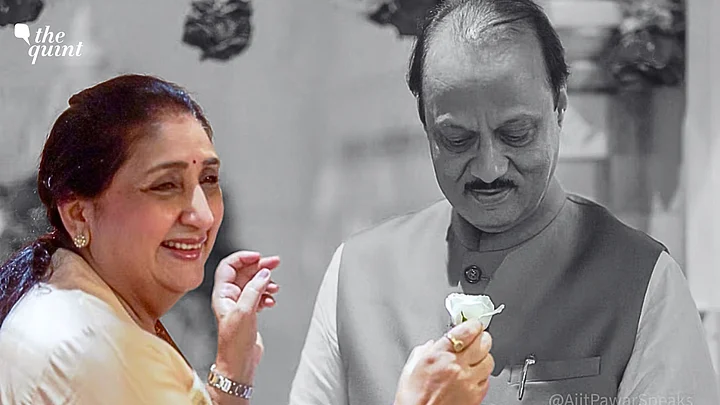
“I have never been interested in politics. It’s not my arena. There are many around me who insist that I join politics, but I have never thought in that direction,” Sunetra Pawar, wife of Nationalist Congress Party (NCP) leader Ajit Pawar, told a Marathi daily candidly in February 2023, explaining why she had stayed away from active politics.
Exactly three years later, Sunetra Pawar took oath as Maharashtra’s first woman Deputy Chief Minister on 31 January.
The death of Ajit Pawar—Maharashtra’s Deputy Chief Minister and chief of the NCP faction bearing his name—has sent tremors through the state’s political landscape, triggering a rapid and consequential succession.
Sunetra Pawar’s entry into active politics is closely tied to Ajit Pawar’s political trajectory: first in 2023, when he split the NCP, and now, a bigger role following his untimely death. On both occasions, Sunetra—who had consistently expressed her reluctance to enter public life—was compelled to step into the political arena.
In the present circumstances, her elevation emerged as the only viable political option before Ajit Pawar’s NCP. However, the decision has also raised questions, particularly after Sharad Pawar claimed he was not consulted.
Why was Sunetra Pawar considered the most logical choice to lead Ajit Pawar’s NCP?
How will her elevation affect the ongoing merger talks with Sharad Pawar?
And what political course does Sunetra Pawar’s appointment chart for the future of the NCP?
To answer these questions, it is necessary to examine Sunetra Pawar’s political journey and her standing within both the party and Maharashtra’s broader political ecosystem.
On the Sidelines, Not on the Outside: Sunetra Pawar’s Political Arc
For Baramati and the NCP, Sunetra Vahini is more than just Ajit Pawar’s wife.
Born in Dharashiv (formerly Osmanabad), Sunetra Pawar is the sister of former cabinet minister and MP Padmasinh Patil, one of the founding members of the Nationalist Congress Party. Her father, Bajirao Patil, was also a prominent politician from the region. She completed her Bachelor’s degree in Commerce from S. B. Arts and Commerce College from Chhatrapati Sambhajinagar (formerly Aurangabad) in 1983.
Actively engaged in verious social initiatives since 2000, Sunetra founded the Environmental Forum of India in 2010, an NGO focused on developing eco-villages.
She was key to transforming the village of Katewadi, the epicentre of the Pawar family politics in Maharashtra, into a model village under the Nirmal Gram Yojana. The village has won several accolades over the years for being open defecation free, producing its won electricity, and water supply. Similar initiatives were taken in other villages of the region under the project.
Since 2006, she has also served as chairperson of the Baramati Hi-Tech Textile Park, which employs more than 15,000 women.
Among voters in Baramati, Sunetra is widely seen as someone who stood firmly by Ajit Pawar, often representing him at meetings and public events in his absence. She has never shied away from interacting with the media— whether to articulate party positions or to highlight their social initiatives.
Over the years, Sunetra Pawar has played a significant role in the Pawar family’s election campaigns and rallies in Baramati, even though much of her organisational work remained behind the scenes.
Her name emerged in the initial investigations into the Maharashtra State Cooperative Bank case over her alleged links to companies involved in sugar mill transactions. In 2021, the Enforcement Directorate attached assets of firms linked to Ajit and Sunetra Pawar, though neither figured in its chargesheet. However, in April 2024, the Mumbai Police’s Economic Offences Wing cleared her, saying no criminal offence was found in the sanctioning of loans or the sale and leasing of the sugar mills.
Despite her philanthropic work and political visibility, Sunetra Pawar’s influence has largely remained confined to the Baramati region.
That prominence made her the undisputed choice to be fielded against Supriya Sule in Baramati during the 2024 Lok Sabha elections, as Ajit Pawar sought to mount a strong challenge on his home turf. Sule went on to win the election with her highest-ever victory margin. Ajit Pawar later acknowledged at a public rally that pitching his wife against his sister was a decision “people did not like”.
Months later, Sunetra Pawar was nominated to the Rajya Sabha, a move that reportedly caused disquiet within Ajit Pawar’s NCP, including a rare public expression of dissatisfaction by senior leader Chhagan Bhujbal.
Why Sunetra Pawar Became the Inevitable Choice
Though she has been a key figure within the party, Sunetra Pawar is yet to be perceived as a leader with a statewide political hold or decisive influence over the party’s administration.
However, for the NCP cadre, loyalty to the party has long been inseparable from loyalty to the Pawar family.
Most party workers and leaders across both factions of the NCP are still coming to terms with Ajit Pawar’s untimely death. Sunetra Pawar’s anointment has helped consolidate sentiment around the family, preventing a leadership vacuum at a time when Ajit Pawar left behind no clear line of succession.
Ajit Pawar’s sons, Parth and Jay Pawar, though politically active, are yet to establish their footing within party circles in the way Sunetra Pawar already has.
Then there are the party’s strongmen outside the family. Praful Patel, the NCP’s working president, is also a Rajya Sabha MP. Chhagan Bhujbal, Narhari Zirwal, and Hasan Mushrif are cabinet ministers in the state, each holding key portfolios. Sunil Tatkare, Ajit Pawar’s lone Rajya Sabha MP, remains influential in the Raigad region. All are powerful figures in their own right, but few command the emotional connect needed to mobilise the party cadre at large—particularly in the epicentre of Baramati.
'Didn't Know,' Says Sharad Pawar: NCP Merger Talks in Limbo
As per reports and party sources, the two NCP factions were mulling a merger months ahead of Ajit Pawar’s demise. Their alliance in the Pune and Pimpri-Chinchwad municipal elections was meant to test where their respective strengths currently lie, as both sides sought to reclaim their erstwhile political bastions.
However, Sunetra Pawar’s anointment may have unsettled the merger talks. On Saturday, Sharad Pawar said he was unaware of the decision, suggesting it was an “internal matter” of Ajit Pawar’s NCP.
Addressing the media, Sharad Pawar distanced himself from both the merger discussions and the reported oath-taking ceremony.
Responding to reports of an imminent swearing-in ceremony, Pawar expressed surprise and said his camp was unaware of any such plans. “I have no idea about the swearing-in and came to know about it only through the news. How can we be present if we are not informed? It is not even clear whether the swearing-in is actually happening,” he said when asked whether any member of the Pawar family would attend.
“I am only reading names such as Praful Patel and Sunil Tatkare in the newspapers. They must have taken that decision for their party,” Pawar added.
He reiterated his position, saying, “The decision to select Sunetra Pawar as the legislative party leader is an internal decision of the NCP (Ajit Pawar).”
“For the past four months, Ajit Pawar and Jayant Patil were engaged in discussions on merging the two parties. After this unfortunate accident, it appears that the process will now come to a halt,” Pawar said, indicating that recent events could stall reconciliation efforts between the two factions.
He added that senior leaders from both camps had been involved in the talks. “Ajit Pawar, Jayant Patil and Shashikant Shinde were part of the merger discussions,” Pawar said.
Pawar also said there had been no communication between the two factions on future political developments. “There has been no discussion with anyone about what lies ahead between the NCP and the NCP-SP,” he said.
So, where does this leave Ajit Pawar’s NCP now?
Even if Sunetra Pawar is now Deputy Chief Minister, does that automatically make her the undisputed leader of the party? With limited political experience and influence beyond Baramati, can she command the authority Ajit Pawar once exercised over the NCP? And if a merger does materialise, where does that place Sunetra Pawar in a larger leadership matrix dominated by Sharad Pawar and Supriya Sule?
The NCP’s power structure in Maharashtra was largely centralised around Ajit Pawar, who emerged as the party’s unquestioned authority after the split. While Sunetra Pawar’s anointment may have temporarily addressed the leadership vacuum in the state government, it remains unclear whether she can consolidate power within the party itself—particularly in the presence of several senior leaders who are far more politically seasoned and entrenched within the organisation.