
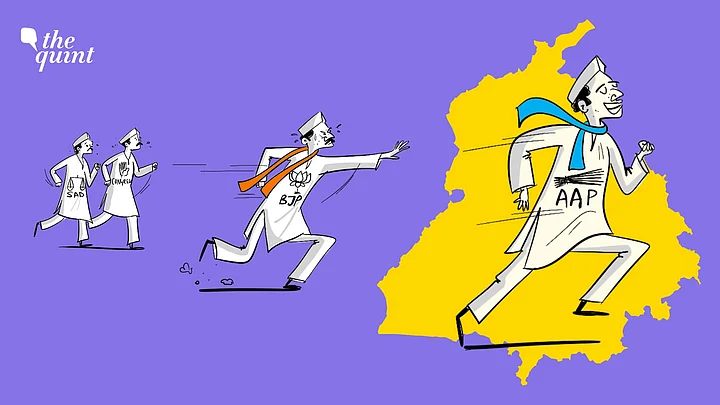
The 2026 Punjab municipal elections have redrawn the state’s urban political sketch.
The Aam Aadmi Party (AAP) emerged as the clear winner, securing nearly half of all wards and capturing five of the state’s eight municipal corporations, but the elections also revealed a second, less discussed trend—of the Bharatiya Janata Party (BJP) gradually establishing an independent foothold in Punjab’s urban politics.
At the same time, it also indicated the continuing decline of traditional political forces like the Congress and the Shiromani Akali Dal.
Conducted across 1,977 wards in 105 urban local bodies, including eight municipal corporations, 76 municipal councils, and 21 nagar panchayats, the elections served as the largest test of political strength since the 2022 Punjab Assembly election.
The verdict suggests that Punjab’s urban electorate is increasingly moving away from the political alignments that defined the state for decades.
Although the ruling party typically dominates local body elections, the AAP significantly increased its representation. This growth reflects the continuing political momentum generated by the AAP’s victory in the 2022 Assembly election, and the party successfully translating its state-level popularity into local urban governance.
The Congress, by contrast, experienced a historic decline. Once the dominant force in Punjab’s municipal politics, it lost substantial ground compared with previous local body elections. Although the party retained pockets of influence, particularly in parts of Doaba, it failed to convert dissatisfaction with the state government into a statewide urban revival.
Equally significant was the continued erosion of the Akali Dal. For much of Punjab’s post-liberalisation political history, urban local bodies were influenced by the party's extensive organisational network. The 2026 results indicate that the party’s decline, which began after 2017, has not been reversed.
Regional Patterns: Punjab’s Emerging Political Geography
Statewide totals tell only part of the story.
A closer examination of regional trends reveals that Punjab’s political competition is becoming increasingly differentiated across regions. Instead of a uniform political contest, different regions are producing distinct patterns of party competition and voter behaviour.
Malwa: The Foundation of AAP’s Urban Dominance
Malwa remained the epicentre of the AAP’s urban success. Accounting for nearly 600 wins, the region delivered the largest share of the party’s statewide gains. Major urban centres such as Bathinda, Barnala and Moga continued to support the AAP, reinforcing the party’s position as the dominant political force in south-central Punjab.
Yet, Malwa also produced one of the BJP’s most symbolically important victories.
In Abohar Municipal Corporation, the BJP secured control and demonstrated that it could win an urban local body election independently of the Akali Dal. While geographically limited, this success suggested that the BJP’s appeal is expanding beyond its traditional alliance-based framework.
Majha: Competitive Politics in the Border Belt
Majha produced a more mixed electoral picture.
The AAP remained dominant in Amritsar, but the BJP registered one of its strongest regional performances in Pathankot. The border district’s demographic profile, military presence and greater exposure to national political narratives distinguish it from much of rural Punjab.
The BJP’s performance in Pathankot suggests that the party may be consolidating support among urban Hindu voters, traders, and middle-class residents in the border belt. Although these gains do not yet constitute a regional realignment, they point to a potentially durable electoral base.
Doaba: Congress Retains Relevance
Doaba remains the one major region where the Congress continues to display organisational resilience. The party’s victory in Kapurthala Municipal Corporation prevented a complete AAP sweep of Punjab’s urban landscape and showed that the Congress retains pockets of influence despite its broader decline.
At the same time, AAP made significant advances in Jalandhar and other urban centres. The region’s politics increasingly appears to be defined by competition between the Congress and the AAP, with the BJP remaining a secondary player.
Puadh: Punjab’s Most Competitive Urban Corridor
The Puadh region, particularly the Mohali-Zirakpur-Derabassi corridor, emerged as Punjab’s most politically competitive urban zone.
The AAP retained a clear advantage, but the BJP recorded some of its strongest performances here. This pattern is significant because the region differs socio-economically from much of Punjab.
Rapid urbanisation, a growing service-sector economy, higher educational attainment, and substantial inward migration have produced an electorate that increasingly resembles neighbouring Haryana and parts of the NCR. These demographic changes may create new opportunities for political competition in the years ahead.
BJP’s Rise: Real but Geographically Concentrated
The most intriguing question raised by the election concerns whether the BJP’s gains represent a temporary urban surge or the beginning of a more durable political presence in Punjab. The evidence suggests that the party's growth is real but geographically concentrated.
Its strongest performances came in Abohar, Pathankot, Fazilka, and parts of the Mohali urban corridor. These areas share several common features: relatively larger urban populations, stronger trading and business communities, and a higher concentration of Hindu voters than many other parts of the state.
The decline of the Akali Dal has created political space that the BJP increasingly appears capable of occupying. For decades, anti-Congress urban voters were represented through the Akali Dal-BJP alliance. With that alliance dissolved and the Akali Dal weakened, the BJP has begun constructing an independent organisational base.
At the same time, the significance of these gains should not be overstated. The AAP remains overwhelmingly dominant, while the Congress continues to retain a wider presence across many urban centres. Nevertheless, the municipal elections indicate that the BJP’s long-term strategy of building an autonomous political identity in Punjab is beginning to yield measurable results.
The Bigger Story: A New Urban Party System
Despite the attention attracted by the BJP’s gains, the larger story of the 2026 municipal elections is the AAP’s transformation into Punjab’s principal urban party. The party now controls five of the state’s eight municipal corporations and commands an organisational presence unmatched by any rival.
At the same time, the elections highlighted the continuing fragmentation of Punjab’s traditional party system. The Congress has lost its position as the dominant urban force, while the Akali Dal’s decline continues.
Rather than a single statewide contest, Punjab increasingly exhibits region-specific political competition: AAP versus Congress in parts of Doaba; AAP versus BJP in emerging urban corridors; and multi-cornered contests in the border districts.
Looking Ahead to 2027
As Punjab moves toward the 2027 Assembly election, these municipal results provide several important signals.
The AAP enters the contest from a position of strength, benefiting from extensive organisational networks and control of key urban institutions.
The Congress faces the challenge of rebuilding its urban base.
The Akali Dal confronts difficult questions about its long-term relevance.
For the BJP, the elections provide grounds for cautious optimism. Although the party remains far behind the AAP in overall strength, its performance in selected urban centres demonstrates that it can compete independently in parts of Punjab’s evolving political landscape.
The municipal elections may, therefore, be remembered as the contest that revealed the emerging contours of Punjab’s next political realignment. The urban political map may not have been completely redrawn, but its contours have undeniably changed.
(The author teaches Political Science at Amity University Punjab, Mohali.)
