
ADVERTISEMENTREMOVE AD

Two U-Turns in Chandigarh: What's Modi Govt's Punjab Strategy?

Centre's U-turns on the Chandgarh Amendment and Panjab University Senate are wins for Punjab's civil society.

Published
story-hero-img
i
Aa
Aa
Small
Aa
Medium
Aa
Large

"Punjab has defeated the Modi government again". This was the sentiment at Panjab University after the administration announced the schedule for the university senate elections, agreeing to the demands of the protesters.

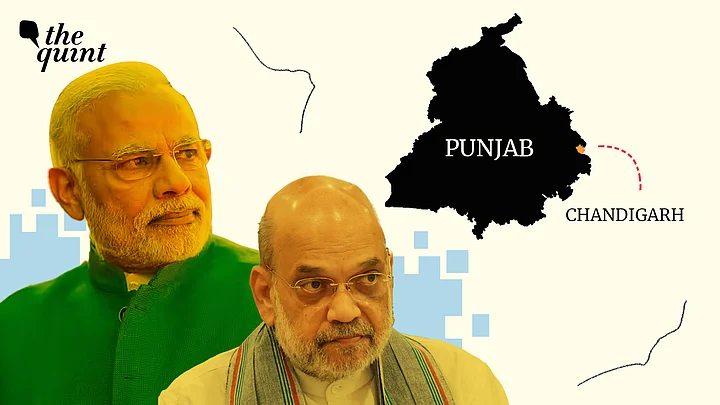
In less than a month, the Modi government has taken two U-turns in Chandigarh.

First, it went back on its decision to dissolve the Panjab University Senate.

Second, it withdrew its own proposal to bring a constitutional amendment enabling the Centre to govern the Union Territory of Chandigarh directly. The move would have brought Chandigarh under a Lieutenant Governor and done away with the arrangement of the Punjab Governor being the ex-officio administrator of Chandigarh.

Both these measures sparked outrage in Punjab as it opened old wounds.

For instance, the Governor arrangement that has been in place since 1984, is seen in Punjab as a symbolic acknowledgement of the state's rightful claim over Chandigarh. PU is seen as replacement of Panjab University that the state lost during Partition.

Now with the L-G move withdrawn and schedule the PU Senate elections announced, it's a major win for Punjab's civil society.

However, the question is - what really is the BJP's strategy in Punjab? What was it trying to achieve through these moves in Chandigarh? And what explains the quick U-turns that it took?

We will try and answer these questions in this piece.

ADVERTISEMENTREMOVE AD

The Chandigarh Moves and Punjab BJP

The L-G move seems to have been Prime Minister Narendra Modi and Union Home Minister Amit Shah's way of testing the waters regarding public sentiment in Punjab. It came in the aftermath of the protests against the dissolution of the Panjab University Senate that was later withdrawn. It came in the aftermath of another event, which we will discuss later in the article.

The two U-Turns also served another purpose - it was the BJP top brass' way of building the credibility of the BJP's Punjab unit.

The Punjab BJP had expressed mild dissent on both the Panjab University and Chandigarh Amendment issues. By agreeing to the Punjab unit's position, the BJP central leadership is trying to adopt a good-cop-bad-cop strategy - that the Centre is capable of taking drastic measures affecting Punjab, but the Punjab BJP can be trusted as an arbiter of the state's interests.

"PM Modi is a reality. People in Punjab need to realise this. Isn't it better if the relationship is based on negotiation and not protests?" a Punjab BJP leader asked, while speaking to The Quint on the condition of anonymity.

The Punjab BJP's belief is that there is a fatigue in Punjab over "protest culture" and that it is in the state's interests to shun the path of confrontation with the Modi government.

Punjab BJP chief Sunil Jakhar does often speak of issues like federalism and his views occasionally don't align with that of the BJP top brass.

The BJP's central leadership believes this difference of opinion may help the party gain credibility in Punjab and grow beyond its core base of urban Hindu voters.

So in that sense, Jakhar's views can also be seen as curated dissent.

This trend can also be seen in Union Minister Ravneet Bittu's recent statement criticising the AAP government in Punjab for the continued incarceration of Khadoor Sahib MP and hardline leader Amritpal Singh.

Possibility of an Alliance With Akali Dal

The Shiromani Akali Dal (Badal) put up a decent performance in the recent bypoll to the Tarn Taran Assembly constituency. It came a strong second, securing 26 percent votes despite its main leader from the seat, Harmeet Singh Sandhu, shifting to AAP as its candidate. In the Panthic space, it also managed to withstand a surge in favour of Amritpal Singh-backed candidate Mandeep Singh Khalsa.

With the rebel Akali Dal led by Giani Harpreet Singh opting out of the race and backing Mandeep Singh, SAD (Badal) managed to send the message that it remains the main moderate Panthic force in Punjab.

The SAD's performance once again sparked speculation of a possible rapprochement with the BJP. On paper, this works for both parties. The BJP has so far failed to grow in rural Punjab, though it has managed to increase its organisational footprint. On the other hand, the SAD remains a distant fourth in urban Hindu-dominated seats and is in no position to compete with the AAP, Congress or BJP in this demographic.

However, the BJP remains divided. In a recent interview, former Punjab CM and BJP leader Captain Amarinder Singh recently for revival of the SAD-BJP alliance.

However, BJP sources reveal that the party wants to prioritise its own growth in Punjab and not jump into an alliance with SAD at this juncture.

The belief is that the SAD didn't let the BJP grow in rural Punjab, except for Hindu-dominated areas. The Rashtriya Swayamsevak Sangh functionaries also have a grievance that the SAD didn't do enough to build a bridge between it and Sikh bodies, such as the Akal Takht Hukamnama against the Sangh.

There's another factor here. The BJP was still willing to play second fiddle to the SAD as long as Parkash Singh Badal was alive and the Akalis were the dominant party in Punjab.

"We have the highest respect for Badal Senior. But the situation is now different. The SAD isn't as strong as it was earlier. On the other hand, the BJP has grown immensely under PM Modi. The terms of the alliance cannot be the same as before," a BJP functionary familiar with the party's matters in Punjab.

The BJP's calculation is that if at all it has to ally with the SAD, it should be on the eve of the 2027 Assembly elections and not any time before that.

Even then, it would prefer a Nitish Kumar or Eknath Shinde-like situation in which the BJP remains the dominant partner even under an ally CM.

ADVERTISEMENTREMOVE AD

BJP Base Pulling in a Different Direction

The problem for the BJP is that its ideologically motivated base across the country and a large part of its rank and file, favour a "Kashmir-style solution" in Punjab.

There is resentment in this section at the "hostility" towards the BJP in Punjab during the farmers' protest and Sikh outfits' and farm unions' consistent criticism of the Modi government's policies.

There was considerable support in the party base for the crackdown against Amritpal Singh's Waris Punjab De.

This brings us to the second event we mentioned above.

The push for a 'decisive approach in Punjab' was further intensified after the recent killing of a Rashtriya Swayamsevak Sangh volunteer Naveen Arora in Ferozepur on 15 November. Arora is from a prominent RSS family - his father Baldev Raj Arora is a senior RSS leader and his grandfather Dina Nath Arora was also associated with the Sangh.

There is a strong feeling in the BJP, RSS and Arya Samaj-affiliated outfits in Punjab against what they call "target killings" of pro-Hindutva individuals in the state. This section wants the Centre to play a more pro-active role in managing the security situation in the state.

ADVERTISEMENTREMOVE AD

What Happens Next?

It appears that the Modi government is weighing its options on Punjab and the now discarded Panjab University and Chandigarh Amendment moves were probably attempts at testing the waters for some bigger decisions.

On the electoral front, BJP is closely watching developments in Punjab and it is contemplating a three-pronged approach.

First, it's hoping for a split in the Panthic space due to the emergence of multiple political actors.

Second, it might align with one or more of the smaller regional outfits.

Third, it may hope for or maybe even work towards a split in either the Congress or AAP.

But there are several roadblocks that lie in the BJP's way. The recent moves in Chandigarh, though aborted, have only increased the distrust towards BJP in Punjab. Farm unions, many student outfits and Sikh bodies are still mostly against the BJP.

While BJP may be the number one choice of urban Hindu voters at the Lok Sabha level, the same may not hold true at the Assembly level. The BJP dominated this demographic in both 2014 and 2019 Lok Sabha elections but it did poorly in the 2017 and 2022 Assembly polls as urban Hindu voters backed the Congress and AAP, respectively.

It has been Punjab's track record that ideological voting among both Panthic and urban Hindu voters is higher in Lok Sabha elections and lower at the Assembly level. Parties that are locally entrenched and have the capability to get votes from across all sections of society have an advantage at the Assembly level.

The next few months will be crucial. The battle of wits between the Centre and Punjab civil society is only going to intensify.

Speaking truth to power requires allies like you.
Become a Member
Monthly
6-Monthly
Annual
Check Member Benefits
×
×