Out of the 131 individuals being conferred with Padma awards in 2026, 38 or about 29 percent happen to be from states that are going to vote in Assembly elections this summer: Tamil Nadu (13), West Bengal (11), Kerala (8), Assam (5) and Puducherry (1).
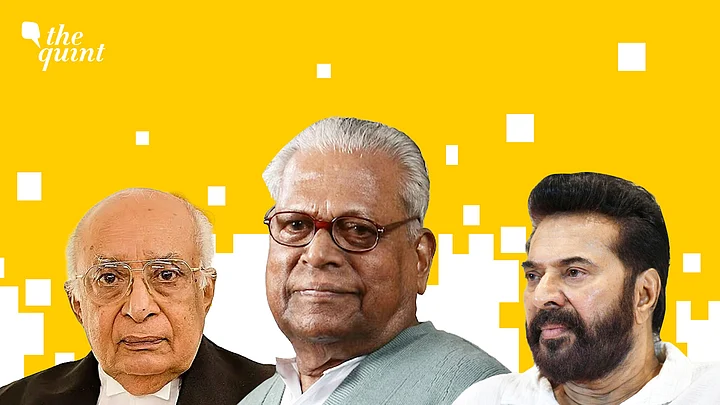
With no Bharat Ratna being awarded in 2026, the Padma Vibhushan remained the highest civilian award announced by the Narendra Modi government in 2026. Significantly, out of the five Padma Vibhushan recipients, three happen to be from Kerala: former chief minister and Communist stalwart VS Achuthanandan, writer/journalist P Narayananan and retired Supreme Court judge KT Thomas.
Individuals from Kerala received two Padma Bhushan awards: film actor Mammootty and SNDP Yogam leader Vellappally Natesan. Padma Shri was given to dance teacher and exponent Kalamandalam Vimala Menon, forest conservationist Kollakayil Devaki Amma and ISRO scientist AE Muthunayagam.
So what's the calculation behind the Modi government's focus on Kerala, especially in its choices for Padma Vibhushan?
There are three factors behind this: Caste, ideology and the need to woo floating voters.
This is particularly evident in the Padma Vibhushan being given to VS Achuthanandan, who has been an ideological opponent of the BJP-RSS throughout his career.
Padma Vibhushan for VS Achuthanandan
The reason behind awarding VS Achuthanandan isn't just his prominence or the fact that he passed away in 2025. Had that been the case, the government could have given an award to former Kerala CM Oommen Chandy as well in the three award cycles that have gone by since his death in 2023.
The choice of VS is more to do with political calculations.
Whenever the BJP has given the Bharat Ratna or Padma Vibhushan award to leaders outside their ideological ecosystem, it has mostly been to co-opt their legacy.
For instance, in 2024 it gave Bharat Ratna to Chaudhary Charan Singh, which acted as a catalyst for Rashtriya Lok Dal chief and Charan Singh's grandson Jayant Chaudhary shifting from the INDIA bloc to the NDA.
The same year, the government awarded Bharat Ratna to PV Narasimha Rao and Pranab Mukherjee, as an overture to Congress leaders who may have been feeling "sidelined" by the Gandhi family.
In 2024, it also awarded the highest award to former Bihar CM Karpoori Thakur as an attempt to blunt the INDIA bloc's caste census pitch.
This raises the question: why is the BJP trying to co-opt VS Achuthanandan, a staunch Communist?
This is related to the three factors we discussed above: caste, ideology and floating voters.
Caste
VS was from the Ezhava community, the largest OBC community in Kerala and a traditional votebank of the Left Front.
Based on both surveys and the BJP's own estimates, the party has a good chance of increasing its influence in this demographic.
According to the latest survey by Vote Vibe (January 2026), the NDA at 31 percent is just three percentage points behind the Left (34 percent) among OBC voters in Kerala, and both are well ahead of the Congress-led UDF (20 percent). In contrast, the NDA's gains among Christians have been nearly negligible as only 6 percent Christian respondents expressed a preference for them.
The NDA remains the top choice among dominant caste voters (Nairs, Brahmins etc), at 46 percent and it needs to win over one more numerically strong community to have even a chance of coming to power in the state.
The Padma Bhushan award to SNDP leader and BJP ally Vellappaly Natesan should also be seen in this context. He heads the Sree Narayana Dharma Paripalana Yogam, the most important organisation of the Ezhava community. The award was also the BJP's expression of support for Natesan, who was facing flak for recent anti-Muslim remarks.
Floating Voters
The recent local body elections seem to have made it clear to the BJP that the UDF is succeeding in consolidating its core base of Christian and Muslim voters and there is very little chance of making any inroads among them. The NDA is also likely to lose some ground among Nair voters compared to the Lok Sabha elections as three of the biggest faces of the Congress in the state happen to be from the same community: VD Satheesan, KC Venugopal and Ramesh Chennithala.
In contrast, the level of dissatisfaction is higher among LDF voters, especially younger ones. The BJP believes that it may be able to win over a section of LDF voters who may prefer the party over the UDF.
Giving Padma Vibhushan to VS is the BJP's way of reaching out to the dissatisfied LDF voter.
The party is also likely to try to capitalise on the perception that VS, known to be a mass leader, was sidelined by CM Pinarayi Vijayan and his loyalists.
Ideology
There's another aspect to this. VS Achutanandan as CM was accused of "soft Hindutva" as he had accused Muslim outfits like Popular Front of India of trying to turn Kerala into a Muslim-majority state in 20 years by "influencing youth an convert them to Islam by giving them money".
Though VS remained anti-Hindutva for much of his career, the right wing latched on to this statement. In fact, it was cited even in the film Kerala Story.
The bogey of demographic change is one of the BJP's major pitches in this election, and its attempts to co-opt VS must also be seen in this light.
Ideology and the RSS Factor
The RSS imprint is far more clear in the other two Padma Vibhushan awardees. P Narayanan has been associated with the RSS since decades. He was the state organisation general secretary and national executive member of the Bharatiya Jana Sangh, the precursor to the BJP. He was also the co-founder and chief editor of Janmabhoomi, a newspaper started by Jan Sangh in the 1970s.
Justice (Retired) KT Thomas, though not associated with the RSS, is a known Sangh sympathiser. He has praised the RSS on a number of occasions.
In 2011, he had praised the Sangh for its "discipline" and called it a victim of a "smear campaign" connecting it to Mahatma Gandhi's assassination. At that time, he had said that RSS is "not anti-minority".
In 2018, he had said that "After the army and Constitution, RSS keeps Indians safe".
In 2025, on the eve of RSS' centenary, Thomas gave RSS credit for forcing "PM Indira Gandhi to lift the Emergency".
It must be remembered that even though the BJP may not have achieved electoral success in Kerala, the RSS has always been strong in the state. By awarding a life-long RSS functionary and a Christian judge soft on RSS, the BJP is trying to send a message to its core supporters. These are people who have been working for the Sangh since decades despite having no chance of coming to power in Kerala.
The Need to Broaden BJP's Appeal
Under Modi, the BJP has been on a constant rise in Kerala. From the 5-6 percent it averaged in Assembly elections in the 1990s and 2000s, the BJP and allies secured 11-12 percent votes in 2016 and 2021. The increase at the Lok Sabha level has been even more significant: from 6.5 percent in 2009 to 10.8 percent in 2014, 15.6 percent in 2019 and 19.2 percent in 2024. In contrast, the LDF has gone down at the Lok Sabha level from 42 percent in 2009 to 33 percent in 2024 even though it has remained strong at the Assembly level.
So far, the pattern over the last decade has been that a portion of LDF voters at the state level choose either Congress or BJP at the national level. The same holds for a section of state-level Congress voters as well.
The challenge for BJP this time is two-fold: preventing any leakage in its Lok Sabha voters and gaining a sizable chunk of voters at the Assembly level to take it past 25 percent. Only then can its votes convert into seats.
This can't be done so long as the BJP is considered an ideological fringe in the state. There may still be voters who would vote on ideological lines at the Lok Sabha level, at the state level voters tend to prefer a party that has a realistic chance of coming to power.
In a state like Kerala, the BJP can appear viable only if it presents itself as a party that can take diverse sections along, not just its own ideological base.
The selection of Mammootty, Achuthanandan and some of the other Padma Awardees not from the Sangh needs to be seen in this light.