"What happened with me, I don’t want to suppress it, I want to express it. Even now, I still I don’t regret going to the protest at all."
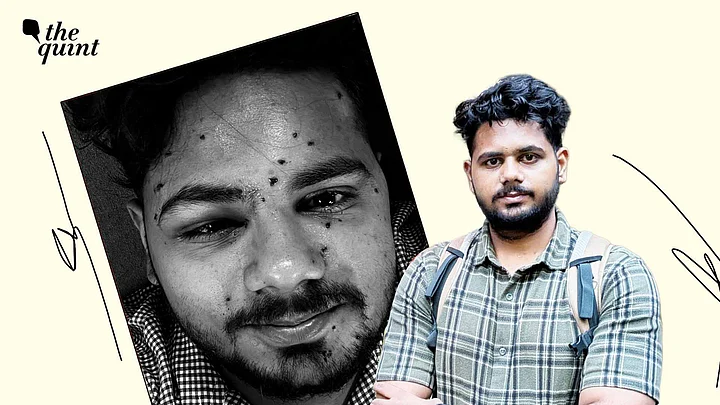
A shaken, but undeterred Sheikh Irshad Mansoor told me on 30 July — a day he found himself sandwiched between one media interview after another. The pellet marks on his face and neck have only now subsided a bit since he faced police brutality on 20 July amid the CJP-led student protests at Jantar Mantar.
In a week, Mansoor's view of a protest, state and the police has drastically changed. Mansoor was the first known case of a pellet victim in Delhi — also the only one who was visited by a BJP Minister, JP Nadda.
"On 20 July, I thought that after the protest, I will go home and then take my father to Gurugram's Cyber Hub. He was waiting for me at home but life had other plans," recalled Mansoor with a faint smile.
This interview was taken in a cab while he was on his way for another interview. "I'm trying my best to put my story forward because I'm asking for accountability."
But who is Irshad Mansoor? How have pellet wounds impacted his life?
The image of blood oozing out of his wounds from the pellet wounds has not left his mind, but he also often thinks about the mundane and simple life he had led before 20 July.
Mansoor belongs to Patan town near Jabalpur, Madhya Pradesh. He was just nine years-old when his mother passed away. The youngest of three siblings (eldest sister and an elder brother), Mansoor left his home as soon as he turned 18. "I am a traveller," he describes himself.
An Accounts Manager at a private company in Gurugram, Mansoor arrived in Delhi three years ago. He graduated in MBA from Indore and did his Bachelors in Geology. In Jabalpur, he studied at a convent school.
Interestingly, Mansoor attempted the competitive examination NEET in 2019 but did not pass the same. Six years later, he found himself at a protest based on the outrage over NEET paper leaks, galvanised by satire-turned-movement, the Cockroach Janta Party.
The student protest in Delhi was the first protest he had attended.
"Did Not Know The Word 'Pellet' Before"
Mansoor had visited the protest site around a week before the 20 July incident. He narrated to The Quint what exactly transpired on the day police unleashed tear-gas, lathi-charge against the protestors.
As per his own account, Mansoor went to site early in the morning at 9 AM. Then he went to attend to some of his personal work.
He returned to the protest site around 3:45 PM. This time too, he was alone.
He stated that he was walking towards the inner circle and then to the main protest site when he saw police and Rapid Action Force (RAF) lathi-charging and firing tear-gas at the students.
"When the police saw us, some of us protestors were raising our hands to convey peace and surrender. The protestors were saying they are not anti-nationals, terrorists or violent," he recalled.
"In an instant, an RAF official positioned his weapon (pellet gun) and then he fired. I heard a loud sound and the bullet came right at me and hit slightly above my left eye. the fragments of the bullet hit and penetrated other parts of my face and neck. The cartridge hit my chin and some of its pieces got stuck to my chin, lower neck and penetrated into my skin."Irshad Mansoor to The Quint
Mansoor said the pellet hit him with brute force. Within a few seconds, the pellet broke into his skin and he started bleeding from his wounds.
"More than 40 pellet wounds were found on my body, the doctors counted and told me," he said.
Mansoor said that although he was conscious but he could not think how to prevent bleeding. Some boys in their 20's saw him and kept a cloth over his wounds to control the bleeding. They took him to a nearby vehicle and then to Lady Hardinge hospital.
When I asked Mansoor what was going through his mind in that moment, he said, "I had donated blood to a 10 year old suffering from cancer, five days ago before I was shot with a pellet gun. After seeing all that blood, I thought I might have some blood issue, thankfully that was not the case."
That day, Mansoor did not know there were pellet injuries until much later.
Once all his scans got over at night on the same day, he was informed of the pellet wounds.
The result came that there were over 40 hits, and there were major 3 pellet pieces that had deeply penetrated. The main one was in my neck, there is a nerve which circulates the blood, so the pellet stopped just 1.mm distance to this nerve. Had the pellet went further inside and crossed this nerve, there would have been internal bleeding, a stroke and I would have died.Irshad Mansoor to The Quint
The second one is his left eye. The pellet hit the part of his eye which controls eye movements. Third one was his cheek, where in the cavity and fluid area, a pellet fragment had penetrated and was poisoning the spot and hence, had to be removed. These removals were done through his nose and mouth.
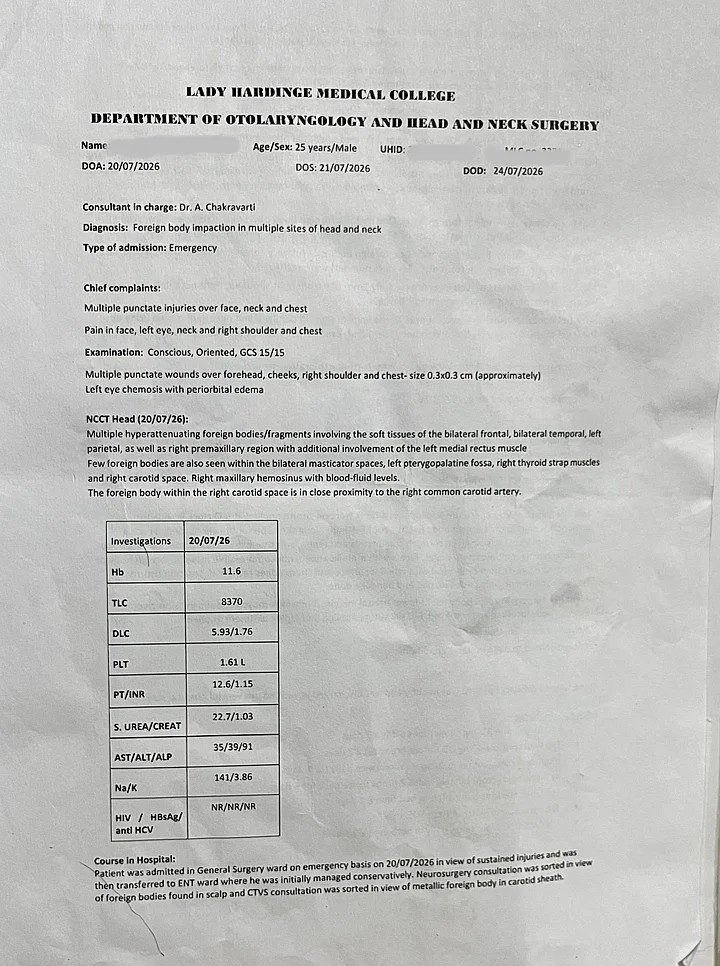
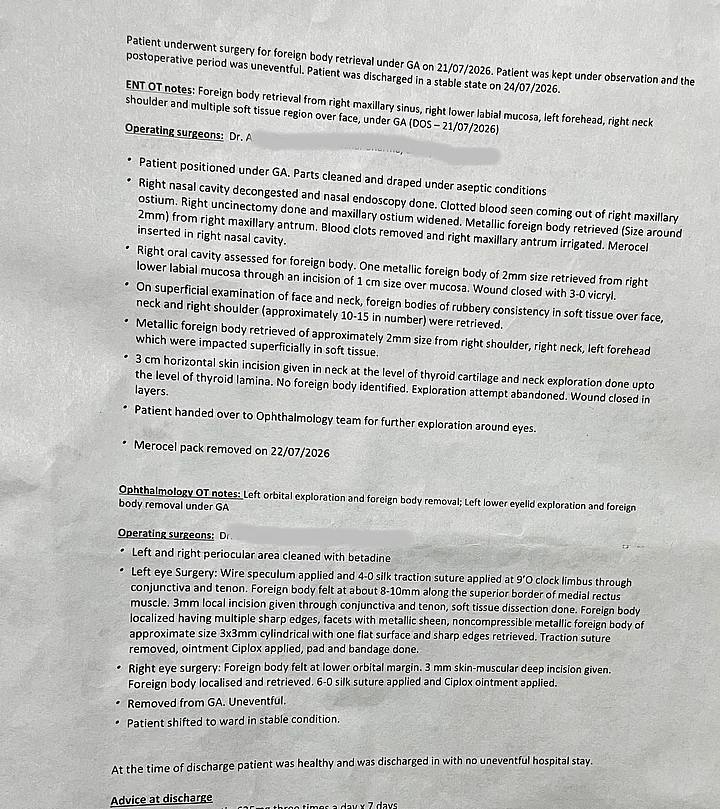
"On 21 July, I went through four surgeries and seven metallic pellets were removed," Mansoor told The Quint. We also accessed his discharge report from the hospital which notes the 'metallic foreign body' in parts of his body several times.

Discharge summary report from Lady Hardinge hospital.
(Photo: Accessed by The Quint)
However, he has not yet received the MLC report from the hospital.
Mansoor's case had also come to the limelight after Union Minister JP Nadda paid him a visit at the hospital.
ANI had posted a video about their meet, but the audio was muted.
Speaking to The Quint, Mansoor narrated his conversation with Nadda:
"It was a 10 minute conversation that they trimmed to 10 seconds. JP Nadda asked my name and where I was from. He asked me why I was there at the protest. I confidently told him that I was part of the protest, with my younger brothers and sisters. I was there to speak up against the corruption in the education system. He did not say anything to it, just smiled and pat my back twice. And then he said don’t worry, the team and HODs, they will help you and get the pellet removed."
On 24 July, after his treatment, Mansoor was discharged from the hospital.
A Police That Still Denies
These accounts of pellet victims also debunk the police's lie. On 22 July, the Delhi police, responding to The Hindu's journalist wrote that the claims of Delhi forces using pellet guns against protestors are "completely false and misleading."
This, despite accounts like that of Mansoor revealing what one protestor went through. Similarly, there have been at least three other identified pellet victims as reported.
Responding to the police's post, Mansoor said, "How I see it, I don’t think it’s just one officer or personnel, this decision to fire pellet guns must have come from some senior official, allowing them to use pellet guns arbitrarily."
RAF chief admitted to using 'excessive force' as he pulled the personnel and their commanders for the 20 July incident, as per The Print's report.
After facing the deadly pellet guns, Mansoor stated that started studying about pellet guns in detail.
He researched how pellet guns were used in Kashmir for the first time in 2010 and then again in 2014. How they were used in Manipur and then in farmers protest until they were used again during the latest student protests.
But what has also shocked Mansoor, being a pellet victim himself is the argument recently made in the Supreme Court.
On 30 July, while hearing a plea on the use of metallic pellet guns in the student protest, Justice Joymalya Bagchi said, "Prayers are not to use pellet guns. In exceptional cases, police regulations permit the use of pellet guns..."
Mansoor is one of the petitioners in this case.
"I have read about police's crowd management and there is a hierarchy and classification of the weapons that can be used. For students, the least that could have been used was a water cannon but there was not a single water cannon that day," said Mansoor.
He continued, "Students protesting peacefully are not exceptional situations. The police used lathi-charge which has some protocols, and they cannot use lathis on upper body, especially against those who are not armed. But they hit on heads, backs and did not see if there was a boy or a girl they were hitting."
The petition has been filed in the Supreme Court seeking a ban on the use of these pellet guns. The main petitioner is Yashovardhan Azad, former IPS, the second petitioner is Prashant Kumar Singh, another pellet victim and the third is Mansoor.
The petition argues, "It is pertinent to note that the victims were hit by pellets in Connaught Place inner circle area when they were retreating from Jantar Mantar. Thus, this is not a case of a security personnel firing the weapon on an aggressive mob marching into or towards Parliament. There is no emergent situation to justify the use of the said weapon."
Further, the petition points out the dangerous nature of the pellet guns, stating that they target a wide zone in the general direction they are fired, thereby increasing the likelihood of injuring the eyes and other vital organs. "The very mechanism of the pellets disqualifies them from being a legally valid option for crowd control..," reads the petition.
To keep the fight alive through this petition was not an easy decision for Mansoor.
"A lawyer connected me to Advocate Vrinda Grover, she has always fought for human rights. As a student, I was scared because I have to think about my future also." But now, for Mansoor, the priority is to get some accountability from the police forces.
In my view, a lot of wrong has happened. Most importantly, the police cannot execute these actions by themselves. There is no accountability. Someone must have given them these pellet guns, who authorised them to use them and why? And allowed them to use them there?Irshad Mansoor to The Quint
'Pellets Are Part Of My Body Now' — The Wound That Remains
When all is said and done, Mansoor still believes that he did not do anything wrong by joining the Jantar Mantar protest. He says that he chose "to stand with his brothers and sisters."
But the pellet injuries have left wounds that cut deep.
It still pains in my wounds. The last time I took a shower was on the 19 July. Because I cannot take one right now but I clean myself carefully because of the wounds and stitches. If I press the towel against my face even a little bit while cleaning then it pains a lot in every wound.Irshad Mansoor to The Quint
Mansoor also told us that there is one pellet that still has not been removed from his neck as doing so could be fatal.
"One pellet has penetrated close to my nerves just below my neck. After a month, a layer would form around the pellets and they won't move. I have consulted doctors and experts who told me it's normal and to let it stay there."
As Mansoor now recovers the brute violence he faced in the student protest, he also grapples with a legal fight in the court and numerous media interviews to show himself as a living proof of an unarmed protestor who faced pellet guns in the national capital.
Only once did the thought of 'why did I come to this protest?' cross his mind when he was hit with the pellet, but the thoughts disappeared soon.
"I have not a single regret. Not even 1%. I did not think again as to why I was there. Kuch paane ke liye kuch khona padta hain, and I think we did exactly that," remarked Mansoor as he headed home after a long, wearying day.