(Help us write and commission more such long-form stories by becoming a member)
I came to Jamia Nagar in 2004, dropped off by a bus from Chandigarh at the Kashmiri Gate stand just before dark, carrying the residue of a science education I had failed rather thoroughly and a fresh decision to study commerce instead. The auto driver who finally agreed to take me to Jamia Nagar spent the ride narrating everything he believed about the locality, its people and its habits, clearly assuming that a boy in modern clothes could have no real business there. I let him talk and did not correct him, mostly because correcting him felt riskier than staying quiet.
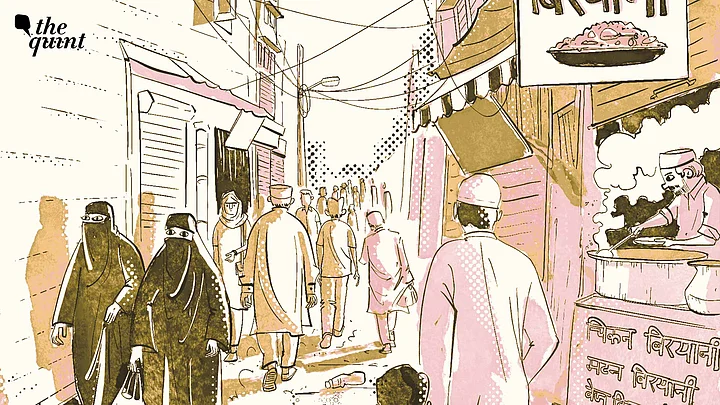
My first sight of the place matched his account closely enough to unsettle me. Open drains, narrow lanes, meat shops advertising Nihari and Biryani along what passed for a main road, women in burqas moving in cheerful clusters I had never seen before in such numbers, all of it pressed in at once. I thought, in that first hour, that this was not a place meant for someone like me, before remembering that I was, in fact, exactly the kind of person it had been built for.
My landlord in those first weeks was an elderly man named Hafeez Sahab. He had been a schoolteacher before retiring, and he let out two rooms on the upper floor of his house to students. Without ever asking, he took it upon himself to feed any tenant who seemed to be skipping meals out of either poverty or homesickness. I was skipping meals out of homesickness, and within a week he had worked this out simply by watching how long I lingered near his kitchen door in the evenings.
From then on a plate would appear outside my room most nights, sometimes with a note in Urdu I could not read and had to get a neighbour to translate, usually some variation of "eat properly, your mother is not here to scold you". He never once asked for extra money for the food, and when I tried to offer some after my first pocket money arrived, he waved it away with the kind of irritation that made clear the offer had offended him more than helped.
Jamia Millia Islamia gave me something none of my earlier schools quite managed: a sense that I did not need to explain myself.
Nobody there asked why I skipped pork or wanted an account of my family's history before deciding whether to trust me. I made friends spanning class lines I had not previously noticed, sons of university guards sitting beside the children of bureaucrats in the same lecture halls, and for the first time since leaving Gaya I felt something close to ease. To understand what that ease meant, I have to go back to where the fear started, long before I had ever heard the name Jamia Nagar.
Before Jamia Nagar: Gaya, 1992
A particular kind of silence falls over a Muslim household when the world outside catches fire. I learned that silence young, in Gaya, on a December evening in 1992, when I was five years old and too small to understand why the television had stopped showing cartoons. My father, then a clerk at Vijaya Bank, paced the room without speaking, and my mother gathered my brother, my sister and me into a single huddle, as though her arms alone could hold back whatever was coming. Men in saffron were climbing a dome on the screen. I did not know the words Kar Sevak or Babri Masjid or Ayodhya, but I knew fear when I saw it on my father's face, and that was the first lesson Indian politics ever taught me.
I remember, too, that my mother had been frying something in the kitchen when the news broke, and that the smell of burning oil hung in the flat for the rest of that night because nobody thought to go back and turn off the stove. Small domestic details like that have stayed with me longer than the political ones, perhaps because a child's memory keeps what it can hold rather than what it ought to. My father did not eat dinner that night. He sat by the window with the lights off, watching the street below as though something might come up it, though nothing ever did in Gaya, that quiet town simply absorbing the news the way it absorbed most things, slowly and without drama.
My father belonged to a generation that believed in the ledger of effort and reward. He had worked his way up from a modest clerk's desk through hard study and longer hours, the kind of climb that eventually made him an officer, and he wanted the same discipline passed down to his children. My elder brother obliged spectacularly, training later at IIT Kanpur, while I struggled through subjects that asked for a kind of precision I did not possess. We moved often in those years, following my father's postings, and each new town brought its own classroom and its own way of reminding me what I was.
One of those postings took us briefly to a small town where my father was the only Muslim officer at his branch. A colleague there, a man named Tiwari who became something close to a family friend, would visit our house each Eid with a box of sweets bought from the only good shop in town. He would sit on our veranda for an hour, drink two cups of tea, and leave without ever once raising the subject of religion, as though the visit itself was the point and any conversation around it was decoration. I did not understand, as a boy, what an unusual thing that friendship was, or how carefully both men had built a small private space where the wider country's suspicions did not apply. I understand it better now, having watched how rare such spaces have become.
At Nazareth Academy in Gaya, where I studied through the nineties, the world still felt insulated. It was a missionary school filled with the children of doctors and engineers, and faith counted for less in the corridors than exam results did. Even there, though, the debris of 1992 found its way in eventually. I remember a drawing class in which I began sketching the dome of a mosque, the kind of outline I had grown up around at home, and a friend leaned over to whisper that I should not bother, since such domes would only be broken again. He went back to colouring his mountains without any apparent malice, and I sat there ashamed of a drawing left unfinished, having absorbed without being told that certain symbols were temporary by nature.
There was another boy in that same class, a Bengali Hindu named Partha, who noticed what had happened. Without making a show of it, he tore a page from his own notebook and began sketching a second dome beside mine, slightly larger and slightly wobblier, the way an eleven year old's hand tends to wobble. He did not say anything about why he was doing it. He simply finished his drawing, slid it across the desk so it sat beside mine, and went back to his mountains as well. I have lost touch with Partha in the years since, the way one loses touch with almost everyone from that age, but I have thought of that gesture more often than I have thought of the insult that prompted it, perhaps because it taught me early that cruelty and decency in this country have always travelled in the same room, often carried by people who would never think to call themselves either one.
Patna Central School, where I studied from 2000, offered a rougher introduction to the world beyond the classroom. The towers fell in New York in September 2001, and within days the atmosphere in school had changed in ways a teenager could feel without being able to name. A year later, the smoke from Gujarat drifted into our drawing rooms in Patna through nightly bulletins, and stories arrived of neighbours turning against neighbours while uniformed men looked away. I was old enough by then to read a newspaper properly, and old enough to register that being middle class, educated and outwardly indistinguishable from anyone else offered no particular protection.
I remember a geography teacher at that school, a stern woman named Mrs Verma who rarely showed any warmth to anyone, calling me to her desk one afternoon during that period and asking, without preamble, whether my family was safe and whether we needed anything. I had not expected the question from her of all people, and I mumbled something noncommittal before she nodded and sent me back to my seat, never raising the subject again. I have wondered since whether she asked the same question of the other Muslim students in the school, or whether mine was a singular kindness extended in a singular moment, but either way it remains one of the few adult interventions from that period I remember as wholly uncomplicated.
On the school playground around that time, a friend once warned the others, in the middle of some trivial dispute, to be careful with me because I would call in reinforcements from Al-Qaeda. The group laughed, and I laughed along with them, because laughing seemed safer than explaining that I had never met anyone from Al-Qaeda and would not have known where to find them. That same year, during a cricket match between our section and the section next door, an argument broke out over a disputed run, and the boy I was arguing with, red faced and out of better insults, called me a Pakistani agent in front of the entire ground. The umpire, a physical education teacher who had no patience for theatrics, simply told both of us to be quiet and play, and the match continued as though nothing had been said. I have noticed, looking back, how often that was the actual response such moments received, not condemnation and not agreement, just an adult impatience that treated the insult as noise rather than as the small violence it actually was.
A year at DAV Panchkula, after another of my father's transfers, taught me a shorter and blunter word for the same idea. Boys there called me mullah without bothering with metaphor, as though my brother's place at one of the country's finest engineering institutes meant nothing once the word had been spoken. I remember one particular boy, the son of an army officer, who took to greeting me each morning with an exaggerated salaam, hands pressed together in mock prayer, until a teacher overheard him one day and made him stand outside the classroom for the remainder of the period. The punishment did not stop him entirely, but it slowed him, and I remember feeling a small, complicated gratitude towards a teacher I otherwise found unremarkable, gratitude for an intervention that should not have needed to happen at all.
That is what arrived with me on that bus from Chandigarh in 2004. The silences of Gaya, the cricket field insults of Patna, the mock salaams of Panchkula, all of it rode along. Jamia Nagar did not erase any of it. But for a while, inside Hafeez Sahab's kitchen and the lecture halls of Jamia Millia, it loosened its grip.
The Friday That Changed Everything
That ease ended on a Friday in September 2008, deep in Ramadan, when gunfire tore through a building called L-18 in Batla House, a short walk from where many of us lived. Two young men, Atif Amin and Mohammad Sajid, were killed in what the Delhi Police labelled an encounter with members of the Indian Mujahideen, and a third, Mohammad Saif, was arrested. An inspector from the Special Cell, Mohan Chand Sharma, also died that day, and television channels gave his funeral the kind of coverage that left little room for any account but the official one. I had skipped Friday prayers that afternoon, staying back in my hostel room out of nothing more than the lethargy of fasting, and I have never quite decided whether that absence was coincidence or some half formed instinct. What followed drained a particular kind of innocence out of an entire generation of us.
I remember the hours immediately after the news broke with a strange, fractured clarity, the way one remembers the minutes before an accident rather than the accident itself. A friend from the floor above mine, a quiet boy from Kishanganj who rarely spoke above a whisper, came pounding on my door asking if I had heard, and we sat together in front of a small television set borrowed from another room, watching a reporter stand outside L-18 talking about a building that, until that morning, had simply been one more building among many. By evening the same reporter was talking about the locality itself in terms that made it sound less like a neighbourhood and more like a diagnosis.
The campus turned watchful within hours. Police vans patrolled the lanes around the university, journalists crowded the streets outside our hostels, and friends began carrying identity cards as though a laminated photograph might offer some protection against arbitrary suspicion. I remember one classmate, an engineering student with nothing whatsoever to do with politics of any kind, being stopped twice on his way back from the market that same evening and asked to produce identification, until he started carrying his student card not in his wallet but in his shirt pocket, within easier reach, a habit he kept for years afterwards even once the immediate danger had passed.
The Jamia Teachers' Solidarity Association soon documented a list of irregularities in the police account, missing independent witnesses, a mismatch between the bullets fired and the forensic findings, a sequence of events that did not hold together under any close reading. None of it altered the official conclusion. When the National Human Rights Commission reviewed the case the following year, it cleared the police without conducting anything resembling a thorough on site inquiry, and the matter was declared closed in a manner that felt less like resolution than instruction.
I remember a candlelight vigil near the university gate in the days that followed, students standing in a silence broken occasionally by a professor's voice, cracking as he told us that what had been lost was not only two young lives or one officer's but the basic possibility of trust between citizens and the state meant to protect them. A girl standing near me, a postgraduate student I barely knew, held her candle so tightly that the wax ran down over her fingers without her seeming to notice, and when I quietly pointed it out she only shook her head and kept standing there, as though the small burn was somehow fitting for the evening.
Azamgarh
Several students were picked up for questioning in the weeks afterwards, their names printed on television screens with an enthusiasm that suggested triumph rather than reporting. I travelled to Azamgarh not long after with a few classmates, a district the press had taken to calling Atankgarh, and sat in the home of a mother whose son had left for Delhi to study and had not returned. Her grief carried a clarity no official report could touch, and the visit taught me something about how easily an entire community could be branded by association with events its members had no part in.
On that same Azamgarh trip, we stopped at a small tea stall near the bus stand where the owner, on hearing where we had come from and why, refused to take money for the tea, saying only that he hoped someone would do the same for his own son one day if it ever came to that. None of us knew quite what to say to him, and we drank the tea in an uncomfortable silence that felt less like gratitude than like a debt none of us could properly repay.
In the months that followed, I noticed changes in myself I did not immediately recognise as depression. Sleep became difficult, food lost its appeal, and ordinary conversations with friends felt like an effort I had to perform rather than something I wanted. Walking past Batla House carried a particular heaviness I could not explain to my parents on the phone, partly because I did not have the language for it at the time and partly because I did not want to worry them further. Looking back, the encounter was not the only cause of that period, but it was certainly the moment fear settled permanently into how I carried myself through the city.
A Friendship Outside the Lanes
College in those years also brought friendships that stretched well beyond Jamia Nagar's own lanes, and one in particular has stayed with me longer than its ending deserved. I had grown close to a classmate I will call Rohan. His father worked in the civil service, and the family's flat in Chanakyapuri carried the particular hush that money buys, carpeted corridors and a domestic helper who addressed me politely without ever quite meeting my eye. We spent whole afternoons there arguing about films and cricket and, now and then, religion, and for a while the friendship felt like proof that the two halves of Delhi I moved between could actually meet.
I remember one of those afternoons especially, not long before things ended between us, when Rohan's mother joined us briefly in the drawing room and, on learning where I lived, asked with what I think she believed was genuine curiosity rather than judgement, whether it was true that the area smelled of meat all day. I answered as evenly as I could, talking through the actual rhythm of the place, the morning vendors, the evening crowds outside the bakeries, and she listened politely before changing the subject. Rohan looked faintly embarrassed without quite managing to say anything in correction. I did not hold the question against her. It was the kind of question an entire class of Delhi asked without registering it as a question at all, simply an observation dressed up as conversation.
It ended over something trivial that grew out of proportion the way arguments between twenty-year-olds often do, and in the heat of it, Rohan said he should have known better than to befriend a Jamia wallah in the first place. I left his flat without answering and took an auto home along Mathura Road, and somewhere on that ride, I made a decision I did not fully recognise as a decision at the time: to stop treating this address as something to escape and start learning to live inside it properly.
Smaller humiliations have followed in the years since, the kind that build up rather than announce themselves all at once. A police constable at a checkpoint near Sarai Kale Khan once asked where I was headed late one night, and when I told him Jamia Nagar, he turned to his colleague and remarked, loudly enough for me to hear, that this was where the terrorists lived. I rode on without answering, since arguing with a man holding a rifle rarely ends well. Cab drivers have refused fares once they heard my address, or driven the rest of the way in a tense quiet that said more than any words could have. I have learned, somewhere along this stretch of years, to give a nearby landmark instead of the locality's actual name when booking a cab after dark, a small dishonesty that has by now become reflex.
I remember one driver in particular, a few years into this habit, who picked me up from a landmark a short walk from my actual address and chatted easily the entire way, asking about my work and telling me about his daughter's school admission troubles, until I asked him to stop at the actual gate of my building rather than the landmark. Something in his manner changed almost instantly, the warmth replaced by a brisk, businesslike silence for the remaining few hundred metres. He took his fare and left without the customary thank you he had offered every other passenger I had seen him drop that evening, and I stood there for a moment afterwards, turning over how quickly an entire conversation's worth of goodwill could be undone by an address.
Politics, until then a subject confined to newspapers I skimmed without much interest, became something I could no longer hold at a distance. I drifted towards Left politics in the years after Batla House, drawn by its vocabulary of resistance and its insistence that the state's actions deserved scrutiny rather than acceptance, and I marched in protests I would have found unimaginable a year earlier. My politics has softened and hardened in turns since, and the certainties of that period have not survived intact, but the seed was planted that Ramadan Friday when the world I had known cracked open without warning.
Layered Griefs
Dadri
The years after Batla House layered new griefs onto old ones rather than replacing them. In September 2015, news arrived from Dadri in Uttar Pradesh that a man named Mohammad Akhlaq had been beaten to death by a mob over a rumour involving meat kept in his refrigerator. I learned later, reporting on similar cases myself, that police in such situations often spent more effort securing the meat for forensic testing than the men responsible for the killing, and that a government minister found time to drape the coffin of one of the accused in the national flag while the victim's family waited for an inquiry that never properly arrived.
I remember discussing the Dadri killing with Hafeez Sahab, my old landlord, by then well into his seventies and still living in the same house, his hands shaking slightly as he held the newspaper. He had taught school for over thirty years, he reminded me, and had never once in that career imagined that a refrigerator could become a charge sheet. He folded the paper after a while and set it aside without finishing the article, something I had never seen him do with a newspaper before, and I understood it as its own kind of statement.
Two years later, in Alwar, a dairy farmer called Pehlu Khan was killed by a mob despite carrying valid papers for the cattle he had purchased, and the first information report that followed treated him, rather than his killers, as the suspect.
Around the same period, the government moved to criminalise instant triple talaq, a practice I had no wish to defend, since I considered it indefensible on its own terms, arbitrary and unjust towards the women subjected to it. What troubled me was the sudden enthusiasm with which the same institutions that had stayed silent through years of mob violence against Muslim men now positioned themselves as protectors of Muslim women, jailing husbands for a divorce the Supreme Court had already declared void. The logic asked me to believe in a concern for gender justice that arrived only when it could also serve as fresh ground for criminalising Muslim men, and I found that combination difficult to accept at face value.
A woman I had come to know through some early reporting work, a tailor in Abul Fazl Enclave who had herself been abandoned by triple talaq years earlier and had fought a long, lonely battle through the local courts for maintenance, told me once that she found the new law almost beside the point for women like her. What she had needed was not a criminal case against her former husband but money she could actually collect, school fees she could actually pay, a roof that did not depend on his goodwill. The law, as written, offered her none of that, and she said so without bitterness, simply as an observation from someone who had lived the gap between a headline and an actual life.
The Babri Verdict
November 2019 brought the Babri Masjid verdict, delivered by the Supreme Court with a kind of reasoning that acknowledged the desecration of 1949 and the demolition of 1992 as violations of law while still awarding the disputed land to the side responsible for both. We were offered five acres elsewhere as compensation, as though what had been argued for thirty years was a matter of real estate rather than the assurance that the Constitution applied to us as it applied to everyone else. That assurance, I understood, watching the verdict delivered, had quietly expired somewhere along the way.
I remember the morning the verdict was announced, sitting in a tea stall not far from my flat with three or four neighbours, the radio turned up loud enough to be heard over the traffic. Nobody said very much as the judgment was read out. An elderly man I knew only by sight, who ran a small stationery shop nearby, simply finished his tea, paid for it, and walked away without his usual exchange of pleasantries with the stall owner, and I remember thinking that his silence said more than any argument could have.
Shaheen Bagh and the Northeast Delhi Violence
Shaheen Bagh
The Citizenship Amendment Act and the proposed National Register of Citizens arrived almost immediately afterwards, asking a population whose documents were often eaten by termites or washed away by floods to produce paperwork proving a belonging few had ever thought to question. Out of that anxiety came Shaheen Bagh, a short walk from where I live, where women who had rarely organised anything beyond a wedding began a sit-in that would last for months and would become, in time, one of the most significant civil rights movements independent India has produced. I spent several nights there myself, mostly listening, occasionally carrying blankets, watching grandmothers debate constitutional provisions with a fluency their own grandchildren had not expected.
I remember one such grandmother, a woman everyone simply called Amma, who had never in her life given a public speech before that winter, telling a circle of younger women one cold night that she had buried a husband, raised four children largely on her own, and survived two riots before this one, and that she intended to survive this as well, sitting exactly where she was for as long as it took. She kept a small thermos of tea beside her at all times and would pour a cup for anyone who looked cold or tired without being asked, journalists included, regardless of what she suspected they might write about her afterwards. One elderly woman told a visiting reporter that her papers were the soil itself, since she had been born there and her father lay buried there, and for a brief period it felt as though the India many of us had grown up believing in might still assert itself.
February 2020
That hope did not survive the riots that swept north east Delhi in February 2020. I walked through Shiv Vihar and Mustafabad in the days afterwards, past a school reduced to ash and a mosque with a saffron flag planted on its minaret, streets that smelled of burning rubber in a way I have not been able to forget. I remember a shopkeeper in Mustafabad standing outside the blackened shell of what had been his electronics shop, running his hand along a wall still warm to the touch, telling me without any particular emotion in his voice that he had voted in every election since he turned eighteen and had never once imagined his shop would end up looking like this. He did not ask me for help or sympathy. He simply wanted, it seemed, for someone passing through to see it and remember that it had happened.
The pandemic lockdown that followed dismantled the remaining protest sites under cover of public health, and several of the student organisers I had come to know were later jailed under anti-terror legislation that seemed designed less for prosecution than for indefinite delay. The farmers who arrived at Delhi's borders later that year, mostly Sikh and Jat men with tractors and a different kind of social standing, eventually won a repeal of the laws they were protesting, while the women of Shaheen Bagh went home with court cases rather than concessions. The contrast taught me something about how resistance in this country is priced differently depending on whose name is attached to it.
My Father's Last Years
My father did not live to see much of what followed. He died in 2021, a disillusioned man by the end, having spent his final years changing the television channel whenever the news turned to the now familiar mixture of shouting anchors and casual hatred. He had believed in a particular bargain, that hard work and education and good conduct would secure his children a stable place in the republic, and he died having watched that bargain quietly withdrawn without ever being formally cancelled.
My father's passing removed the last person in my life who still carried that older, harder-won optimism, and I have missed it more than I expected to.
I remember, in his last year, asking him once whether he regretted having raised us in the cities he had, given everything that had happened. He thought about the question for longer than I expected before answering that regret was a luxury he had never quite learned to afford, that a man builds with the materials available to him and does not spend his remaining years wishing for different ones. It was, I think, the closest he ever came to admitting how much the country had asked of him without ever properly repaying the debt, though he would never have put it in those terms himself.
After He Was Gone
The years since his death have brought their own bureaucratic cruelties rather than sudden eruptions of violence. Girls in Karnataka were barred from their own classrooms in 2022 for wearing the hijab, an image that stayed with me longer than I expected given how familiar such humiliations had already become. Bulldozers arrived in town after town following any communal incident, demolishing homes that belonged overwhelmingly to Muslim families without notice or trial, until the machine itself became a kind of verdict. In January 2024 the circle that had opened in Gaya when I was five closed formally, when the Ram Temple was consecrated on the exact site where the mosque once stood, an occasion the wider country celebrated as a civilisational awakening and one that I, along with millions of others, observed in a silence closer to mourning.
I remember that January evening particularly, sitting with my mother on the phone, neither of us saying very much, the television in the background carrying images of celebration from a city neither of us had ever visited together as a family, though my father had once, decades earlier, mentioned wanting to take us all to Ayodhya someday simply to see the Saryu river, an intention that had nothing at all to do with the dispute and everything to do with an ordinary middle class father's wish to show his children a new place. That plan had long since been forgotten by the time the dispute consumed the town's name entirely, and I remember telling my mother that evening that I thought of that old, abandoned plan more than I thought of anything the news anchors were saying. She was quiet for a moment before agreeing.
A more recent journey on the Vande Bharat Express gave me a smaller but no less precise instance of where things now stand. A fellow passenger, bearded and wearing a skull cap, had his digital identification checked and cleared by the ticket inspector without incident, only for a woman seated nearby to grow visibly anxious at his appearance and summon the police twice over, first to verify his identity again and then to search his bag. He opened it without complaint, offering to show that it held nothing more than clothes and a book. I sat through the entire exchange without intervening, partly because an earlier experience of being abused on television for raising similar concerns had taught me the cost of speaking up in public, and I have not entirely forgiven myself for that silence. When I approached him afterwards at Nizamuddin station to ask if he needed help, he only smiled and said that for people like him, such things had become normal.
I remember walking with him a short distance along the platform after that exchange, neither of us saying much, until he mentioned, almost as an afterthought, that the book in his bag had been a collection of Iqbal's poetry he was carrying for an elderly relative who could no longer read small print easily and had asked for a fresh, large format copy. He laughed, a tired sort of laugh, at the thought of that book being treated as evidence of anything, and said he supposed he should be grateful it had not been a more obviously suspicious title, though he did not specify what such a title might be. We parted at the station exit, and I have thought of him occasionally since, without ever learning his name.
A Single Pulse
What has struck me most over these twenty two years is how this locality could respond to distant political events with something close to a single pulse, despite holding such different lives inside it. Rickshaw pullers and university professors share the same lanes here as daily wage labourers and former bureaucrats, and the locality has counted, in earlier decades, people of the standing of Salman Khurshid and Syeda Hamid among its residents. The evening the 2014 general election results came in, the tea stalls along the main road fell into a quiet that did not feel like individual disappointment so much as a shared one, as though the entire locality had absorbed the same news at the same moment.
I remember sitting in one of those tea stalls that evening with a group of much older men I barely knew, listening to one of them, a retired postal worker, predict with quiet certainty exactly which of the coming decade's headlines would touch this particular neighbourhood and which would pass it by. He was not a political analyst by any formal measure, simply a man who had read enough newspapers over enough decades to recognise a pattern when it announced itself, and I remember being struck by how little surprise registered on his face in the years that followed, as though he had already lived through the headlines once in his own head before they happened.
Five years later, after the Babri verdict and through the anti-CAA agitation that followed, that same unity took a more active form, with men who had never previously discussed an election arguing late into the night about what the party in power owed them and what it had instead taken away. By the time the 2024 results were announced, I remember sitting with three neighbours on a charpai outside a chemist's shop, watching their faces move between disbelief and a relief none of them wanted to name too loudly, as a stronger opposition seemed, for the first time in a decade, like something more than a hope spoken quietly among ourselves.
What We Have Built
It would be dishonest to end this account there, however, because the last several years in Jamia Nagar have also carried a quieter current alongside the one I have spent most of this writing on. Younger residents who could easily have settled in more comfortable parts of the city have chosen instead to stay and build something here, reading circles, legal aid efforts, heritage walks around Humayun's Tomb that try to recover a shared cultural inheritance rather than only defend against the next accusation.
I think often of a young law graduate I met through one of those legal aid efforts, a woman who had grown up in Ghaffar Manzil and could easily have taken a corporate posting elsewhere in the city, who instead spends her weekends helping families navigate the kind of paperwork disputes the CAA anxieties had made urgent again, birth certificates, ration cards, school leaving certificates gone soft and illegible with age. She told me once, half joking, that she had become something between a lawyer and an archivist, since half her work now consisted of helping families locate documents rather than arguing about what those documents meant. She does this largely without payment, fitting it around a job that does pay, and when I asked her why, she shrugged and said only that somebody in the family had to learn the system properly, and it might as well be her.
Karvaan India
I have had a hand in one such initiative myself, Karvaan India, which began as an attempt to record the locality's literary and architectural history and has grown since into something closer to a publication, offering a cultural voice that does not need to apologise for existing. We have run heritage walks through Humayun's Tomb and the older quarters nearby, built a small archive of advisory board profiles and organisational photographs, and started putting together membership tiers for people who want to support the work without necessarily writing for it themselves.
I remember the first of those heritage walks rather vividly, a small, nervous group of perhaps a dozen people gathered outside the tomb gates on a cool morning, several of them residents of the very lanes we were about to walk through who had never once, in years of living there, been told the history beneath their own feet. One older participant, a woman who had lived near Nizamuddin her entire life, stopped at one point during the walk and said, almost to herself, that she had passed this particular wall every single day for forty years without ever knowing what it had once been part of, and that she felt, in that moment, a strange mixture of pride and quiet anger, pride at the history and anger that nobody had thought it worth telling her sooner. That sentence has stayed with me longer than almost anything else from that first walk, because it captured precisely what we had set out, without fully realising it at the time, to do.
None of this erases what the rest of this account has set down, the checkpoints, the cab drivers, the bulldozers, the verdicts handed down in language that sounded fair while landing unfairly. It has given a number of us, particularly the younger residents who could easily have settled in more comfortable parts of the city and chose instead to remain, something to construct rather than only something to protect. There is no certainty that any of this will alter how the rest of Delhi regards Dilli 25, the old nickname for this stretch of the city, but the attempt itself has changed how several of us think about staying.
Between Delhi 6 and Delhi 25, as locals still put it, there are other neighbourhoods that look like islands of light against the surrounding dark, fancy markets and gated enclaves where people would give you a strange look for admitting where you actually live. I have spent twenty two years inside that look and the assumptions behind it, long enough to stop expecting it to change and long enough also to stop needing it to. Jamia Nagar is not flat in its own internal arrangement either, holding Batla House and Shaheen Bagh and Abul Fazl Enclave and Ghaffar Manzil each with its own character and its own share of this history, and I have lived through most of their recent chapters from somewhere inside the locality rather than as a visitor reporting on it from outside.
I no longer think of this place as somewhere I happened to end up. The open drains and narrow lanes that startled the seventeen-year-old who arrived here in 2004 have become the geography of my own memory, every junction carrying some version of a protest, a friendship, a humiliation, or a quiet act of rebuilding that I have watched unfold close enough to touch. I would not call it home in the simple, settled sense the word often implies, since too much of what I have lived through here has been formed by exclusion rather than comfort. I would say only that it has become the measure against which I weigh every other place I am offered, and that this, after everything, may be the closest version of belonging that a city like Delhi has been willing to extend to someone like me.
Some days I still think of my father pacing that room in Gaya in 1992, a man who believed that a ledger of effort and reward would eventually balance in his children's favour. He did not live to see the locality I have tried to set down in these pages, the one that buried two of its residents after Batla House and still found, within a decade, enough resolve to send its grandmothers onto a road in winter for months at a stretch. He did not live to see Karvaan India either, or the heritage walks, or the younger residents choosing to stay when staying was no longer the only option available to them. I think he would have recognised something of his own stubbornness in that choice, even if he never had occasion to call it by name. I carry his caution about the country alongside whatever hope I have managed to keep for this particular stretch of it, and most days the two sit together without much argument, the way an old habit settles beside a newer one once both have been lived with long enough.
There is a version of this story that ends in despair, and I have come close to writing that version more than once over these twenty two years. I have chosen, for now, to end it here instead, with a locality still arguing with itself about what it owes its own future, still burying its dead and still building its archives in the same season, because that contradiction has come to feel truer to how I have actually lived here than any single, tidier conclusion could.
(Asad Ashraf is an independent journalist and former student of Jamia Millia Islamia.)