
(Exposing communal hatred is a key part of The Quint's reporting. It requires courage and editorial independence. Become a member and help us with such reporting.)
In November 2025, self-styled godman Dhirendra Krishna Shastri, better known by his moniker “Baba Bageshwar,” took out a massive padyatra (foot march) all the way from Delhi to Vrindavan. Under the banner of Sanatan Ekta, the foot march—ostensibly organised for the purpose of uniting Hindus in the country to ensure the preservation of their religion and culture—saw explicit calls being made for a “Hindu Rashtra.”
This was further compounded by instances of political dogwhistling, hate speeches, and incitement to violence, as the orator walked with thousands of devotees, elected ministers, and other luminaries from the cricketing and entertainment worlds.
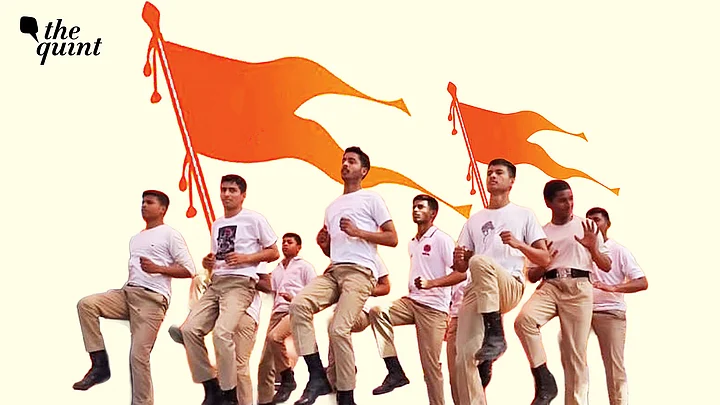
In January 2026, a senior functionary of the Rashtriya Swayamsevak Sangh (RSS) declared that the organisation had decided to conduct one lakh Hindu Sammelan events across the country, to mark the centenary of the organisation.
These events—religious gatherings, sammelans, yatras—are not isolated spectacles. They form a growing ecosystem of Hindutva mobilisation in which spiritual leaders, far-right outfits, and political figures intersect under the religio-political authority of organisations like the Vishwa Hindu Parishad (VHP), RSS, Bajrang Dal, and others to circulate divisive narratives, often taking recourse to explicit appeals for violent measures.
A report by the Centre for the Study of Organised Hate (CSOH) noted a staggering 1,318 instances of hate speech that targeted religious minorities in 2025—on average, nearly four such cases every day. This included unabated proliferation of conspiracy theories, dehumanising references, calls to arms, as well as calls to destroy places of religious worship.
In 2026, such events continue to surface with unsettling regularity, suggesting a sustained campaign of extremist mobilisation. The executive director of CSOH, Raqib Hameed Naik—who also operates Hindutva Watch, a portal that documents instances of hate speech and human rights abuses against minorities—asserted that hate in India is not organic, but manufactured. There are “special interest groups” in the country, he went on to say, which are working in cahoots with the Hindutva ecosystem, bulwarking their political goals with the authority of religious godmen.
“Love jihad,” gau raksha, demographic anxieties over a Muslim “takeover,” and the “reclamation” of Kashi and Mathura, form some of the recurring motifs in these Hindu sammelans, all carrying the same emotional registers—the burden of historical injustices, and the urgent need to redress them.